
The point of an MVP, a minimum viable product, is to learn whether your idea works before you spend everything proving it. In dating, the MVP discipline is especially valuable, because dating apps are expensive to build and most niches fail. This guide explains what belongs in a dating app MVP, what does not, and the fastest route to a real one.
What a dating app MVP is for
An MVP exists to answer one question as cheaply and quickly as possible: does this dating app idea actually work. Not "is it polished," not "does it have every feature," but "do the people in this niche sign up, engage, match, and pay."
This matters in dating because the economics are unforgiving. A full custom dating app costs a great deal and takes a year or more, and the majority of dating niches do not succeed. Spending the full cost and the full timeline before you have any evidence is a serious gamble. An MVP lets you get evidence first.
So the MVP mindset is to build the least you can build that still genuinely tests the idea, put it in front of real users in the niche, and learn. If the evidence is good, you invest further with confidence. If it is poor, you have learned that cheaply. The MVP is a learning instrument, and every decision about what to include should be judged against whether it helps you learn.
The core MVP feature set
A dating app MVP needs a specific, small set of features, the ones without which it cannot function as a dating app at all.
The core set is: onboarding and registration, so a user can join; profile creation with photos, because a dating app without profiles is nothing; a discovery or browse experience, so users can see others; a matching or interest mechanism, so two interested users can connect; messaging, so matched users can talk; reporting and blocking, because even an MVP must be safe and this is not optional; and a payment path, so you can test whether users will actually pay, which is part of testing viability.
That is the genuine core. Each of these earns its place because the app cannot test the idea without it. A user who cannot make a profile, cannot find anyone, cannot match, or cannot message has not tested anything. Build these well enough to work, and stop.
What to leave out of the MVP
Just as important as what goes in is what stays out, and operators consistently include too much.
Leave out: video profiles and video calling, voice messages, advanced filters, personality quizzes and compatibility scoring, gamification, events, community features, sophisticated AI matching, and the long list of refinements that mature dating apps have. None of these are needed to test whether the core idea works, and every one of them adds build time, cost, and something else that can break or distract.
The instinct to include more comes from comparing your MVP to Tinder, Hinge or Bumble. That comparison is the trap. Those apps are the product of a decade and enormous budgets. Your MVP is not competing with their feature lists; it is testing whether your niche responds to the core dating experience. Ruthlessly cutting everything non-core is not a compromise. It is the whole method.
Why "viable" matters as much as "minimum"
The word "minimum" gets the attention, but "viable" is equally important, and an MVP that is too thin fails differently from one that is too fat.
Viable means the MVP genuinely works as a dating experience. The core features must function properly: the app must be usable, the matching must work, the messaging must be reliable. An MVP so stripped-down or rough that users cannot have a real dating experience does not test the idea either; it just tests their patience.
So the MVP sits in a specific place: nothing beyond the core feature set, but the core feature set done genuinely well. A user trying the MVP should be able to have a real, if basic, dating experience and form a genuine view of whether the app is worth using. Minimum on scope, viable on quality. Get either wrong, too many features, or core features that do not work, and the MVP fails to do its job.
The build paths for an MVP
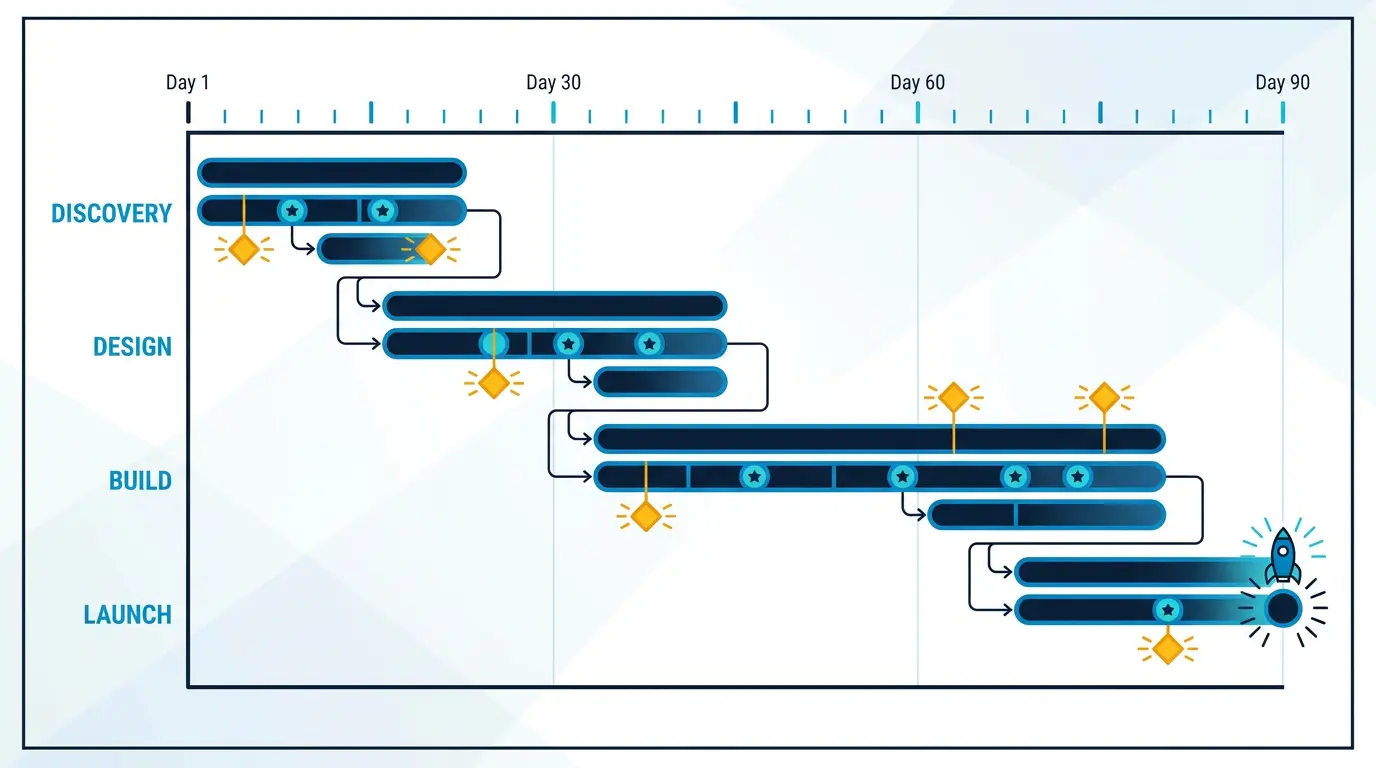
There are three ways to get a dating app MVP, the same three paths as for any dating app, and they reach an MVP very differently.
Building the MVP from scratch means engineering even the minimal version, which still takes months and a real budget, because even a core feature set is a genuine software project. It gives you ownership but it is slow and expensive for a learning exercise.
Using an app builder or dating script to assemble an MVP is faster and cheaper than a custom build, and can produce a testable MVP in weeks to a couple of months, at the cost of the limitations and operational burden covered in the development guides.
White labelling is the third path, and for an MVP it is unusually compelling, as the next section explains.
The key point is that the MVP mindset, build the least you can to learn, naturally favours the fastest, cheapest path that still delivers a viable product. Spending a year and a large budget to build an MVP largely defeats the purpose of an MVP.
White label as the fastest MVP
is, in effect, the fastest possible dating app MVP, and it is worth seeing why.
A white label app delivers the entire core feature set, onboarding, profiles, discovery, matching, messaging, safety, payments, already built, already working, and already maintained. You configure and brand it rather than building it. It can be live in weeks, for little or no upfront cost, with the provider carrying the technology, moderation and compliance.
Crucially, a white label MVP is not empty. Because of the , it can show real members from day one, which means it genuinely tests the niche, can users find and engage with relevant people, in a way a custom MVP cannot until it has solved the cold start.
The trade is the usual one: a revenue share and limited product control. But for an MVP, whose entire purpose is to learn cheaply and fast whether a niche works, white label fits the purpose almost perfectly. An operator can validate a niche on a white label app, with real members, in weeks, for a few thousand pounds, and only then decide whether a custom build is justified. That is the MVP method working as intended.
The cold-start problem and the MVP
The cold-start problem, the impossibility of a dating app being useful while empty, interacts with the MVP in a way operators miss.
A custom or app-builder MVP launches empty. So when you put it in front of test users, they see an app with almost nobody on it, and they cannot have a real dating experience, which means the MVP cannot actually test the niche. You end up unable to tell whether a poor result means "the niche does not want this" or "there was nobody to match with." That ambiguity ruins the MVP as a learning instrument.
A white label MVP avoids this, because the shared pool populates it. Test users see real, relevant members and can genuinely use the app, so the result, good or poor, actually means something.
This is a strong, often-overlooked reason that white label suits the MVP purpose. An MVP only works if it can give users a real experience, and an empty MVP cannot. Whatever path you choose, plan for how the MVP will be populated, because an unpopulated MVP teaches you nothing.
Validating with your MVP
Once you have a viable, populated MVP, the point is to learn from it, which means watching the right things.
Watch whether users in the niche sign up at a reasonable rate, and whether they complete profiles. Watch whether they engage: do they browse, do they match, do they message. Watch whether matches turn into conversations. And watch whether users will pay, by having a real payment path and seeing the conversion. Alongside the numbers, talk to users: the numbers tell you what is happening, conversations tell you why.
Set, in advance, a rough sense of what a good result looks like, so you are not interpreting ambiguous data after the fact. Then read the MVP honestly. A strong result justifies further investment. A weak result is not a failure of the MVP; it is the MVP doing its job, telling you cheaply that this niche, or this positioning, needs to change before you spend more.
How long to run the MVP
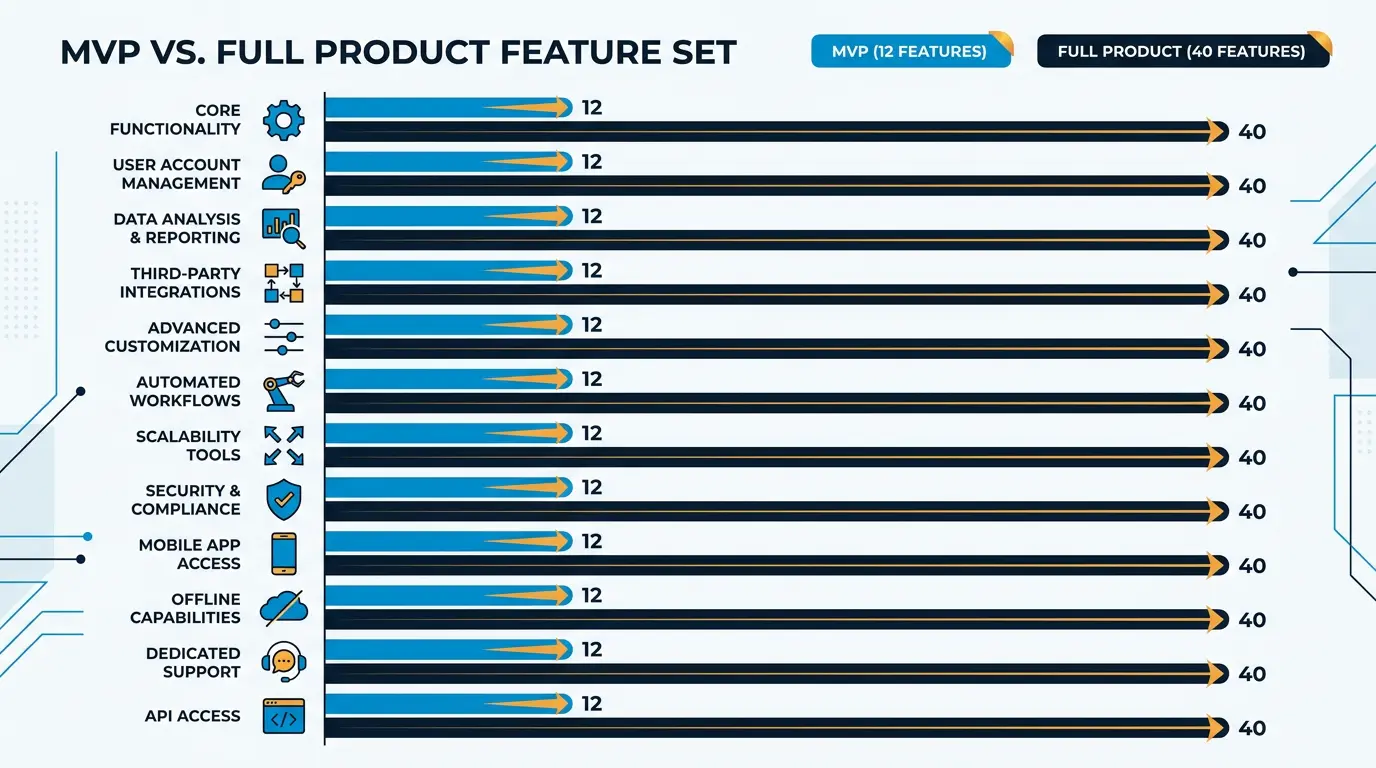
An MVP is a learning instrument, and like any experiment it needs to run long enough to produce a real answer, but not so long that it stops being a test and quietly becomes the business by default.
Too short is the more obvious error. An MVP judged after only a week or two has not gathered enough evidence to mean anything. Dating behaviour unfolds over time: a member signs up, builds a profile, browses, matches, has conversations, decides whether to pay, and decides whether to come back. A meaningful read on whether a niche works needs enough members to have moved through that whole sequence, and enough time to see early retention, not just signups. Cutting the experiment off before that produces a verdict based on noise.
Too long is the subtler error. An MVP that runs for many months without a decision has usually stopped being an MVP. The operator is no longer testing; they are simply running an under-invested product and postponing the judgement the MVP existed to force. If the evidence is there, a decision should follow it.
There is no single correct duration, because it depends on how quickly the MVP gathers members and data. The better way to think about it is in terms of evidence rather than weeks. The MVP has run long enough when it can answer the questions it was built to answer: are members in this niche signing up, completing profiles, engaging, matching, having conversations, and paying, and are the earliest members showing any sign of staying. When those questions can be answered with real data rather than hope, the experiment is done.
The discipline is to decide, before launching the MVP, roughly what evidence will count and roughly how long is reasonable to gather it, and then to hold to that. An operator who sets no end point tends either to give up too early on a niche that was working, or to drift indefinitely on one that was not. Decide what you need to see, gather it, and then read it honestly.
From MVP to full product
If the MVP validates the idea, the path forward depends on which build route you used.
On a white label MVP that succeeds, you may simply keep going. The white label app is not only an MVP; it is a real, operating product. Many operators validate on white label and then continue on white label indefinitely, because it keeps working. Others, once a niche is genuinely proven and the economics justify it, move to a more owned model, and the MVP results are exactly the evidence that justifies that larger investment.
On a custom or app-builder MVP that succeeds, the path is to expand the validated core: add, now, the features you deliberately left out, guided by what real users asked for, building outward from a base you know works.
Either way, the discipline carries forward: add features because validated demand calls for them, not because competitors have them. The MVP method, build to learn, expand on evidence, is not just for the first version.
Common mistakes
The defining mistake is building too much: trying to launch an MVP with the feature list of a mature app, which inflates cost and time and defeats the purpose.
The second is building too little, an MVP so thin or rough that users cannot have a real dating experience, so it tests nothing.
The third is forgetting the cold start and launching an empty MVP that cannot give test users a genuine experience, producing ambiguous, useless results.
The fourth is spending a year and a large budget building an MVP, which contradicts the entire idea of a minimum viable product. The fifth is building the MVP to impress rather than to learn, and then ignoring what it teaches. The MVP is an instrument for evidence. Use it that way.
What to read next
For the build decision, read dating app development: build, buy or white label. For validation before you build anything, see how to validate a dating site idea. For the launch process, read how to start a dating app. And to launch a populated MVP fast, DatingPartners.com can take a validated niche live in weeks.
Skip 90 days. DatingPartners launches your MVP in 7 days with apps, payments and safety included.
Visit DatingPartners.com →