
A dating app is not just a dating site with a different shape. The economics are different, the approval process is different, and the cost of a mistake is higher because you cannot quietly patch a live app the way you can patch a website. This guide is written for founders who have decided dating is their market and now need to know what building an app actually involves. I have operated dating platforms for 21 years across both web and mobile, and I will be honest about where apps are worth it and where they are not.
Do you actually need a native app?
Start here, because the honest answer for many first time operators is no, or at least not yet. A responsive mobile website or a progressive web app gives you most of the mobile experience with none of the App Store friction, none of the platform commission, and a far faster path to live. You can validate a niche, build an audience, and generate revenue on the web first.
A native app earns its place when you need features the web cannot deliver well, such as reliable push notifications, smooth real time chat, or camera and location access that feels native. It also earns its place once you have product market fit and the app stores become a genuine acquisition channel rather than just a cost. My standard advice is to prove the niche on the web, then add an app once the numbers justify it. If you are certain you need the app from day one, read on.
The three ways to build a dating app
There are three realistic build paths, and they sit at very different points on the cost and control scale.
| Path | Time to launch | Typical cost | Control | Best for |
|---|---|---|---|---|
| app | 3 to 6 weeks | £0 to £8,000 | Brand and content only | Niche operators wanting speed |
| No code or app builder | 1 to 3 months | £3,000 to £25,000 | Moderate | Non technical founders, simple feature sets |
| Custom native build | 4 to 9 months | £60,000 to £150,000 plus | Full | Funded teams with a unique product |
Many white label dating providers now ship native iOS and Android apps as part of the package, published either under their developer account or yours. That is the fastest and cheapest route, and it inherits the provider's and compliance posture. No code app builders sit in the middle and suit a simple swipe and chat product. A custom build gives total control and is the right call only if you have funding and a genuine technology bet, because the cost and timeline are an order of magnitude larger.
Choose a focused feature set
The most common mistake I see is trying to launch with everything Tinder, Hinge, and Bumble have built over a decade. You do not have their budget, and your members do not need all of it. Ship a focused first version and add features once real members ask for them.
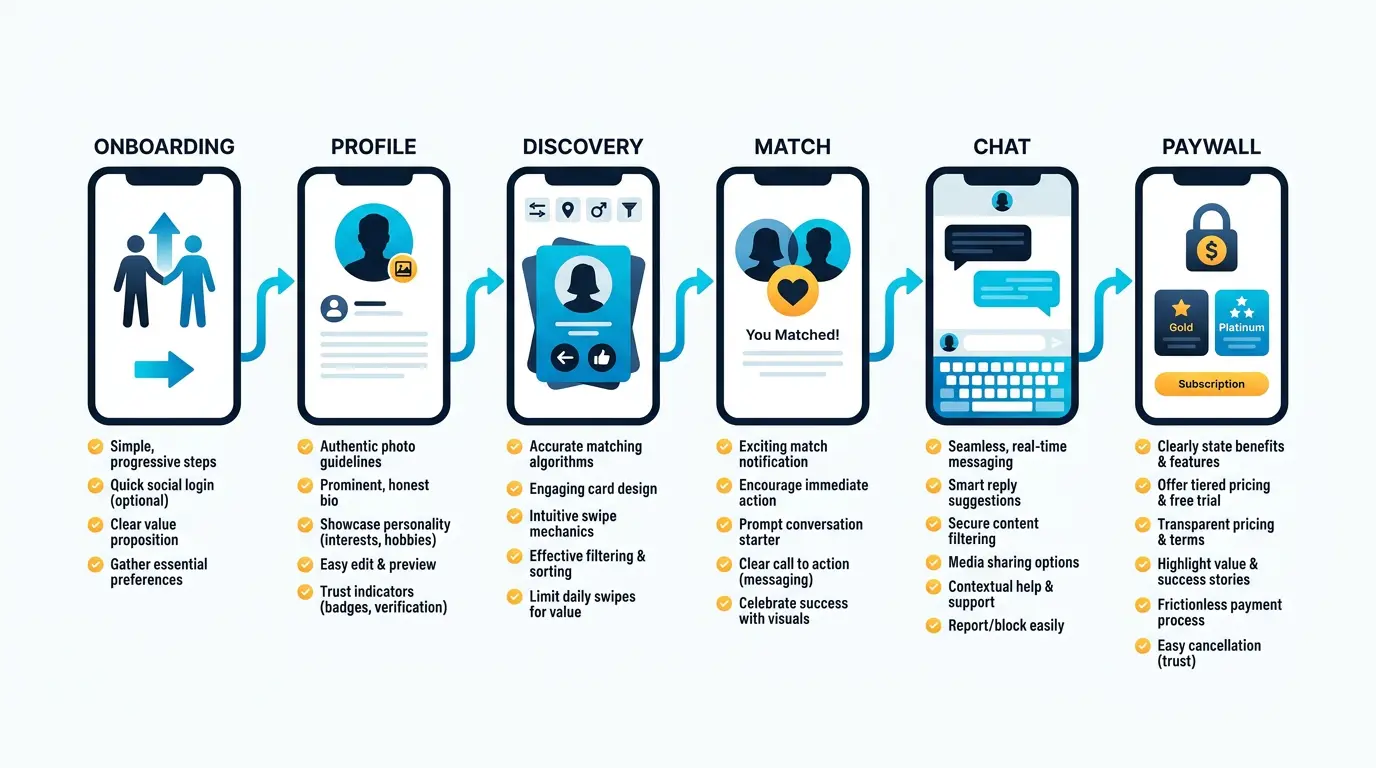
A credible launch feature set is a clean onboarding flow, profile creation with photo upload, a discovery or browse experience, a matching or interest mechanism, real time messaging, reporting and blocking, and a payment flow for your premium tier. That is enough to be a real product. Video profiles, audio messages, events, advanced filters, and gamification can all wait. Every extra feature at launch adds build time, adds review risk, and adds something else that can break.
Matching and messaging architecture
You do not need to be an engineer to start a dating app, but you should understand the two systems that decide whether it feels good. The first is matching, which is how the app decides who a member sees. Early on this can be simple, based on the niche, age, location, and stated preferences. A heavy machine learning approach is not necessary until you have enough members and data to justify it.
The second is messaging, which has to feel instant. Members judge a dating app on whether a message arrives the moment it is sent and whether they are notified reliably. On a white label or builder platform this is handled for you. On a custom build it is one of the harder pieces of engineering, so make sure your team has done real time messaging before. A laggy chat will sink an otherwise good app.
iOS, Android, or both?
Most founders ask whether to launch on iOS, Android, or both. The honest answer depends on your build path and your audience.
On a white label platform the question often answers itself. If the provider ships both apps as part of the package, launch on both, because there is no extra cost to you and you reach the whole market. On a custom build, each platform is a separate piece of engineering and a separate ongoing maintenance burden, so launching one platform first to prove the product is a reasonable way to control cost.
The two stores attract different audiences. Android has the larger global install base by a wide margin, so it matters more in emerging markets and for sheer reach. iOS users, on average, spend more on digital subscriptions, so an iOS led audience can produce stronger revenue per user even from a smaller base. In the United Kingdom, United States, and Australia, iOS share runs higher than the global average, which is worth knowing if those are your target markets.
My default advice is simple. If you are on white label and both apps are included, take both. If you are building custom and need to stage the cost, look at where your specific niche audience actually is and start there, then add the second platform once the first is earning. Do not split a small budget thinly across two custom builds at once.
App Store and Play Store approval
Both Apple and Google review dating apps more closely than most other categories, and rejection is common on a first submission. Plan for it rather than being surprised by it.
Apple expects a working app with real functionality, a clear and accessible privacy policy, age gating, and a defined approach to user generated content that includes the ability to report and block, filtering of objectionable content, and a published way to contact moderation. Google has similar requirements and is strict about its own user generated content and dating policies. Both will reject an app that feels empty, so do not submit a shell with no members or content.
Build two to four weeks of review and resubmission time into your plan. If you are launching through a white label provider, ask whether they handle store submission and whether the app is published under their developer account or yours, because that affects who owns the listing and the reviews.
In-app purchases and the platform tax
This is the part that surprises new app founders, so understand it before you build your pricing. When you sell a digital subscription or digital extras inside an iOS or Android app, Apple and Google generally require you to use their in-app purchase systems, and they take a commission. The standard rate is around 30 percent, dropping to around 15 percent for many small businesses and for subscriptions after the first year.
That commission changes your unit economics. A £19.99 subscription sold on the web nets you close to the full amount after payment processing. The same subscription sold through in-app purchase nets you significantly less. The regulatory picture around this is shifting in some markets, but plan your pricing on the assumption that the platform tax applies. Many operators run a hybrid model, offering web signup and billing alongside the app, which is allowed within the stores' current rules when handled carefully.
Realistic costs and timelines
A white label app can be live in three to six weeks for under £8,000, because you are branding an existing, approved product. A no code or app builder route runs one to three months and £3,000 to £25,000 depending on how custom the design and features are. A custom native build is four to nine months and £60,000 to £150,000 or more, and that is before ongoing maintenance, which is a real and permanent cost on native apps because the operating systems change every year.
Add to any of these the cost of an Apple Developer account and a Google Play Developer account, your marketing budget, and moderation. The honest message is that an app is more expensive and slower than a website on every path, which is why validating on the web first is so often the smart move.
Pre-launch and app store optimisation
Your app store listing is a marketing asset, not a formality. The title, the subtitle, the keyword field, the screenshots, and the description all affect how many people who see your listing actually install. This is app store optimisation, and it is the equivalent of SEO for the stores. Research the terms your niche audience would search, write the listing around them, and design screenshots that sell the benefit rather than just showing the interface.
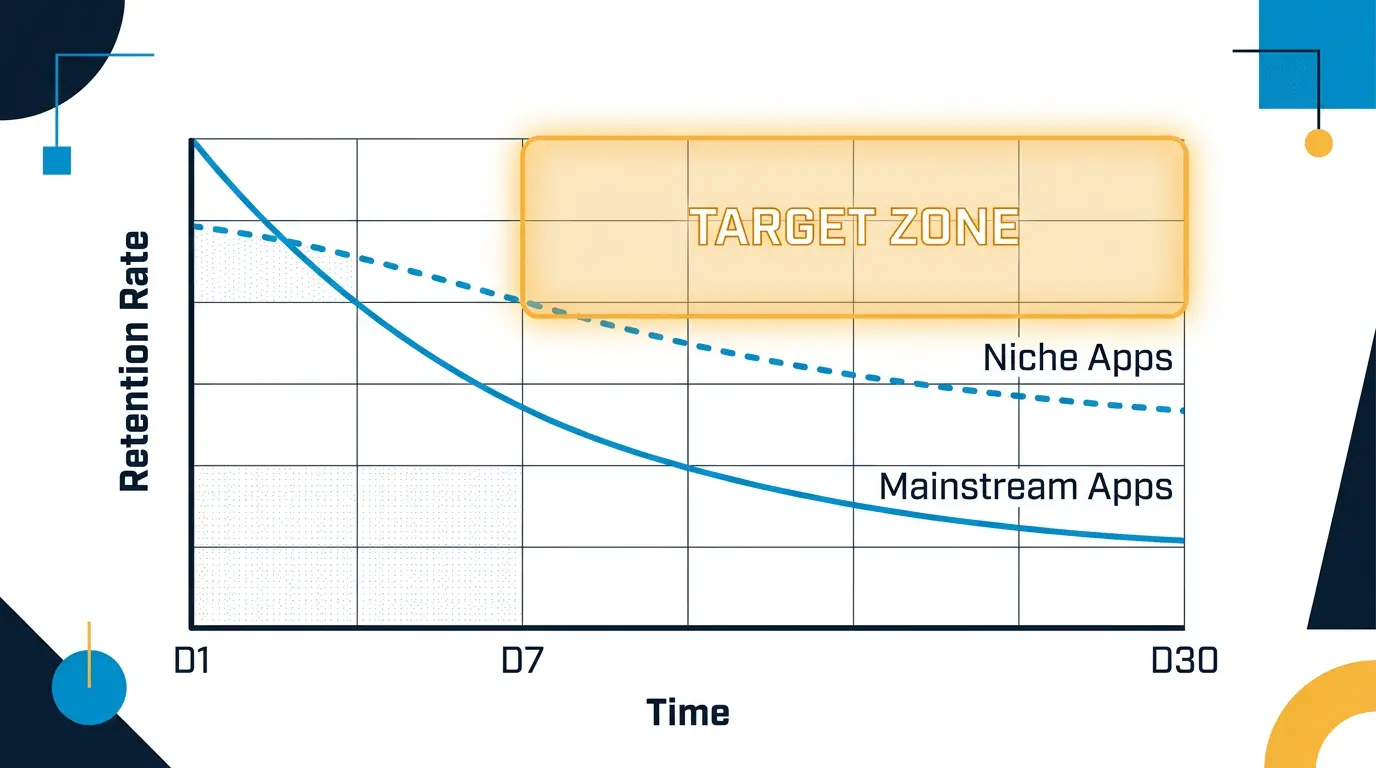
Before launch, line up your first wave of members so the app does not feel empty on day one, and prepare a small set of honest reviews from real early users, because rating and review volume strongly influence store ranking. If you built a waitlist while validating the niche, this is when it pays off. Treat the first two weeks after launch as an active campaign, not a quiet period.
Common mistakes new app founders make
A handful of mistakes account for most failed dating app launches, and all of them are avoidable.
The first is building the app before validating the niche on the web. An app is the most expensive and slowest way to test an idea. Prove that people want the niche with a cheap web landing page first, then build the app for a niche you already know works.
The second is cloning a major app feature for feature. Tinder, Hinge, and Bumble have spent a decade and enormous budgets building what they have. Copying all of it means a longer build, a riskier store review, and more that can break, with no advantage to the member. Ship a focused product and earn the right to add features later.
The third is pricing without accounting for the platform commission. If you set your subscription price as though you keep all of it, then lose 15 to 30 percent to Apple or Google on every in-app purchase, your unit economics quietly stop working. Build the platform tax into the price from the start.
The fourth is submitting an empty app. Both stores reject apps that feel hollow, with no members and no content. Line up a first wave of members before you submit, so a reviewer opening the app sees a living product.
The fifth is forgetting ongoing maintenance. A native app is not finished at launch. Apple and Google update their operating systems every year, and an app that is not maintained will eventually break. Budget for maintenance as a permanent line, not a one off.
The last one is quieter but costly. If your white label provider publishes the app under their own developer account rather than yours, you may not own the store listing, the reviews, or the install base. Ask the question before you sign, and understand exactly what transfers to you if you ever leave.
What to read next
If you have not decided between web and mobile, read dating site versus dating app: which to build first. For the broader launch process, see how to start a dating site. For the full cost picture, see how much it costs to start a dating site. And if you want a turnkey platform with native apps included, DatingPartners.com can walk you through what is bundled and what is not.
DatingPartners offers native iOS and Android white label apps with in-app purchase support and App Store approval assistance. Your app can be live in 4-6 weeks.
Visit DatingPartners.com →