
The Three Paths Explained
You're sitting in a coffee shop with an idea: "I want to build a dating app for [niche]. It'll be like Tinder but for [your specific audience]."
Here's the reality check. You have three legitimate options. Fantasy land (bootstrapping a Tinder clone) is not one.
Let me walk through each path, the real timelines, costs, and outcomes. If you're unsure about the business side, see our guide on dating site business plan to validate your idea first.
Path 1: Custom Development
You hire a team (or are the team) to build your dating app from scratch. You own the code. You control everything.
The Pitch: Build a custom dating app and you're not locked into any vendor. You can iterate quickly. You own your data. If you get acquired or IPO, the code is yours. This is the venture capital path.
The Reality: This takes longer, costs more, and fails more often than founders expect.
Timeline: 6-12 months to launch
Breaking this down:
- Months 1-2: Design and architecture (wireframes, database schema, API design). Who builds this? A CTO or tech co-founder. Cost: $5K-$10K if you hire a contractor, free if you have a co-founder.
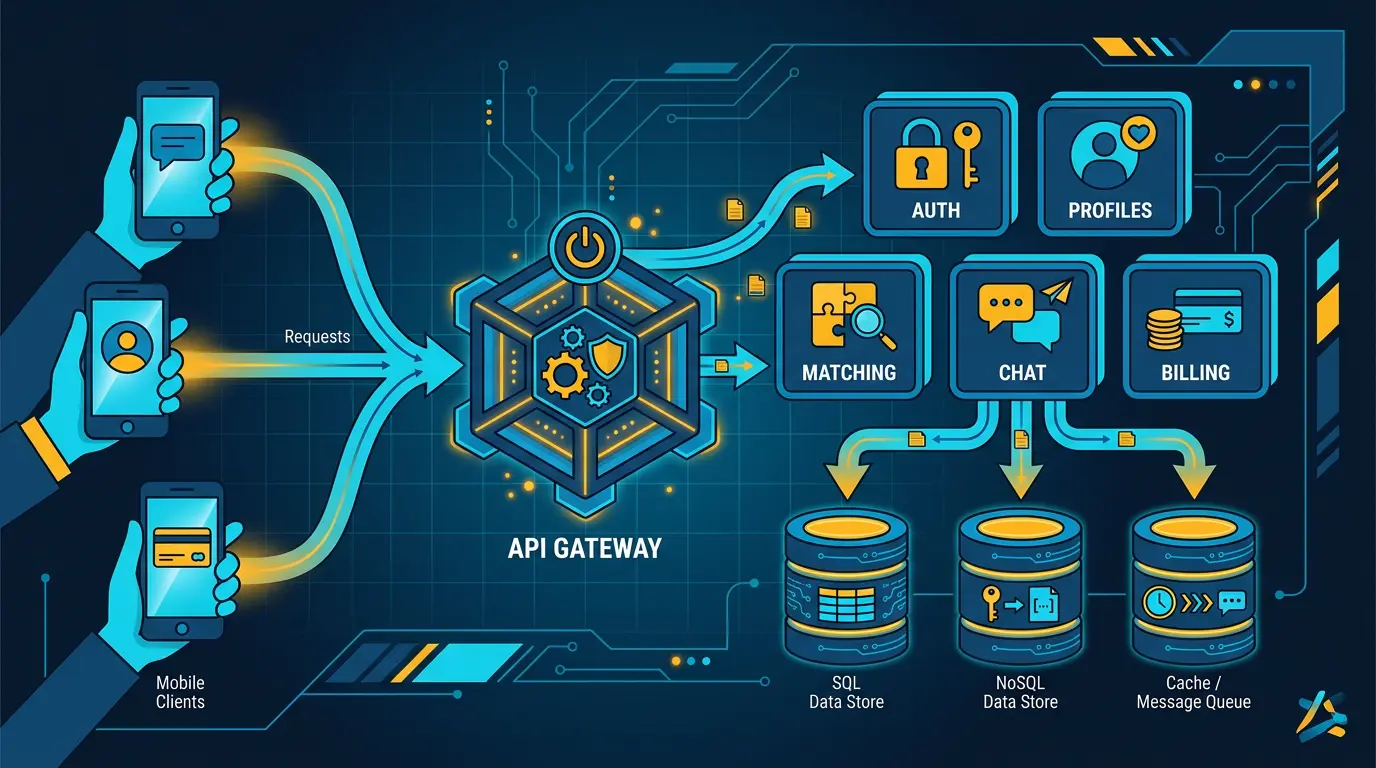
- Months 3-5: MVP backend development (user authentication, matching algorithm, messaging, payments). This requires 1-2 full-time developers. Cost: $30K-$50K.
- Months 4-6 (parallel): iOS app development. One developer minimum. Cost: $20K-$40K.
- Months 4-6 (parallel): Android app development. One developer minimum. Cost: $20K-$40K.
- Months 5-6 (parallel): Design and UX. One designer. Cost: $8K-$15K.
- Months 6-7: Testing, bug fixes, performance optimization. Add 20% more time. Cost: $8K-$12K.
- Month 8: Launch to app stores and marketing site. Cost: $3K-$5K (design, copywriting, paid ads setup).
Total cost: $94K-$177K for a basic MVP.
If you're bootstraped and building solo? 6-12 months of your own unpaid time. Realistically, 12-18 months if you're working a day job.
Team Needed:
- Backend developer (1-2)
- iOS developer (1)
- Android developer (1)
- Designer (1, can be half-time)
- Product manager (1, often the founder)
- QA tester (can be founder or contractor)
If you're hiring contractors, this is expensive. If you have co-founders, split the work.
Costs Breakdown:
| Item | Cost |
|---|---|
| Backend development | $40K-$60K |
| iOS development | $20K-$40K |
| Android development | $20K-$40K |
| Design/UX | $8K-$15K |
| Testing and QA | $5K-$10K |
| Infrastructure setup | $2K-$4K |
| Domain, SSL, tools | $1K-$2K |
| Legal (terms, privacy) | $2K-$3K |
| Launch marketing prep | $3K-$5K |
| Total MVP | $101K-$179K |
Ongoing monthly costs once launched:
- 1 developer for maintenance and bugs: $5K-$8K
- Server hosting and infrastructure: $1K-$3K
- Customer support tools: $200-$500
- Analytics and monitoring: $300-$500
- Total ongoing: $6.5K-$12K per month
Advantages:
- You own the code and can pivot quickly
- Full control over features and roadmap
- If you raise venture money, VCs prefer custom code
- You can customize to your exact vision
- No vendor lock-in
Disadvantages:
- Highest upfront cost ($100K+)
- Longest timeline (6-12 months before launch)
- Requires managing a technical team (hiring, onboarding, firing)
- Ongoing technical debt. Custom code needs maintenance and updates.
- Payment processing, compliance, and security are on you to handle
- Bug fixes and new features take longer
- If a developer leaves, knowledge walks out the door
- Most small dating sites built custom fail because they run out of money before hitting product-market fit
When to choose this path:
- You have $150K+ in funding
- You have a CTO co-founder who can lead development
- You're solving a unique problem that existing solutions don't handle
- You're venture-backed and need long-term optionality
- You have a 12+ month runway
See our cost to start a dating site guide for a full breakdown if you're comparing approaches.
Path 2: Buying a Dating Script
Dating script vendors sell pre-built code and platforms. You buy the license, customize it, and launch.
Popular options include SkaDate, PG Dating Pro, Chameleon (acquired), and a dozen smaller vendors.
How it works:
- Buy license from vendor: $5K-$25K upfront
- Download source code or get access to a sandbox
- Hire developers to customize (change colors, add features, integrate payments)
- Host on your own servers or vendor's hosting
- Launch and maintain
Timeline: 3-6 months to launch
- Week 1: Purchase license, access code
- Weeks 2-4: Setup development environment, customize theme, integrate payment processor
- Weeks 5-8: Add custom features or third-party integrations (SMS, analytics, chat)
- Weeks 9-10: Testing and quality assurance
- Week 11-12: Deploy to production, launch marketing
You save time because the core functionality (matching, messaging, user profiles) already exists. You're customizing, not building.
Costs Breakdown:
| Item | Cost |
|---|---|
| License (SkaDate, PG Dating Pro) | $5K-$25K |
| Customization and setup (contractor) | $15K-$30K |
| Server hosting (your own, annual) | $3K-$8K |
| Domain, SSL, tools | $1K-$2K |
| Legal and compliance | $2K-$3K |
| Launch marketing | $2K-$5K |
| Total MVP | $28K-$73K |
Ongoing monthly costs:
- Server hosting: $500-$1.5K
- Support from vendor (if needed): $200-$500
- Developer for customization and bugs: $3K-$5K
- Customer support and ops: $500-$1K
- Total: $4.2K-$8K per month
Advantages:
- Faster to launch than custom (3-6 months vs 6-12)
- Cheaper upfront than custom ($30K-$70K vs $100K+)
- Core features already built and battle-tested
- Active developer community for some scripts (SkaDate has plugins)
- You own the code after purchase
- Vendor handles payment integrations and updates (sometimes)
Disadvantages:
- Limited to what the vendor's code can do. Customization is expensive.
- Code quality varies. Some scripts are poorly architected.
- Vendor support is often slow or non-existent
- You're still responsible for hosting, scaling, security, and compliance
- If you hit scaling issues, the script might not support it
- Hard to pivot or add novel features without rewriting large chunks
- Community can be small and outdated
- Vendor may discontinue support or go out of business
- Payment processor integration can be fragile
When to choose this path:
- You have $40K-$80K and want to move faster than custom
- You need a fairly standard dating app (no weird niche requirements)
- You're comfortable hiring contractors to customize
- You want to own the code (vs where you don't)
- You plan to run this for 3-5 years and are okay with technical debt
- You have a technical co-founder who can manage customization
This is one approach covered in our white label vs custom dating platform comparison.
Path 3: White Label
You use a white label dating platform operator (like DatingPartners, DatingFactory, or others). They host the platform, manage payments, handle compliance. You brand it and market it.
Think of it like: Shopify for dating sites. You get a turnkey platform you customize and launch.
How it works:
- Sign up with white label provider
- Set custom branding (logo, colors, domain)
- Choose features you want enabled
- Set pricing and payment methods
- Configure matching preferences
- Launch and drive marketing
- Vendor handles technical operations, scaling, compliance
Timeline: 2-4 weeks to launch
- Days 1-3: Setup account, customize branding
- Days 4-7: Configure matching rules and features
- Days 8-10: Set up email templates and notifications
- Days 11-14: Testing and QA
- Days 15+: Marketing and user acquisition
Some white label providers let you launch in a single week if you're ready.
Costs Breakdown:
| Item | Cost |
|---|---|
| Platform setup fee | $2K-$5K (one-time) |
| Monthly platform fee | $2K-$10K (depending on users) |
| Initial branding and design | $1K-$3K |
| Email templates and SMS | $0-$500 |
| Domain and SSL | $0 (provided) |
| Legal and compliance | $0-$2K (provider usually handles) |
| Launch marketing | $2K-$5K |
| Launch costs: | $7K-$20.5K |
| Year 1 platform costs: | $26K-$125K |
Monthly ongoing costs (Year 1 average):
- Platform hosting: $2K-$10K
- Customer support: $500-$1K
- Marketing and acquisition: $3K-$5K
- Miscellaneous: $500-$1K
- Total: $6K-$17K per month
Year 2+ platform costs are variable. Some providers charge:
- Flat monthly: $2K-$5K
- Per-user model: $0.50-$2 per user per month
- Revenue share: 15-30% of your subscription revenue
Advantages:
- Fastest to launch (2-4 weeks)
- Lowest upfront cost ($7K-$20K)
- No need to hire developers
- Vendor handles servers, scaling, uptime, security
- Payment processing already integrated and PCI-compliant
- Regular feature updates from vendor
- Compliance and age verification built-in
- You focus 100% on marketing and customers
- Easiest to test product-market fit quickly
- Can validate a niche with minimal risk
- Most non-technical founders succeed with white label
Disadvantages:
- You don't own the code or platform. If vendor shuts down, you're stuck.
- Customization is limited to what vendor allows
- You're locked into vendor's pricing (can be expensive at scale)
- Monthly recurring cost reduces profitability
- Less competitive advantage (competitor can white label same platform)
- Vendor owns your user data (though you can usually export)
- If vendor gets acquired, priorities may change
- Platform updates are imposed, not chosen
- Differentiation is harder (your site looks similar to others on same platform)
- At scale, white label becomes expensive vs owning the code
When to choose this path:
- You're non-technical and want to launch fast
- You have limited budget ($10K-$50K total)
- You want to test a niche before investing heavily
- You're an affiliate or marketer, not a software company
- You want zero operational burden (servers, scaling, compliance)
- You plan to acquire users through your marketing, not product innovation
- You want to launch in weeks, not months
- You're risk-averse and prefer recurring costs to huge upfront bets
Read our guide on best white label dating software for vendor options and how to choose white label dating provider to evaluate your options.
The Detailed Comparison
Here's a side-by-side comparison to help you choose.
| Factor | Custom Development | Dating Script | White Label |
|---|---|---|---|
| Timeline to launch | 6-12 months | 3-6 months | 2-4 weeks |
| Upfront cost | $100K-$180K | $30K-$70K | $7K-$20K |
| Monthly costs (Year 1) | $6.5K-$12K | $4K-$8K | $6K-$17K |
| Code ownership | You own it | You own it | Vendor owns it |
| Customization level | Unlimited | Moderate (expensive) | Limited |
| Technical skill needed | High (manage team) | Medium (manage customization) | Low |
| Hosting/Operations | Your responsibility | Your responsibility | Vendor handles |
| Scaling | Limited (depends on team) | Limited (depends on code) | Unlimited (vendor's problem) |
| Payment processing | You integrate | Pre-integrated (usually) | Pre-integrated |
| Compliance (age verify, safety) | You handle | You handle | Vendor handles (mostly) |
| Time to profitability | 18-24 months | 12-18 months | 6-12 months |
| Break-even users | 15K-30K | 8K-15K | 3K-8K |
| Ability to pivot features | High | Medium | Low |
| Long-term cost efficiency | Best (at scale) | Medium | Worst (recurring) |
| Vendor risk | None | Moderate (support, code updates) | High (vendor lock-in) |
| Best for | VC-backed founders | Bootstrapped technical teams | Non-technical entrepreneurs |
| Failure rate | High (80%+) | High (70%+) | Medium (50%+) |
How to Choose Your Path
Ask yourself these questions in order:
!Comparison matrix showing timeline, cost, control, and risk for custom development, dating scripts, and white label approaches *Three paths to dating app: comparing development timeline, costs, control, and technical risk*
Question 1: Do you have technical co-founders?
If YES: You can consider custom or script. Go to Question 2. If NO: White label is likely best for you. Consider ending here.
Question 2: Do you have $100K+ funding or runway?
If YES: Custom development might work. You can afford a team for 12+ months. If NO: Go to Question 3.
Question 3: Do you have $40K-$70K?
If YES: Dating script is viable. You have budget for customization. If NO: White label is your only realistic option.
Question 4: How much unique customization do you need?
If a LOT (matching algorithm is proprietary, complex integrations): Custom development. If SOME (different UI, custom fields, niche-specific features): Dating script. If LITTLE (standard dating app, but for your niche): White label.
Question 5: What's your timeline pressure?
If you need to launch in 1-2 months: White label only. If you have 3-4 months: Script or white label. If you have 6-12 months: Any option is viable.
Question 6: Will you need to scale to 100K+ users?
If YES: Custom development. White label becomes prohibitively expensive. If MAYBE (more likely 10K-50K): Script or custom. If NO (you're happy with 3K-10K): White label is fine.
Decision Tree:
``` Start: "How do I create a dating app?"
Have technical co-founders? -> YES + $100K+ funding? -> CUSTOM DEVELOPMENT -> YES + $40-70K? -> DATING SCRIPT -> NO -> NEXT QUESTION
Have $40-70K budget? -> YES -> DATING SCRIPT -> NO -> NEXT QUESTION
Need launch in <2 months? -> YES -> WHITE LABEL (only option) -> NO -> Dating script is viable, but white label is simpler
Need to scale to 100K+ users within 3 years? -> YES -> CUSTOM DEVELOPMENT (only long-term option) -> NO -> WHITE LABEL or SCRIPT both work
Confident in your ability to market to your niche? -> YES -> WHITE LABEL (focus on marketing, not tech) -> NO -> Any path. Pick based on budget.
Final recommendation:
- Most non-technical founders: WHITE LABEL
- Technical founders with funding: CUSTOM DEVELOPMENT
- Technical founders, bootstrapped: DATING SCRIPT
```
Red Flags for Each Approach
Red Flags for Custom Development:
- "We'll build the next Tinder" with a $30K budget. That's not possible.
- You have no technical co-founder and are hiring a "full-time developer" for $30K/year. That's a junior developer who may not ship.
- You've never built a web or mobile product before. Dating apps are complex. This is not a good learning project.
- Timeline is "launch in 6 weeks" and budget is $50K. That's a red flag for cutting corners.
- Your only differentiator is "better algorithm." Algorithms are table stakes, not differentiation.
- You're planning to hire contractors in different time zones with no project management experience. Coordination will fail.
- No one on the team has shipped a mobile app before. You'll hit unexpected technical blockers.
Red Flags for Dating Scripts:
- The vendor's code is 5+ years old and hasn't been updated. It's probably EOL.
- The vendor promises customization but doesn't have documented APIs. Customization will be painful.
- You're buying a script to save money, but then hiring expensive developers to customize it. You're spending $50K+ anyway. Why not build custom or use white label?
- The script uses outdated technology (IE6-compatible, Flash, jQuery 1.x, etc.). You'll need to rewrite core parts.
- Vendor support is non-existent or responses take weeks. When bugs hit, you'll be alone.
- The vendor has 2 employees and 0 documentation. This is a hobby project, not a business.
- You're buying a script in a technology you don't understand (you don't know PHP, but buying a PHP script). Maintenance will be impossible.
Red Flags for White Label:
- White label provider requires a long contract (2+ years) with high minimum fees. You can't exit if it's not working.
- Pricing is per-user and scales aggressively. At 50K users, you're paying $100K/month. You can't be profitable at that cost.
- The white label provider is opaque about revenue splits or data ownership. Read the fine print.
- Their platform is slow (page loads take 3+ seconds). Users will churn.
- Customer support is non-existent. You can't reach anyone when there's a problem.
- The provider is a tiny company with one founder. If that founder leaves, the platform may disappear.
- You can't customize basic flows or branding. You'll look exactly like 10 competitors using the same platform.
- The vendor changes pricing or features with 30 days notice. You have no control.
Key Takeaways
- There's no right path. There's only the right path for your situation.
- Custom development is not the default answer. It takes 12+ months, costs $100K+, and has high failure rates.
- Most non-technical founders should start with white label. Launch in weeks, not months. Test your niche. Prove unit economics.
- Dating scripts are middle ground. You own code, but customization is expensive and time-consuming.
- Validate demand before choosing any path. Get 100 target users to sign up for a waitlist. Get 50+ to say "yes, I'd pay $X/month."
- Timeline matters. If you need to launch in 4 weeks, white label is the only realistic option.
- Budget matters. If you have $10K, white label only. If you have $50K, script is viable. If you have $150K+, custom development makes sense.
- Think long-term costs, not just upfront. White label costs $6K-$17K/month forever. Custom costs $10K upfront, then $6K/month. Scripts cost $5K upfront, then $5K/month. At scale (50K+ users), custom is cheapest.
- The "build the next Tinder" mindset kills most dating startups. Tinder took 5+ years and $20M+ to reach product-market fit. You won't. Pick a niche, move fast, and validate.
- Most successful dating entrepreneurs today use white label to launch, then migrate to custom once they have revenue. That's the pragmatic path.
Skip most of the build. DatingPartners provides the full backend plus native apps — you bring the niche, brand, and audience. Launch 20x faster.
Visit DatingPartners.com →