
Push notifications are one of the most powerful tools a dating app has, and one of the easiest to misuse. Used well, they keep a dating app alive in members' lives. Used badly, they get the app muted, uninstalled, or in trouble with the app stores. This guide covers both the strategy and the technology.
Why push matters so much in dating
Push notifications matter more in dating than in most app categories, for a specific reason: dating is built on time-sensitive events.
When someone likes a member back, when a match is made, when a message arrives, those are moments the member genuinely wants to know about, and wants to know about soon. A match that goes unnoticed for two days often goes cold. A message that sits unseen kills a conversation before it starts. Push is the mechanism that closes the gap between an event happening and the member responding to it, and in dating that gap directly affects whether connections turn into conversations.
Push is also the primary re-engagement tool. A dating app, unlike a daily-habit app, is not opened constantly, so it needs a way to bring members back when something relevant has happened. Done well, push is the heartbeat that keeps a dating app present in members' lives. That power is exactly why it must be handled with care.
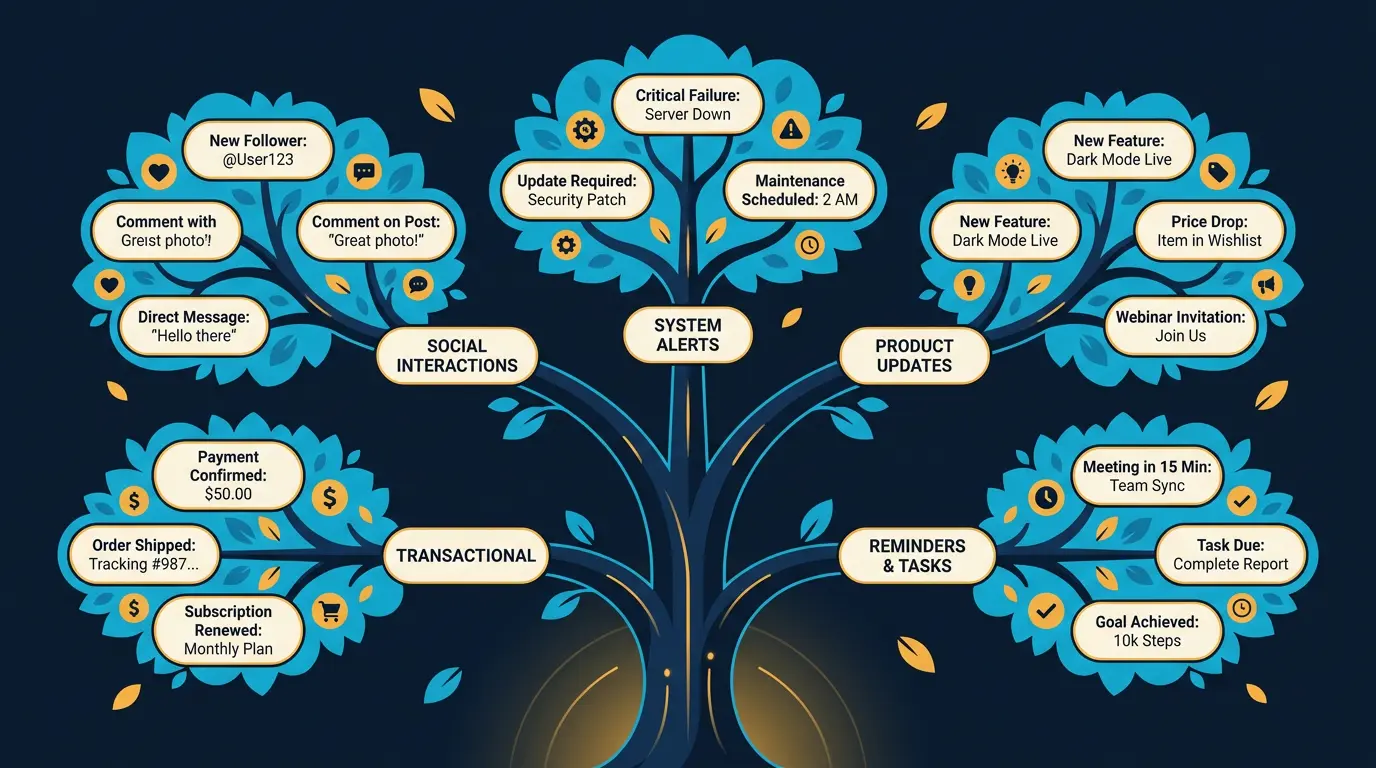
The types of dating push notification
Dating push notifications fall into a few clear categories, and distinguishing them is the start of using push well.
Activity notifications tell a member about something real that has just happened to them: a new match, a new like, a new message, someone viewing their profile. These are the most valuable notifications, because they are genuinely useful and genuinely wanted.
Re-engagement notifications bring back a member who has been away: a prompt that there are new people to see, or that activity is waiting. These are useful when honest and restrained, and harmful when they manufacture activity that does not exist.
Onboarding and prompt notifications help a member get value from the app: a nudge to complete a profile, add a photo, or send a first message. Used early and sparingly, these genuinely help.
Transactional notifications cover account and billing matters. Promotional notifications cover offers and features. Both have a place, used honestly and rarely.
The distinction that matters: activity notifications are the foundation, because they are real and wanted. The others are useful in moderation and damaging in excess.
The strategy of good push
The strategy of dating push reduces to one principle: every notification should be genuinely worth the interruption.
A push notification interrupts someone's life. The member has, in effect, lent you the right to do that, and every notification spends a little of that trust. If the notification is worth it, real news the member wanted, the trust is repaid. If it is not, noise, fake urgency, a prompt that leads nowhere, the trust is spent for nothing, and the member moves toward muting or uninstalling.
So good push strategy is disciplined. Lead with activity notifications, because they are reliably worth it. Use re-engagement and prompt notifications sparingly and only when they carry genuine value. Avoid manufactured urgency entirely. And always make sure a notification leads to something real: a member who taps a notification and finds nothing of substance learns not to tap the next one.
Think of push not as a marketing channel to maximise but as a trust account to protect. The apps that use push best send fewer, better notifications than the ones that use it worst.
The technology behind push
Push notifications do not travel directly from your app to a member's phone. They go through the platform owners' services.
On iOS, push runs through Apple Push Notification service. On Android, it runs through Firebase Cloud Messaging. When something happens in your app that should trigger a notification, your back end sends a request to the relevant service, and that service delivers the notification to the member's device. The device's operating system then shows it, subject to the member's permissions.
This means a dating app needs back-end infrastructure that can detect events, decide which should trigger notifications, personalise them, respect each member's permissions and preferences, and send them through the right service to the right device. It also needs to handle the practicalities: device tokens, members with multiple devices, members who have revoked permission, and time zones.
For an operator, the good news is that on a platform this technology is the provider's responsibility, as the later section explains. The operator's job is the strategy, not the plumbing. But understanding that push depends on Apple's and Google's services, and on real back-end infrastructure, explains why it is a genuine technical component rather than a simple toggle.
Earning the opt-in
A dating app cannot send push notifications to a member who has not granted permission, and on modern mobile operating systems members must actively opt in. So the first push challenge is earning that opt-in.
The mistake is to ask for notification permission immediately on first launch, before the member understands the app or has any reason to say yes. A member asked too early, with no context, often declines, and once declined the permission is hard to recover.
The better approach is to ask at a moment when the value is obvious: after the member has set up their profile and is about to start engaging, framed around what they will get, knowing the moment someone likes them or messages them. When the member can see why notifications would help, far more of them say yes.
The opt-in is the gateway to the whole channel, so it is worth designing the request carefully: the right moment, honest framing, and a clear sense of the value. An app that earns a high-quality opt-in has the channel available; an app that squanders the request loses it.
Timing and frequency
Two practical levers, timing and frequency, separate push that members welcome from push that members mute.
On timing, notifications should arrive when they are useful and not when they are intrusive. An activity notification is naturally well-timed, because it fires when the event happens. But re-engagement and prompt notifications should respect the member's time zone and sensible hours, no notifications in the middle of the member's night, and ideally land when the member is likely to be receptive.
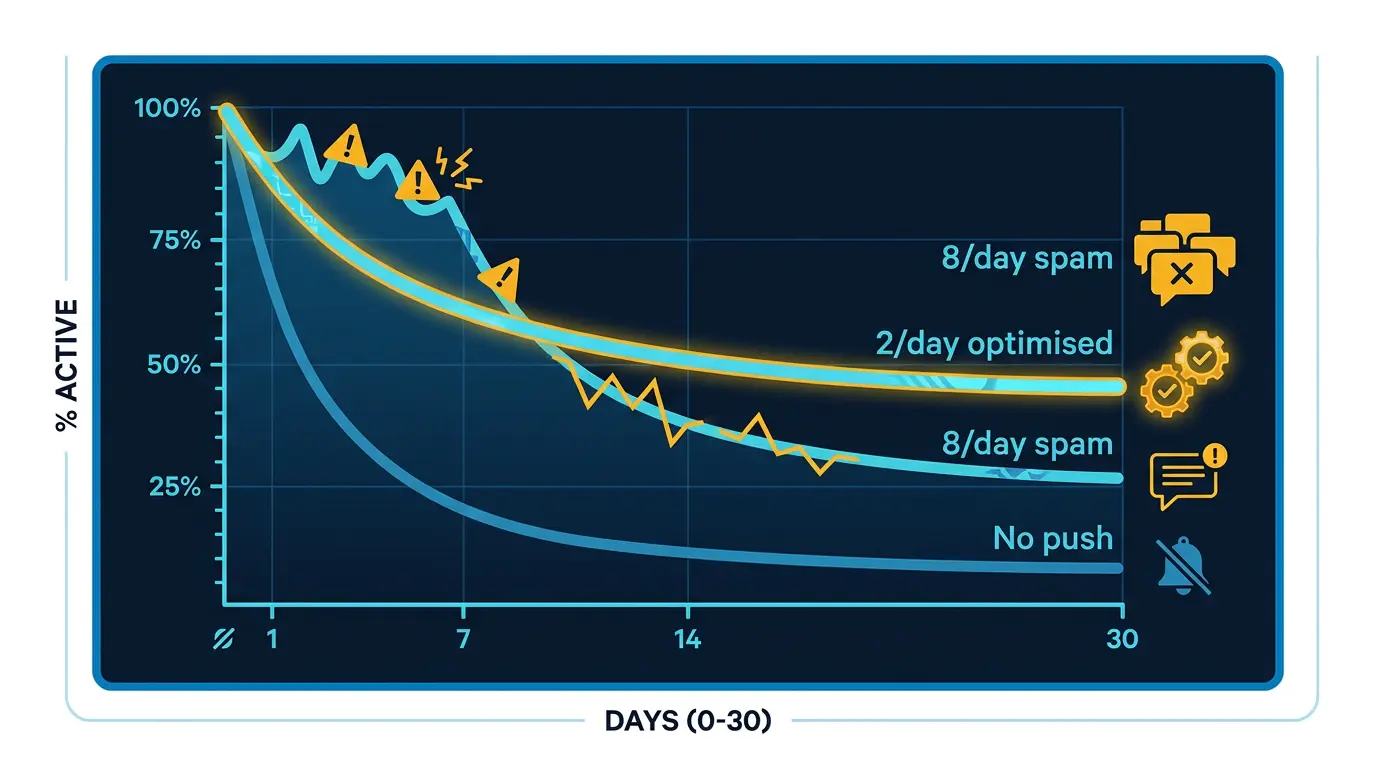
On frequency, less is almost always more. A dating app that sends many notifications a day, especially low-value ones, trains members to ignore or disable them. A dating app that sends a small number of genuinely valuable notifications keeps the channel alive. Frequency should also adapt: a highly active member with lots of real activity naturally receives more, while a quiet account should not be bombarded with manufactured prompts to compensate.
Giving members control over frequency and types, in notification settings, is both respectful and smart, because a member who can tune notifications to what they want is far less likely to switch them off entirely.
Personalisation
A personalised notification is worth far more than a generic one, and dating gives unusually good material for personalisation.
The strongest personalisation is simply accuracy and specificity: a notification that says exactly what happened, a real match, a real message, a real like, to this specific member, is personalised by being true. Beyond that, notifications can reflect the member's activity and preferences, surfacing what is genuinely relevant to them.
Personalisation should make a notification more useful, not more manipulative. The line is clear: using what you know about a member to tell them, accurately, about something they will care about is good personalisation. Using it to craft a more effective false urgency is not. Good personalisation, in dating push, is mostly about being specific and honest rather than about clever targeting.
Measuring push performance
Push should be measured, but measured against the right goal.
The obvious metrics are delivery, open or tap rate, and the action taken after the tap. These are useful. But the metric that matters most is the long-term one: are notifications helping retention and engagement, or are they driving members to mute notifications and ultimately leave.
A push programme can show a healthy short-term tap rate while quietly damaging the app, if it is achieving those taps through volume and urgency that erodes trust. So measure not just whether members tap, but whether they keep notifications on, whether they keep using the app, and whether the notifications correlate with genuine engagement rather than annoyance. Watch the opt-out and mute rates as carefully as the open rates. The goal of push is a healthier app, and that is the thing to measure.
The ethics of push, and the rules
Push notifications are an area where the ethical line and the commercial line point the same way, and where the rules are tightening.
The ethical principle is honesty: do not manufacture activity, do not invent urgency, do not send notifications designed to exploit the emotional pull of dating. A notification implying someone is interested when no one is, or that something is waiting when nothing is, is a deception, and members increasingly recognise and resent it.
This is also a rules matter. The app stores have standards around notifications, and manipulative or deceptive push can breach them. Consumer protection and, in some contexts, marketing rules also bear on how notifications are used. Sending honest, genuinely-triggered notifications keeps an app on the right side of both the ethics and the rules. Manipulative push risks member trust, app store standing, and regulatory attention at once.
The simple, durable rule: a dating push notification should always be true. If it is, the channel is sustainable. If it is not, the short-term gain is borrowed against the app's future.
What white label handles for you
For an operator on a white label platform, the technology of push is the provider's job, and that removes a genuine piece of complexity.
A white label platform typically includes the push infrastructure: the integration with Apple's and Google's push services, the back-end detection of events, the handling of device tokens, permissions and time zones, and the delivery mechanics. Activity notifications, the most important kind, generally come built in, firing on matches and messages automatically.
What remains the operator's responsibility is the strategy and, where the platform allows, the configuration: how re-engagement and prompt notifications are used, the tone, the restraint, and the ethical line. Some platforms give operators control over notification settings and campaigns; the degree varies, so confirm with the provider what is configurable.
The division is the familiar white label one: the provider supplies the working machinery, the operator supplies the judgement about how to use it. With push, the judgement, send value not noise, stay honest, is the part that actually decides whether the channel helps the app or harms it.
Common mistakes
The defining mistake is over-sending: too many notifications, especially low-value ones, which trains members to mute or disable them and kills the channel.
The second is manufacturing urgency or activity, sending notifications that imply interest or events that are not real, which deceives members, erodes trust, and risks app store and regulatory trouble.
The third is asking for notification permission too early, before the member sees any value, and squandering the opt-in.
The fourth is notifications that lead nowhere, where a member taps and finds nothing of substance, teaching them not to tap again. The fifth is measuring only short-term tap rates while ignoring whether push is driving mutes, opt-outs and churn. Send fewer, better, honest notifications, and the channel stays powerful.
What to read next
For the broader engagement picture, read dating app analytics: what to measure and dating app onboarding flows that convert. For retention strategy, see dating site retention. And to confirm what push features a platform includes, DatingPartners.com can walk through its notification capability.
DatingPartners ships with push infrastructure, segmentation and analytics. See it running.
Visit DatingPartners.com →