
The Faith-Based Dating Market
The faith-based dating market is enormous, profitable, and fragmented. This is one of the most underestimated opportunities in online dating.
There are roughly 330 million people in North America. About 84% identify with a religion or spiritual tradition. That's 277 million people. Of those, an estimated 35-40% are single or in the dating market. That's over 100 million potential users across all faith traditions.
But here's the critical insight: they're not using mainstream dating apps. Or rather, they're using mainstream apps reluctantly, frustrated by the lack of values alignment. A Christian wants to find another Christian. A Muslim wants someone who respects Ramadan and prayer times. A Jewish person wants to find someone who shares their culture and traditions. Mainstream apps fail these users because they treat "religion" as a checkbox, not a core value.
The market is heavily segmented:
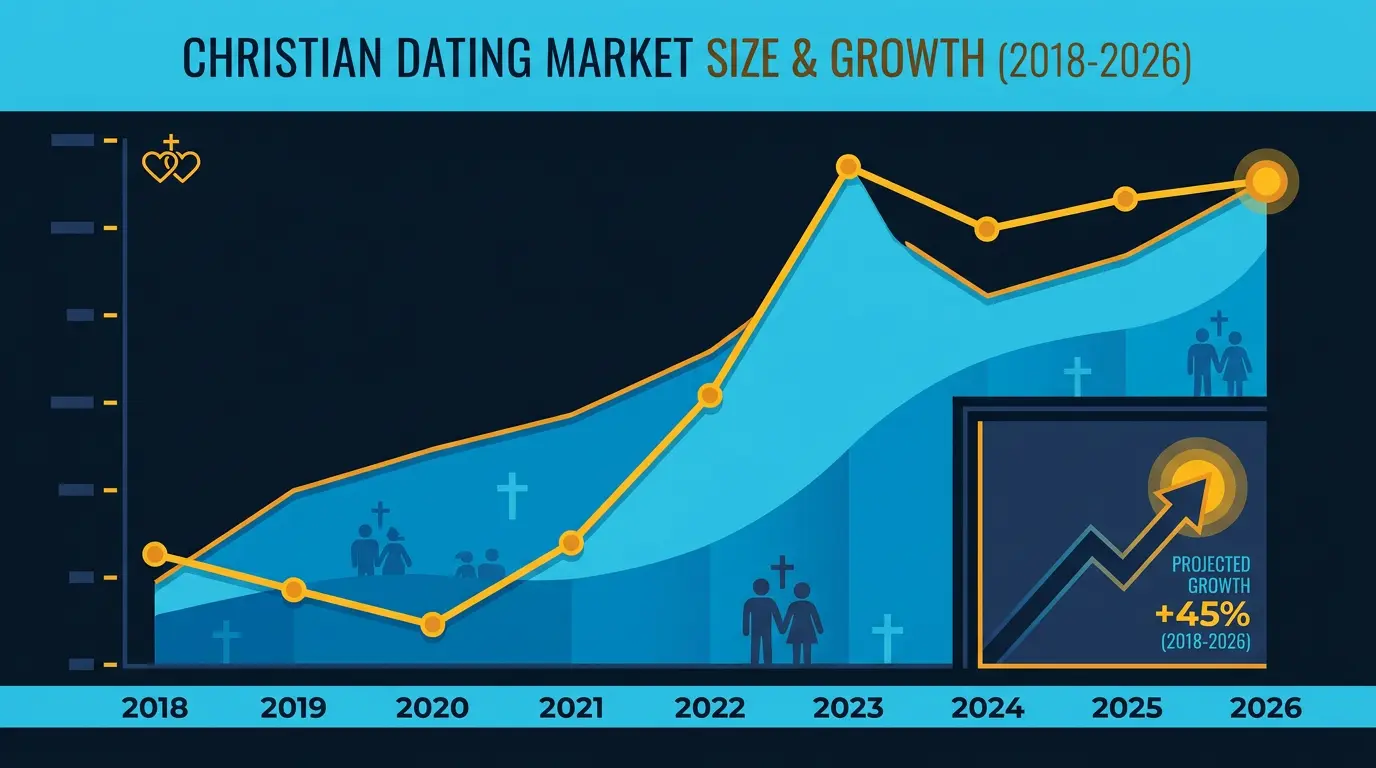
Christian Dating: Largest segment. ChristianMingle reports 15+ million members globally. US and Canadian market estimated at $250-300M annually.
Muslim Dating: Fastest-growing segment. Muzmatch, Muzz, and similar apps have millions of users. Market estimated at $100-150M annually, with 30%+ year-over-year growth as Muslims increasingly embrace online dating.
Jewish Dating: Mature market. JDate and JSwipe have strong presence. Market estimated at $50-80M annually. Slower growth but very profitable (Jewish users skew affluent and willing to pay).
Hindu/Sikh Dating: Growing but underserved. Apps like Rishta, Hinge (with good Hindu demographic) capture some volume, but dedicated Hindu and Sikh platforms are rare. Market estimated at $30-50M annually.
Buddhist and Other Traditions: Smaller but growing niches. Market estimated at $20-30M annually.
Interfaith Dating: Many people want to date across faith traditions. No dominant platform exists for interfaith matching with values alignment. This is untapped.
The total addressable market for faith-based dating in North America is $500-700M annually, with 15-20% year-over-year growth.
| Faith Tradition | Est. Single Users | Market Size | Growth Rate | Dominant Platforms |
|---|---|---|---|---|
| Christian | 15-18M | $250-300M | 10% | ChristianMingle, eHarmony |
| Muslim | 2-3M | $100-150M | 30% | Muzmatch, Muzz |
| Jewish | 800K-1M | $50-80M | 5% | JDate, JSwipe |
| Hindu | 1.5-2M | $30-50M | 25% | Rishta, Hinge |
| Sikh | 400-600K | $15-25M | 20% | Minimal dedicated platforms |
| Buddhist/Other | 500-800K | $20-30M | 15% | Very few dedicated platforms |
| Interfaith | Varies | $50-100M | 35% | No dominant platform |
Why is it fragmented? Because faith communities are tight-knit, regional, and culturally distinct. What works for Christian dating doesn't work for Muslim dating. Muzmatch's features (prayer time integration, halal dining options) make no sense for JDate. And a platform that serves all faiths equally serves none of them well.
The opportunity is massive: a "Christian Dating for the Pacific Northwest," a "Muslim Dating for Toronto," or a "Interfaith Dating for Progressive Communities" can own that niche in ways national platforms can't.
Your Target Audiences
Faith-based dating isn't one market. It's six markets, each with distinct values, relationship goals, and cultural norms.
Christian (All Denominations): Age range 25-65, values vary widely by denomination (Catholic, Protestant, evangelical, mainline, Orthodox). Some seek marriage, others companionship. Common values: honesty, family, faith. Income: varies. Largest segment. Audience is comfortable with technology and likely on multiple apps simultaneously.
Muslim (Across Traditions): Age range 20-55, values include modesty, family involvement, faith commitment. Sunni vs Shia traditions may matter. Some seek quick marriage, others companionship. Income: varies. Growing demographic. More private about dating (less likely to tell family). Expect higher churn due to marriages happening quickly or relationships being hidden from family.
Jewish (Ashkenazi, Sephardic, Orthodox, Conservative, Reform): Age range 25-60, values include heritage, family, tradition, education. Often seeking marriage-minded partners. Income: skews higher. Sophisticated users with high expectations. Willing to pay premium prices. Smaller market but highly profitable.
Hindu: Age range 20-50, values include family involvement, caste considerations (though this is changing), tradition. Parents often involved in matchmaking. Some use dating apps independently, others as family tool. Income: varies. Growing demographic of diaspora youth seeking connection to heritage.
Sikh: Age range 20-55, values include faith, family, community. Often seeking marriage. Age-conscious (family pressure). Income: varies. Smaller market but tight-knit community. Word-of-mouth is powerful.
Buddhist and Other: Age range 25-65, values include mindfulness, spiritual alignment, personal growth. Often less family-focused, more individual. Income: varies. Smaller but growing.
Interfaith Seekers: People comfortable dating across faith traditions. Want values alignment without requiring same faith. Age: 25-60. Income: varies. Growing demographic as populations become more diverse.
The critical insight: faith isn't just a preference, it's foundational to how these people see relationships. Someone seeking Christian dating isn't just filtering by religion - they're seeking someone with specific worldview, values, and life goals. A Jewish person seeking to date other Jews isn't just ethnic preference - it's cultural continuity. A Muslim seeking Muslim partners isn't just religious observance - it's modesty, family expectations, and lifestyle alignment.
The Competitive Landscape
Christian Segment: ChristianMingle (owned by Match Group, 10M+ users) dominates. ChristianCafe is strong second. eHarmony has Christian focus. Hundreds of smaller sites exist but are outdated. No dominant regional player.
Muslim Segment: Muzmatch (1M+ users) and Muzz (200K+) lead. Both well-funded, technically solid, understand Muslim culture. Halal Lovin' and other smaller players exist. This segment is the most competitive. Muslim women especially gravitating toward apps designed by and for Muslims.
Jewish Segment: JDate (1M+) and JSwipe (owned by Match, 500K+) lead. Mature, profitable market. Little room for new entrants, but high-income niche could support premium/luxury positioning.
Hindu/Sikh Segment: Rishta (Indian diaspora-focused, 500K+ users) is largest. Hinge has strong Hindu demographic. Matrimony.com (massive, designed for family involvement) is different model. Dedicated Hindu and Sikh apps are rare. Opportunity here.
Interfaith: No dominant player. Hinge and mainstream apps capture some volume, but no platform optimized for interfaith matching with values alignment.
The gaps are clear:
- No major player in interfaith dating
- No dominant Sikh dating platform
- No regional Christian dating sites (all national)
- Hindu dating is underserved except matrimony-focused sites
- Buddhist and other smaller traditions have zero dedicated platforms
Essential Features for Faith Communities
Generic dating features miss what faith users need. You must build for religious values and lifestyle.
Faith/Denomination/Sect Filtering: Essential. Users should be able to specify and filter by exact faith, denomination, sect. "Christian - Evangelical Lutheran," not just "Christian." "Muslim - Sunni," not just "Muslim." "Jewish - Reform," not just "Jewish." Detailed filters attract serious users and prevent mismatches.
Values-Based Matching Algorithm: Match on values, not just attraction. Ask about core values: "How important is your faith to you?" "Do you want to raise children in your faith?" "How important is family approval?" Use these to rank matches. A Christian who wants to marry a Christian is more important than physical attraction stats.
Religious Community and Involvement Level: Ask users about their community involvement. "Active in my faith community," "Attend weekly," "Occasional," "Spiritual but not religious," etc. Match people at similar levels. Someone deeply committed to their faith wants someone equally committed.
Family and Marriage Intentions: For faiths where family involvement is high (Hindu, Sikh, Jewish, Muslim), ask about family involvement in dating. Some users want parental approval, others don't. Some are open to arranged-by-app, others aren't. Make this explicit.
Holiday and Observance Information: For Muslim users, prayer times and Ramadan observance matter. For Jewish users, Sabbath observance, dietary laws, holiday traditions. For Hindu users, festival dates and observances. For Christian users, service times and denominational traditions. Show this prominently.
Modesty and Privacy Controls: Especially for Muslim, Hindu, and some Christian users, privacy matters. Allow limited photo visibility, discreet profiles, or "appear offline" modes. Some users aren't openly dating and need privacy for family reasons.
Values-Aligned Profile Prompts: Generic "What's your vibe?" doesn't work. Use questions like: "What role does faith play in your daily life?" "Describe your ideal Shabbat/Ramadan/Easter." "What's a core value you won't compromise on?" "How important is family in your life?"
Community Features: Create spaces for faith community discussion (not dating). Study groups, theology discussions, event coordination. This builds engagement beyond matching.
Interfaith Toggle: For interfaith-curious users, allow signaling "Open to dating across faith traditions." Match interfaith seekers with each other. This opens new markets without diluting faith-specific segments.
Parent/Family Portal (For Some Niches): For Hindu and Sikh dating especially, create a "parent view" where family members can see profiles (with user consent) and help in matchmaking. This is how some communities prefer dating to work.
Verification and Trust Badges: Because faith communities are close-knit, verification matters. "Verified Christian," "Verified Member of [specific temple]," etc. Build trust through community credentials.
No Swiping, Swipe Behavior: Faith users often find gamified swiping disrespectful. Prefer messaging-based interfaces or "like and wait" models. Let them see full profiles, read about values, then decide if interested.
Choosing Your Platform
Three options: build, white-label, or acquire.
!Faith-based dating market segmentation showing growth rates and market size by religious tradition *Faith-based dating market segmentation showing growth rates and market size by religious tradition*
Build from Scratch: Expensive ($500K+), slow (12-18 months), risky. Only do this if you have serious tech expertise and funding. Most founder shouldn't take this path.
White-Label Platform: Recommended. DatingFactory, AffinityMedia, and others offer white-label solutions. Customize heavily for your faith tradition. Cost: $5K-$20K monthly. Timeline: 3-4 months. You get to launch quickly and focus on community building.
Key white-label requirements:
- Flexible matching and filtering (denominations, values, etc.)
- Customizable profile fields
- Messaging system that allows patience (faith users want to think, not rush)
- Community/group features
- Photo gallery with privacy controls
- Desktop and mobile that work equally
- Customizable UI (brand with faith tradition imagery, colors, etc.)
Acquire and Reposition: If you find an existing faith dating site that's struggling (there are several old Christian and Jewish sites), acquire it for $30K-$150K. Risks: outdated code, small user base. Advantage: SEO history, existing users, brand recognition in faith communities.
For most founders, white-label with heavy customisation is fastest and smartest.
How Faith Users Want to Pay
Faith communities have different economics and expectations than mainstream users.
Subscription Model (Primary): Monthly at $17.99-$29.99 or annual at $129-$199. Faith users will pay reliably. They take relationships seriously. Annual plans work especially well (discount incentive to commit). Retention is 55-70% annually, higher than mainstream.
Premium features:
- Unlimited messaging
- Advanced values-based filtering
- See who liked you
- Priority matching (algorithmic boost)
- Profile spotlights
- Extended search results
À La Carte Purchases: Low-friction options. "Feature my profile this week" at $5.99. "See all who viewed me this month" at $3.99. "Extend my church group visibility" at $2.99. Faith users will buy if it's meaningful and not exploitative.
Group/Community Pricing: Offer bulk memberships to churches, synagogues, mosques, temples, community centers. A church buys 20 memberships at $10/month each (your monthly cut: $7 per membership). They distribute to interested singles. Revenue is recurring, CAC is zero (the institution markets for you).
Referral Program: "Refer a friend, both get 1 month free." Faith communities are word-of-mouth driven. This compounds powerfully.
Premium Tiers: "Basic" (free or $5/month), "Standard" ($17.99/month), "Premium" ($29.99/month with all features). Most users settle in Standard, some convert to Premium. This pricing ladder works well for faith users who want to gradually commit.
Annual Bundles: "Find your match this year" positioning. Offer 12 months for $120 (save $55 vs monthly). Frame it as a commitment to finding someone. Faith users respond to commitment framing.
Partnership Revenue: Partner with faith travel companies, religious book publishers, faith-based counseling services. Cross-promote. Earn referral commissions. 5-10% revenue share with quality partners.
Pricing insight: Faith users are less price-sensitive than mainstream users if the value is clear and the community is trusted. Charging $19.99/month is fine if your community is real and moderated. Charging $99/month looks exploitative. Stay fair and transparent.
Marketing to Faith Communities
Faith communities don't use TikTok. They use email, podcasts, trusted media, and community networks.
Faith-Based Media Partnerships: Advertise in Christian media (Relevant Magazine, Christianity Today), Jewish media (The Forward, Tablet), Muslim media (IslamToday.net), Hindu media (Indian American publications). Cost varies but generally reasonable. Audience is highly targeted.
Church and Community Partnerships: Work with churches, synagogues, mosques, temples, gurudwaras directly. Offer them group memberships. Set up tables at faith community events. Sponsorships of religious gatherings. Get permission to speak at faith groups about online dating.
Podcast Sponsorships: Faith podcasts are massive (The Bible in a Year, Islamic podcast networks, Jewish podcast ecosystem). Sponsor them. Audience is engaged and loyal.
Email List Building: Collect emails from prospect visitors. Send regular, valuable content. "Dating advice from a Christian perspective." "How to navigate family expectations in Muslim dating." "Jewish dating in your 40s." Conversion from email is 5-10%, much higher than ads.
Facebook and Instagram: Faith communities are highly active on Facebook (church groups, faith networks). Instagram for younger demographics. Target by faith affiliation and interests.
Influencer Partnerships with Faith Leaders: Partner with faith influencers (pastors with social presence, Islamic scholars, Jewish educators, etc.). They recommend your platform to their audiences. Cost: $500-$2K per partnership.
Blog Content and SEO: Write about faith and dating. "Christian dating principles," "How Islam approaches modern relationships," "Jewish matchmaking traditions," etc. Rank on Google for "Christian dating advice," "Muslim dating etiquette," etc. This brings long-tail traffic.
Community Events: Host or sponsor speed dating for your faith community. Interfaith dialogue events. Discussion panels about values and relationships. Build community offline, grow online.
Webinars and Virtual Events: Host free webinars on faith-specific dating topics. Partner with faith leaders to co-host. Record and use as evergreen content.
Referral and Word-of-Mouth: This is your strongest channel. Encourage members to refer friends. Offer incentives ($5-10 credit per referral). Faith communities are built on relationships. Leveraging that is powerful.
Google Search: Rank for "Christian dating sites," "Muslim dating apps," "Jewish dating," etc. Organic traffic is high-intent and free. Invest in SEO.
Budget allocation (Year 1):
- Faith media partnerships: 35%
- Google SEM + organic SEO: 25%
- Email and content: 20%
- Community partnerships and events: 15%
- Influencer and podcast: 5%
Expected CAC: $2-5 per member. Faith communities are tight and word-of-mouth is powerful, so CAC is lower than mainstream dating. easily justifies it.
Building Trust and Community
Faith dating succeeds through trust, values alignment, and community. Here's how to build it.
Testimonials and Success Stories: Feature couples who met on your platform. Especially stories of shared faith leading to marriage. Write detailed stories with interviews and photos. This is your best marketing and community builder.
Active Moderation and Values Enforcement: Remove profiles that violate community standards. A profile that's disrespectful to a faith tradition should be removed. A user who harasses based on beliefs should be banned. Enforce the values you promote.
Community Guidelines Rooted in Faith Values: Make clear that you're enforcing respect, honesty, and faith-aligned behavior. "We welcome all faith traditions. We don't tolerate disrespect of anyone's beliefs." Transparency here builds trust.
Faith Leader Endorsements: Get local faith leaders to endorse your platform. A pastor or imam recommending your site to their community is powerful. Build formal partnership programs.
Educational Content: Write and share content about faith, relationships, values alignment. "How to discuss faith expectations on a first date." "Navigating different levels of religious commitment in relationships." This builds thought leadership and community.
Verification and Badges: Verify users' faith community membership where possible (ask for letter from faith leader, temple membership, etc.). Show verified badges. This builds trust.
Regular Community Events: Host virtual or in-person events for your users. Speed dating, faith dialogue panels, relationship advice from faith leaders. This builds community beyond matching.
Success Stories and Impact Metrics: Monthly reports on marriages, engagements, long-term relationships. "47 couples got engaged this month through [Site Name]. Many got married after meeting here." Transparency and celebration build trust.
Member Spotlights: Feature members who are doing interesting things in their faith communities. Volunteer leaders, community organizers, etc. Build culture of respect and purpose.
Legal and Values Compliance
Faith dating has unique legal and ethical considerations.
!Faith-based dating marketing channels showing effectiveness of media partnerships, community engagement, and email marketing *Faith-based dating marketing channels showing effectiveness of media partnerships, community engagement, and email marketing*
Terms of Service: Clear rules about respectful behavior. No harassment based on beliefs. No deceptive profiles. No scamming. Faith users expect you to enforce values.
Privacy and Data Protection: Faith users may be cautious about data. Make clear how data is used, who has access, how long it's retained. No selling data to third parties. GDPR/CCPA compliance if applicable.
Age Verification: Verify that users are adults. Some faith traditions require marriage, so it's important that all users are legal adults.
Profile Verification: Verify that profile information is honest. Photo matching, at minimum. For some niches, religious affiliation verification (letter from faith leader).
Scam Prevention: Romance scammers target all dating platforms but especially faith-based ones (they target lonely people). Active moderation, quick reporting response, user education.
Insurance: Liability insurance covering online dating platform. Cost: $5K-$15K annually.
Community Standards Documentation: Be clear about what's acceptable and what's not. What constitutes harassment? When is a profile removed? Transparency prevents lawsuits and builds trust.
Consider Faith Advisors: For each major faith tradition you serve, consult with faith leaders or chaplains. Understand nuances. Avoid tone-deaf mistakes. Invest $500-$2K annually in this.
Avoid Religious Gatekeeping: Don't become arbiters of "real" faith. A conservative Christian and a progressive Christian are both Christian. Verify affiliation, not theology.
Revenue Expectations
Faith-based dating economics (for focused niche, e.g., "Christian dating in the Southwest"):
Year 1:
- Marketing spend: $140K
- Platform + ops: $85K
- Team (you + community manager): $55K
- Misc: $35K
- Total cost: $315K
- Target sign-ups: 3,000
- Premium conversion: 12% (faith users convert higher)
- Paying members at year-end: 360
- : $150/year
- Annual revenue: $54K
- Year 1 loss: $261K
Year 2:
- Customers from Y1 + retention (60%) + new from marketing/referral: 1,400 paying
- Revenue: $210K
- Costs decline: $290K
- Year 2 loss: $80K
Year 3:
- Paying members: 2,600
- Revenue: $390K
- Costs: $280K (ops scaling)
- Year 3 profit: $110K
Year 4-5:
- Word-of-mouth and faith community referrals dominate
- Paying members: 4,500+
- Revenue: $675K+
- Profit: $300K+
Key variables:
- Conversion rate (faith users convert 12-15% vs 8-10% mainstream)
- Retention (faith users stay 55-65% annually vs 35-45% mainstream)
- ARPU (faith users pay $120-180/year vs $80-120 mainstream)
- CAC (faith word-of-mouth is powerful, CAC can be $2-4 vs $4-8 mainstream)
Profitability timeline: 24-30 months if you build community trust well.
Key Takeaways
- Faith-based dating is a $500-700M market across Christian, Muslim, Jewish, Hindu, Sikh, Buddhist, and interfaith niches, with 15-20% annual growth.
- Each faith community is distinct in values, relationship goals, and relationship timeline. Depth in one niche beats breadth across many.
- ChristianMingle and Muzmatch lead their respective niches nationally, but gaps exist in interfaith dating, Hindu/Sikh platforms, denominational niches, and regional brands.
- Essential differentiators: values-based matching, detailed faith/denomination filtering, community features, family involvement options (for some niches), and privacy controls.
- White-label platform with heavy customisation is fastest path to launch (3-4 months, $5K-$20K monthly).
- Monetise via subscription ($17.99-$29.99/month or $129-$199/year). Faith users have high retention (55-70% annually) and strong conversion rates (12-15%).
- Market primarily through faith media partnerships, church/mosque/temple partnerships, email, and word-of-mouth. CAC is lower than mainstream dating due to community trust.
- Build trust through success stories, active moderation, faith leader endorsements, and transparent community standards.
- Profitability takes 24-30 months. Own one faith tradition or interfaith niche deeply. Go broad and you serve no one well.
- Legal compliance, values enforcement, and fraud prevention are essential. Faith users will abandon platforms that feel exploitative or unsafe.
Launch a Christian dating brand on DatingPartners in 30 days. Template included.
Visit DatingPartners.com →