
Week 1-2: Pre-Launch Foundation
The first two weeks are about getting your infrastructure right. This isn't exciting work, but it's where most founders stumble. You need to make decisions fast because every day of delay is a day you're not learning what users actually want.
Day 1-3: Platform and Technology Decision
Your first choice is the biggest: build custom, use a solution, or modify open-source code. Each path has different trade-offs.
If you choose white-label, you'll launch faster and spend less. A solution like DatingFactory or WeLoveDates handles the core matching, messaging, and payment infrastructure. You rebrand it, customize the look and feel, and launch in weeks instead of months. The downside is less differentiation and higher ongoing costs. But you're not competing on technology, you're competing on community and positioning.
Building custom takes 4-6 months minimum, even if you're experienced. You need matching algorithms, real-time notifications, payment processing, fraud detection. This costs $50k-500k depending on scope. Only do this if you have deep differentiation or a specific niche that needs custom functionality. Most founders choosing custom are overestimating their technical needs.
Open-source platforms like Tinder's original architecture (if you could access it) aren't realistic for solo founders. They're complex and require DevOps knowledge most entrepreneurs don't have.
Decision: Make this call by day 3. If you're not funded and it's just you, go white-label. You can always rebuild custom later if the business proves out.
Day 4-7: Domain, Branding, and Legal Structure
While tech is setting up, handle the boring stuff.
Register your domain. Don't overthink it. Avoid made-up words that no one can spell. DatingNiche.com beats DaytngXchange.com. Check if the social handles are available too (@DatingNiche on Twitter, Instagram, etc). If the .com is taken, consider a geo-based domain (DatingBoston.com) or niche domain (SeniorFriendsFirst.com).
Set up your business entity. Consult a lawyer who knows tech. You need an LLC or C-Corp depending on your location and funding plans. This takes a day and costs $500-2000. Don't skip it. You're taking on liability once users are on your platform.
Create your brand identity. Logo, color scheme, fonts. Spend $500-2000 on a designer or use a tool like Canva. Your brand should signal what your dating site is about. If you're targeting professionals, look professional. If you're niche (specific age, religion, lifestyle), make that clear in the visual language.
Day 8-14: Legal Pages and Compliance
This is the unsexy stuff that saves your business later.
Write your Terms of Service, Privacy Policy, Community Guidelines, and Safety Policy. Don't copy another dating site's policies. Use templates (many available online for $100-500) but customize them for your actual business model and features.
Key sections for a dating site:
- Privacy Policy: Be explicit about what data you collect, how long you keep it, who can access it. GDPR compliance if you're targeting EU users. California's CCPA applies if you have California users.
- Terms of Service: Explain your payment terms, dispute resolution, content rules, suspension/removal policy.
- Community Guidelines: What gets you banned (scamming, harassment, explicit photos without consent, bots). Be specific. Vague rules are harder to enforce.
- Safety and Reporting: How users report abuse, what you'll do about it, response times.
Contact a lawyer who specializes in online dating or fintech (payment processing is regulated). Budget $2000-5000 for legal review. This protects you from the biggest risks: payment disputes, data breaches, user safety incidents.
Also: if you're processing payments, you'll need to verify you're compliant with your payment processor's rules. Different processors (Stripe, PayPal, Nuvei) have different requirements for dating sites. Some don't support dating at all. Check this before you launch.
Day 8-14: Payment and Monetization Testing
Set up your payment infrastructure now, not at launch.
Choose a payment processor that supports dating sites. Stripe and PayPal generally do, but they'll review your account before going live. Nuvei and similar processors specialize in higher-risk verticals. Some processors require manual review for dating, which takes 5-10 days.
Decide your pricing model. This should be tied to your business model decision (subscription, freemium, credits). Don't overthink it yet. You can change it. But you need something in place to test.
Run test transactions. Buy a premium feature yourself. Test the signup flow, payment flow, receipt, access grant. Do this 10 times with different payment methods (credit card, PayPal, Apple Pay). Make sure everything works and feels frictionless.
Document your churn assumptions. If 10% of users upgrade and 5% churn per month, how long does your business survive? You need this rough math to know if you're on a viable path.
Day 10-14: Seed Profiles and Content
This is critical and most founders skip it. Don't.
When you launch, your site needs activity. Empty dating sites die. No one joins a site where there's no one to talk to. It's the chicken-and-egg problem. You solve it with fake profiles initially. Yes, fake profiles are bad long-term. But they're necessary short-term to bootstrap user acquisition.
Create 50-200 seed profiles, depending on your niche. If you're niche (golf enthusiasts, Christian singles, LGBTQ+), you can get away with 50. If you're broader, aim for 200. These profiles should be realistic and diverse. Use publicly available photos from Pexels or Unsplash (with attribution). Create different ages, interests, locations.
Write genuine bios. Don't make them all perfect. Real profiles have typos, weird interests, incomplete info. Seed profiles should feel real.
Set up workflows so these accounts fade out as real users join. After 30 days or once you hit 500 real users, slowly retire fake accounts. Don't delete them suddenly (users will notice). Just stop them from showing up in searches.
Create 10-20 blog posts or guides to seed your content. Nothing fancy. "5 First Date Ideas in Boston," "How to Write a Better Dating Profile," "Red Flags in Online Dating." These are for SEO and to give your site substance beyond just profiles.
Week 3-4: Launch Phase
You've built the foundation. Now you go live.
Day 15-17: Final Testing and QA
Don't skip QA. Spend 2-3 days testing everything:
- Sign up flow (email verification should work)
- Profile creation (all required fields work)
- Photo uploads (compression, dimensions)
- Messaging (send, receive, notifications)
- Payments (all paths work)
- Mobile (if mobile app exists)
- Search and filtering
- Reporting abuse (you need to be able to respond)
Create a test plan. Write down 30 scenarios. Test them yourself, have a friend test them. Document any bugs. Fix critical ones (payments broken, signup fails). Non-critical bugs can wait until post-launch.
Day 18: Soft Launch (Private)
Go live to a small audience first. Invite friends, family, advisors. Get real usage data. Give them tasks: "Sign up, create a profile, message someone." Watch what breaks.
Fix any critical issues immediately. Check your payment processor dashboard. Make sure payments are processing correctly.
Monitor uptime and performance. Is the site fast? Are there errors in your error logs? Talk to your hosting provider if there are issues.
Day 19-21: Public Launch
You're ready. Announce publicly.
Write a launch announcement for your email list (if you have one). Post on Twitter, LinkedIn, relevant subreddits, niche forums. Get press coverage if possible (local media loves a local startup story).
Launch your first paid ads (or organic if bootstrapped). Keep spend low initially. You're learning, not scaling. Aim for 100-500 signups in week 1. That's a good launch for a niche site.
Set up analytics. Google Analytics 4, Mixpanel, or Amplitude. You need to track: signups, activation (completed profile), messaging starts, upgrades, churn. Without data, you're flying blind.
Month 2: Growth and Community Building
Launch is done. Now focus on keeping people around and making them active.
Week 5-8: Content Marketing Begins
Start publishing regularly. One blog post per week is minimum. Topics should be keyword-researched (use Ahrefs, SEMrush, or free tools like Ubersuggest).
Target keywords with low competition but real search volume:
- "Best dating apps for [your niche]"
- "[Niche] dating site reviews"
- "How to [activity] and meet people"
- "[Niche] dating tips"
Each post should link back to your site. This drives organic traffic over time. Don't expect immediate results. SEO takes 2-3 months to show real impact.
Week 5-8: Community Building
If your niche supports it, build community beyond just dating profiles.
Create a forum or discussion board. Let users talk about shared interests. If you're a golf dating site, have a forum where golfers discuss courses, tournaments, tips. This keeps people engaged beyond just searching for matches.
Start a weekly email newsletter or blog series. Share dating tips, user stories (anonymized), new features. Remind people to check back.
Create a Discord or Slack community if you want real-time engagement. This is especially valuable for niche communities where users might become friends beyond dating.
Week 5-8: First Revenue Push
You've had signups. Now convert them to paying users.
Review your onboarding. Where do users drop off? If 100 sign up but only 20 create a profile, your profile creation process is broken. Fix it.
Implement a paywall strategically. Let users message a certain number of people for free. After that, require a subscription or credit purchase. Time this right (after they've had a good experience, not immediately).
Run a promotion. First month 50% off or 3 months for the price of 2. You're building momentum and generating cash.
Track which types of users convert best. Are niche users converting better? Males or females? Younger or older? Use this to focus your marketing in month 3.
Month 3: Optimization and Revenue
You've launched and had 60 days of real data. Now optimize.
Week 9-12: Analytics Deep Dive
Pull a full cohort analysis. Look at your users by signup week.
| Cohort | Total Signups | % Activated (Completed Profile) | % Paid Conversion | Avg (est.) | 30-Day Churn |
|---|---|---|---|---|---|
| Week 1 | 145 | 62% | 8% | $24 | 35% |
| Week 2 | 189 | 58% | 9% | $28 | 32% |
| Week 3 | 156 | 65% | 7% | $18 | 40% |
| Week 4 | 203 | 60% | 10% | $31 | 28% |
Look for patterns. Which cohort converts best? Which churns least? What was different about week 4?
Identify your leakiest points:
- Signup to profile completion (activation)
- Profile completion to first message (engagement)
- First message to premium conversion (monetization)
Fix the biggest leak first. If only 50% activate, profile creation is your constraint. Make it faster, simpler, more intuitive.
Week 9-12: Conversion Rate Optimization
Run A/B tests on high-impact pages.
Test your pricing. If 10% convert at $9.99/mo, what happens at $7.99? At $14.99? Run each with equal traffic and measure. You might find a price that gives you more revenue with lower volume.
Test your call-to-action copy. "Upgrade Now" vs "See Who Likes You" vs "Unlock Premium" - they convert differently. Test them.
Test your free-to-paid transition. Is it obvious how to upgrade? Is it easy? Some users don't know they can pay. Make it obvious.
Week 9-12: Marketing Scaling
If you're profitable (CAC < LTV), start scaling paid ads.
Set up Google Ads for high-intent keywords. "Meet [niche] singles" should be high-intent. Pay-per-click is efficient here.
Run Facebook/Instagram ads targeting your niche. If it's professionals, target by job title. If it's an interest (golf, hiking, reading), target that interest. Start with lookalike audiences of your best users.
Track your CAC obsessively. If you're spending $5 to acquire users with $30 LTV, scale. If you're spending $40 to acquire, pause and optimize.
Week 9-12: Hitting Month 3 Targets
By day 90, aim for:
- 1,500-3,000 total signups (depending on marketing spend)
- 60%+ activation rate (users completing profiles)
- 8-12% paid conversion (if subscription model)
- 50-100 paying members (depends on niche)
- $1,000-5,000 MRR (monthly recurring revenue)
- <30% monthly churn for paid users
If you're hitting these, you have a viable business. Scale marketing. If not, diagnose the problem using your analytics.
The 90-Day Launch Timeline
Here's a consolidated view of your entire launch:
| Phase | Weeks | Key Tasks | Owner | Success Criteria |
|---|---|---|---|---|
| Pre-Launch | 1-2 | Choose platform, domain, legal setup | Founder | Platform live in dev, legal docs drafted |
| Payment testing, seed profiles created | Tech/Content | 50+ seed profiles, payments tested | ||
| Launch Prep | 3 | QA and soft launch | Tech | <5 critical bugs found |
| 3-4 | Public launch, analytics setup | Marketing | 500+ signups week 1 | |
| Month 2 | 5-8 | Content creation, community build | Content/Community | 4+ blog posts, community active |
| First revenue push, user retention focus | Product/Marketing | 8%+ paid conversion | ||
| Month 3 | 9-12 | Data analysis, optimization, scaling | Founder/Marketing | 1,500+ total users, $1,000+ MRR |
Critical Success Metrics to Track
From day 1, measure these numbers daily:
!90-day timeline showing four phases: setup, go-live, activation, optimization with key milestones and tasks *90-day launch plan: phased approach from platform setup through optimization for sustainable growth*
- Signups: How many new users joined today? Weekly trend matters more than daily.
- Activation Rate: % who completed profiles. Target 60%+.
- Engagement Rate: % who sent their first message. Target 30%+.
- Paid Conversion: % of signups who became paying members. Target 8-12%.
- Churn Rate: % of paid users who canceled. Target <5% monthly.
- LTV (Lifetime Value): Average revenue per user across their lifetime.
- CAC (Customer Acquisition Cost): How much you spend to acquire each paying customer.
- CAC Payback Period: How many months until you recoup acquisition cost. Target 3-6 months.
If any metric is trending wrong, that's your next problem to solve.
Common Launch Delays and How to Avoid Them
Most founders delay launch because they're waiting for perfection. Don't.
"The site isn't ready" - Define "ready." Can users sign up, create a profile, and message someone? If yes, launch. You can fix bugs later. You can't learn from users who don't exist.
"We don't have enough seed profiles" - 50 is enough to start. Add more as you learn what users want. Perfect seed profiles aren't necessary.
"The legal stuff isn't done" - Get a template, customize it, have a lawyer review it. This takes 1-2 weeks, not 2 months.
"We need more funding first" - If you're bootstrapping, you can launch on $5k-10k. White-label costs $300-2,000/month. Domain and legal are one-time. Marketing can start at $0 (organic, social).
"The branding isn't perfect" - Your logo doesn't need to be perfect. It needs to be yours. You can rebrand later.
The number one thing that kills launches: waiting for the perfect product instead of launching and learning. Your assumptions about what users want are often wrong. Only real users will teach you.
Post-Launch: What Happens Next
Day 91 and beyond, your focus shifts:
Month 4+: You're no longer in launch mode. You're in growth mode. Double down on what's working. If organic growth is strong, invest in SEO and content. If paid ads work, scale them. If community engagement is high, build more community features.
Unit Economics: By month 4, you should have clear unit economics. You should know your CAC, LTV, and payback period. If they don't work, you need a different strategy (different niche, different pricing, different marketing).
Team Building: If you're profitable or funded, hire. A marketer can accelerate growth. A customer support person can improve retention.
Product Development: Now that users are using it, you'll see feature requests and bugs. Prioritize ruthlessly. Build what moves the needle on your key metrics.
Key Takeaways
- Week 1-2 is infrastructure: Tech platform, domain, legal, payment setup, seed profiles. This foundation determines your ability to launch on time.
- Week 3-4 is launch: Go live with real users, not a perfect product. Your assumptions about the market are wrong. You need real data.
- Month 2 is retention: Keep users active, convert them to paying, build community. Your first month's users are your test market.
- Month 3 is optimization: Use data to fix your leakiest metrics. Double down on what works. Scale what's profitable.
- Avoid perfectionism: A 70% product with real users beats a 95% product with no one using it. Launch, learn, iterate.
- Track key metrics from day 1: Signups, activation, engagement, conversion, churn, LTV, CAC. You can't optimize what you don't measure.
- Niche beats broad for new founders: It's easier to dominate a small, specific audience than compete with giants in a broad market. Start niche, expand later.
Key Takeaways
- Launch in 90 days with white-label: Choose your platform, domain, and legal setup in week 1-2. You don't need to build from scratch.
- Go live at 70% ready: A working product with real users beats a perfect product with no one using it. Real feedback is worth more than your assumptions.
- Seed profiles are essential: An empty site is dead on arrival. Create 50-200 fake profiles initially to bootstrap the network effect.
- Track metrics from day 1: Signups, activation, engagement, conversion, churn. Without data, you're flying blind.
- Monetize by day 30: You need to know if your users will pay. This is a validation step, not a revenue step yet.
- Month 2 is about retention: Focus on keeping users active and converting them to paying. Growing paid users matters more than growing total users.
- Month 3 is about optimization: Use analytics to fix what's broken. Double down on what works. This determines if you have a viable business.
- Avoid perfectionism and delays: The biggest killers are founders waiting for perfection or for more funding before launching. The best learning comes from real users.
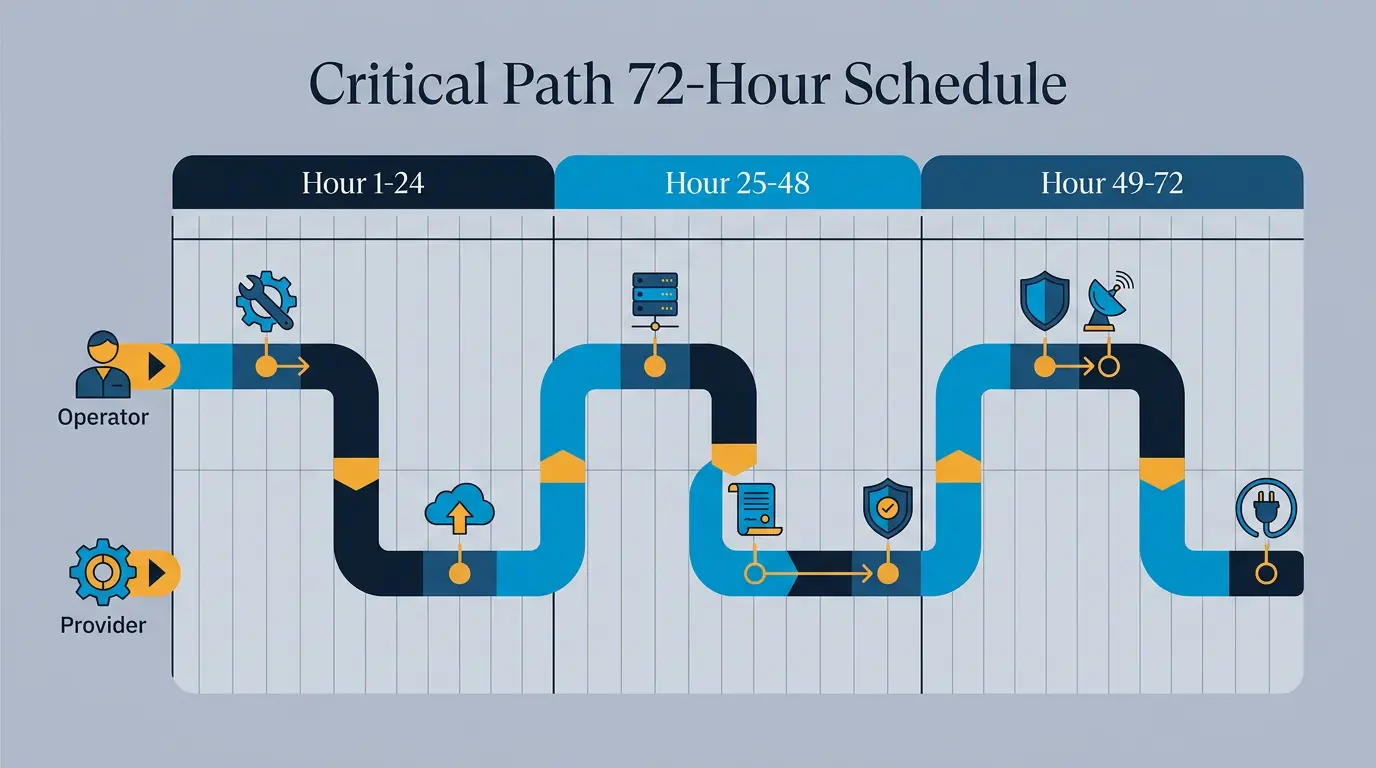
DatingPartners' onboarding team runs a 72-hour launch track with live kickoff, real-time setup support, and a go-live review. Book your launch slot.
Visit DatingPartners.com →