
The Core Choice: White Label vs Custom
When you're launching a dating platform, you'll face a fundamental decision that shapes everything that comes after: build your own system from scratch or license an existing one and rebrand it.
This isn't a question with a universally correct answer. It's a strategic choice that depends on your capital, timeline, technical expertise, market position, and growth ambitions.
dating platforms have become increasingly sophisticated. Companies like DatingPartners.com have built robust infrastructure that handles the hard technical problems. You white label their software, add your branding, customize the UI, and launch.
Custom development means hiring developers, building the tech stack yourself, managing infrastructure, and assuming responsibility for security, scalability, and feature development. You own everything but you also pay for everything.
Most dating entrepreneurs today choose white label for their first venture. But understanding the real tradeoffs matters, because the choice you make now might lock you into a certain growth ceiling.
Cost Comparison Breakdown
This is usually the deciding factor, especially if you're bootstrapping.
White Label Costs
Initial Setup: $1,000-5,000
- Domain and basic branding integration
- Logo and color scheme customization
- Initial email sequences
- Payment gateway configuration
Monthly Recurring: $100-500 per month
- Basic white label plan: $100-200/month
- Advanced features: $200-350/month
- Premium scaling plan: $350-500/month
Payment Processing: 2-3% + per-transaction fees
- This is variable based on transaction volume
- Usually the largest cost after monthly licensing
Additional Tools: $500-2,000/year
- Email marketing (Mailchimp, Klaviyo)
- Customer support platform (Intercom, Zendesk)
- Analytics and tracking (Mixpanel, Amplitude)
- Content moderation tools
Total Year One: $2,500-11,500 (depending on transaction volume and feature tier)
The beauty of white label is that your biggest costs scale with your success. If you have no users, you pay very little. As revenue grows, costs grow proportionally.
Custom Build Costs
Development Team: $50,000-150,000+ (MVP to launch)
- Small team (2-3 developers): $50K-80K
- Moderate team (4-5 developers): $80K-120K
- Full team with design: $120K-200K+
- Timeline: 4-12 months depending on scope
Infrastructure: $500-2,000/month
- Servers, databases, CDN
- Monitoring and security tools
- Backup and disaster recovery
- This scales up as you grow
Ongoing Development: $30,000-80,000/year
- Bug fixes and maintenance
- Feature additions
- Security updates
- Scaling infrastructure
Compliance and Legal: $10,000-50,000
- GDPR compliance (serious for dating apps)
- Payment processor certifications
- Data protection audits
- Regulatory consultation
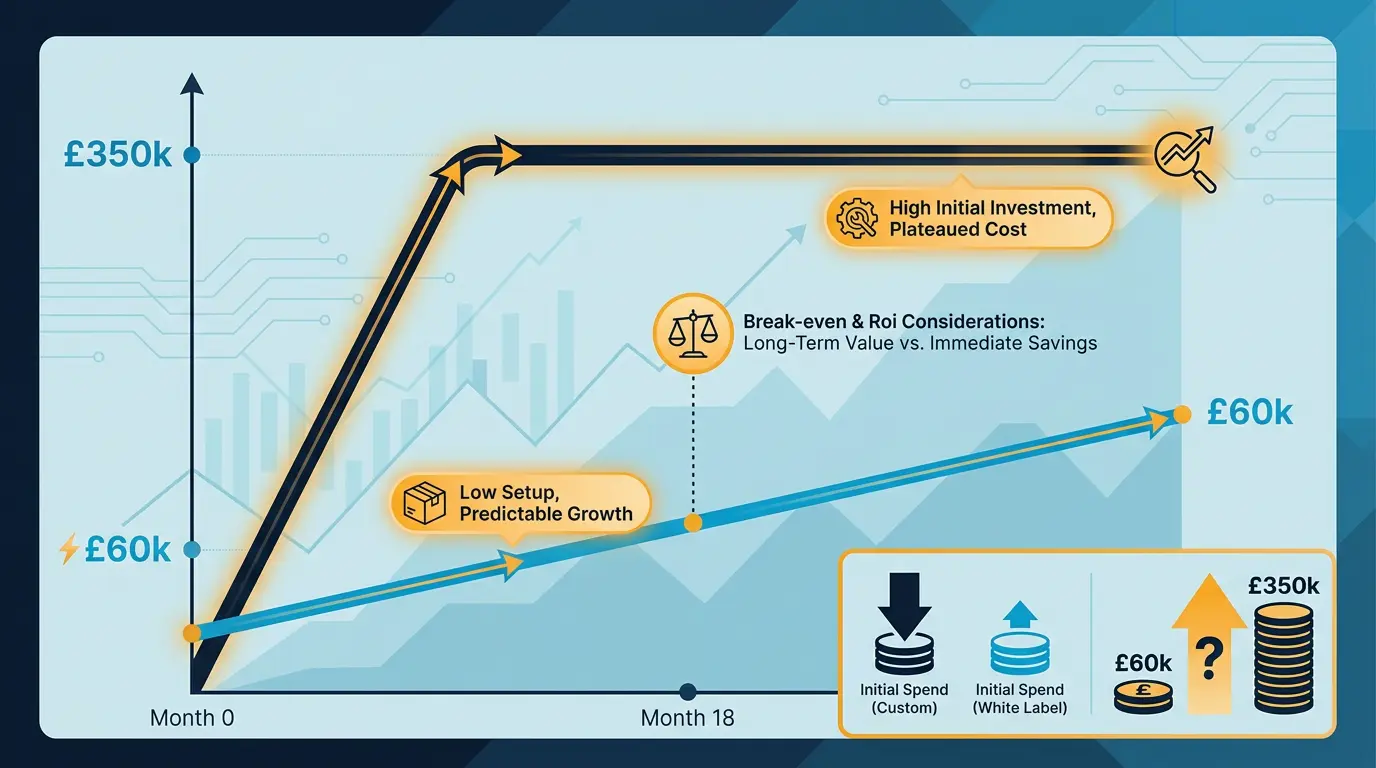
Total Year One: $80,000-250,000+ (development + infrastructure + operations)
Even with the most conservative estimate, a custom build costs 7-10x more than white label in year one.
| Cost Component | White Label | Custom Build |
|---|---|---|
| Initial Setup | $1,000-5,000 | $50,000-150,000 |
| Monthly Recurring | $100-500 | $500-2,000 |
| Year One Total | $2,500-11,500 | $80,000-250,000+ |
| Break-Even Point | 500-2,000 users | 5,000-10,000 users |
| Cost Per Active User | $5-25 | $40-100 |
The white label approach removes the financial risk of platform development. You're not betting $100K on whether your dating site will work. You're betting $300/month on whether your marketing and community building will work.
Time to Market: Speed vs Sophistication
Speed matters in the dating space. Markets move fast. Trends shift. Niches get saturated.
White Label Timeline
Week 1-2: Setup and Configuration
- Signing up with provider
- Domain configuration
- Basic branding and colors
- Payment processor integration
Week 3-4: Customization
- Email template customization
- Landing page modifications
- User interface adjustments
- Basic feature configuration
Week 5-6: Testing and QA
- Test user flows
- Payment processing
- Mobile app testing
- Bug fixes
Launch: Week 6-8
You can legitimately have a dating platform live in 4-6 weeks from contract signature. Some teams have launched in under 4 weeks.
Custom Build Timeline
Month 1-2: Planning and Architecture
- Requirements gathering
- Technology stack selection
- Architecture design
- Team assembly
Month 3-8: Core Development
- User authentication and profiles
- Matching algorithm
- Messaging system
- Payment integration
Month 9-11: Polish and Testing
- Performance optimization
- Security hardening
- Mobile app refinement
- User testing and iterations
Launch: Month 12 (or later)
A realistic custom build takes 9-15 months from concept to launch. That's a lot of runway to burn before you get any market feedback.
The white label speed advantage is genuine. You get to market faster, validate your niche, and adjust based on real user data. By the time a custom build team launches, you could have 5,000 users and concrete revenue data.
Customization and Feature Flexibility
This is where the conversation gets nuanced. White label gives you less flexibility, but not zero flexibility.
White Label Customization Limits
What You Can Customize:
- Branding (colors, logos, fonts)
- Email templates and messaging
- Landing pages and onboarding flow
- User profile fields (within limits)
- Some matching algorithm parameters
- Payment tiers and pricing
What You Usually Can't Customize:
- Core matching algorithm (you get templates, not custom logic)
- Payment processing (tied to provider's processor)
- Advanced analytics and reporting
- Complex workflow automations
- Proprietary features beyond standard dating functionality
Customization via API: Most white label providers offer API access. This lets developers extend functionality if you have the budget and team.
Example: You can't rebuild the matching algorithm to use a proprietary machine learning model. You can customize settings and parameters, but the core logic is pre-built. If your business model depends on a unique matching approach, this becomes a serious constraint.
Custom Build Flexibility
With custom development, you're limited only by:
- Budget
- Technical capability
- Time
- Architecture decisions you've made
You can build:
- Proprietary matching algorithms
- Unique gamification mechanics
- Custom integrations with external services
- Completely original UI/UX
- Advanced analytics and insights
- Platform-specific features that differentiate you
The tradeoff: This flexibility is expensive. Each custom feature is 20-80 hours of development. A seemingly simple "add video to profiles" feature might require API changes, mobile app updates, video processing infrastructure, storage, and moderation tools. That's not two weeks of work. That's two months.
Scalability and Performance
Both white label and custom platforms can scale to millions of users. The difference is in cost and control.
White Label Scalability
Advantages:
- Infrastructure scaling is someone else's problem
- Provider handles database optimization
- CDN and caching built in
- Automatic backups and redundancy
- Load balancing handled by provider
Disadvantages:
- You're constrained by provider's infrastructure
- If the provider has performance problems, so do you
- Limited ability to optimize for your specific use case
- Database bottlenecks can't be addressed by you
- Performance degradation during peak times depends on provider's investment
Real Example: If your white label provider uses shared database infrastructure and another major client on their platform gets a traffic spike, your platform might slow down. You have limited recourse.
Custom Build Scalability
Advantages:
- Complete control over infrastructure
- Can optimize specifically for your use patterns
- Can choose best-in-class components
- Can scale components independently
- Can implement advanced caching strategies
Disadvantages:
- You pay for scaling directly
- Requires infrastructure expertise
- Requires ongoing optimization
- Costs increase with scale
- Technical debt can compound
Infrastructure Costs at Scale:
| User Level | White Label Cost | Custom Build Cost |
|---|---|---|
| 1,000 users | $200/month | $1,000/month |
| 10,000 users | $300/month | $3,000/month |
| 100,000 users | $500/month | $15,000/month |
| 1,000,000 users | $1,500-2,500/month | $50,000+/month |
At massive scale (100K+ users), custom infrastructure can become more cost-effective because you control everything. But you need the expertise and capital to get there.
Maintenance and Ongoing Operations
Every platform needs maintenance. The question is who does it and who pays for it.
White Label Maintenance
Provider Handles:
- Security patches and updates
- Database optimization
- Infrastructure maintenance
- Uptime monitoring
- Backup and disaster recovery
- Compliance updates
You Handle:
- Content moderation
- User support
- Feature requests and product management
- Marketing and acquisition
- Revenue optimization
Staffing: You typically need 1 person for operations/support per 10,000 users.
Ongoing Costs: Mostly just your operations team salaries and the monthly platform fee.
Reliability: Depends on provider's SLA (usually 99.5-99.9% uptime guaranteed).
Custom Build Maintenance
You Handle Everything:
- Security patches and updates
- Database optimization and migrations
- Infrastructure monitoring
- Backup and disaster recovery
- Scaling decisions
- Uptime monitoring
- Compliance updates
- Bug fixes and technical debt
Staffing Requirements:
- DevOps engineer: monitoring, scaling, infrastructure
- Backend engineer: 20-30% time on maintenance
- Frontend engineer: 10-20% time on maintenance
- Operations person: user support, moderation, systems administration
Ongoing Costs: $120,000-300,000/year in salaries alone, plus infrastructure.
Reliability: Depends entirely on your team's competence. SLA is your responsibility.
The maintenance burden is real. Many dating entrepreneurs underestimate how much ongoing engineering time a platform requires. Even after launch, you're looking at constant work. White label removes this burden. Custom development puts it squarely on you.
Intellectual Property and Data Ownership
This is the most consequential difference long-term, even though it doesn't matter in month one.
White Label IP and Data Ownership
IP Ownership:
- You own your branding, marketing, content
- You do NOT own the platform software
- You do NOT own the matching algorithm
- You cannot resell the platform code
- You cannot license it to competitors
- Customizations might be owned by you (depends on contract)
Data Ownership:
- You own user data, but with constraints
- Provider can access user data for support and analytics
- Provider's terms control data portability
- If you want to migrate, you might face extraction delays
- GDPR gives users the right to their data, but portability to a new platform is your responsibility
Practical Impact: If your white label provider shuts down, changes pricing, or gets acquired, you're vulnerable. You can't simply port your platform and users to a new provider. You'd need to rebuild or find a compatible alternative.
Real case: When certain white label providers have been acquired or shut down, customers had to migrate platforms entirely. Users sometimes needed to re-create profiles. The data migration was messy.
Custom Build IP and Data Ownership
IP Ownership:
- You own everything
- You can resell the platform
- You can license to others
- You can modify and redistribute
- You own the matching algorithm
- You own all custom code and features
Data Ownership:
- Complete control over user data
- You decide data retention policies
- You control data access and usage
- You can migrate to any platform anytime
- Full GDPR compliance is your responsibility
- You can implement advanced analytics on your own data
Strategic Advantage: With custom development, you build an asset. A platform with 100,000 engaged users has value. You could license it, sell it, or franchise it. With white label, you have a business, but not an asset you can easily transfer.
Competitive Differentiation
How different can you make your platform?
!Customization comparison showing what can and cannot be modified in white label vs custom development platforms *Customization flexibility: what you can control with white label vs complete customization with custom development*
White Label Differentiation Limits
You differentiate through:
- Niche Focus: Target a specific demographic or geography
- Community Building: Create content, events, messaging that resonates
- Marketing: Find underserved audiences
- Pricing: Different monetization model
- Content: Blog, guides, educational resources
You usually can't differentiate through:
- Product Features: Everyone on the same platform has similar features
- Technology: The matching algorithm is standard
- Performance: No competitive edge in speed or reliability
- Integrations: Limited third-party integration possibilities
Real Problem: If three white label operators all target the same niche, they're competing on marketing and community. The actual product is identical. This means commoditized competition and price pressure.
Custom Build Differentiation Advantages
You differentiate through:
- Unique Features: Video-based matching, AI compatibility scoring, niche-specific matchmaking
- Superior Matching: Proprietary algorithm built for your market
- Better Performance: Optimized for your use patterns
- Smart Integrations: Connect to relevant third-party tools
- Brand Experience: Completely custom UI/UX
- Data Insights: Advanced analytics and reporting
Strategic Advantage: A well-built custom platform for a specific niche can become defensible. Competitors copying you face the same $100K+ development cost. Your first-mover advantage matters.
This is why successful dating platforms eventually go custom. They outgrow white label constraints.
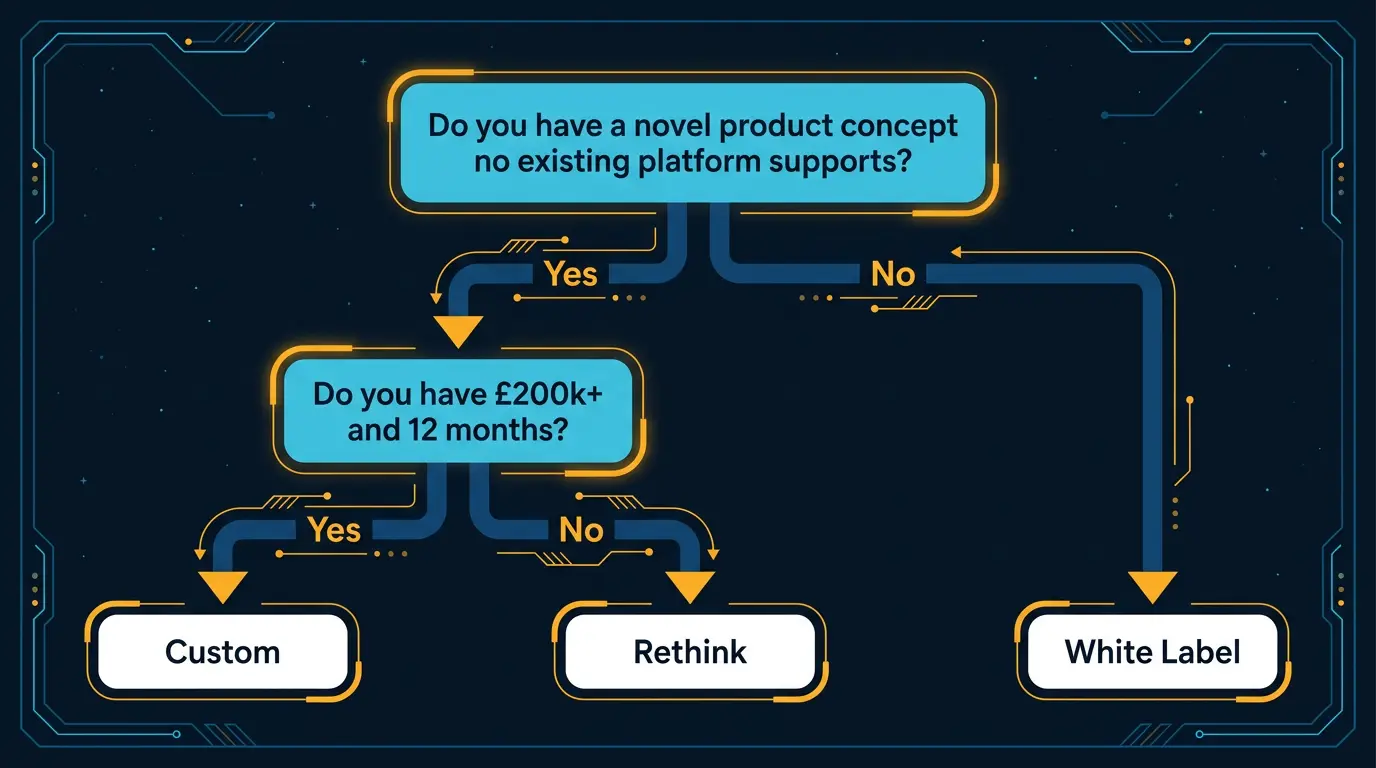
Decision Matrix and Scenarios
Here's the framework: when to choose white label, when to choose custom.
Choose White Label If:
- You're Bootstrapped
- No outside capital
- Limited personal savings
- Need to test a niche before raising money
- Can't afford $100K+ development costs
- Speed to Market is Critical
- Market window is closing
- Competitors are launching
- You need to validate quickly
- You want market feedback in 4 weeks, not 12 months
- You're Testing a Niche
- You're not 100% sure this market will work
- You want to prove demand before building custom
- You need revenue to fund development
- You want to iterate based on user feedback
- Your Differentiation Isn't Technical
- You're competing on community, not features
- Your value is in the user experience and community building
- You have a network already (ex-colleagues, regional focus)
- You're targeting a specific, underserved demographic
- Operational Simplicity Matters
- You don't want to manage infrastructure
- You don't have a technical co-founder
- You want someone else responsible for uptime
- You want to focus purely on business metrics
Choose Custom Build If:
- You Have Capital
- Raising venture funding
- Have investor capital ($100K+)
- Can afford 12 months of runway without revenue
- Planning for venture-scale growth
- Your Idea Requires Unique Technology
- Proprietary matching algorithm
- Unique user experience or gamification
- Advanced AI or machine learning
- Features that don't exist on white label platforms
- Integrations critical to your business model
- You're Building a Platform Business
- Plan to license/franchise the platform
- Targeting multiple geographic markets
- Building a network effect business
- Need to control every aspect of the product
- IP and Data Ownership Matters
- You want to own the technology outright
- You plan to raise Series A+ and need own IP
- You want exit optionality (acquisition, licensing, franchising)
- Long-term defensibility is important
- Performance and Reliability are Critical
- Your users demand high performance
- You need advanced analytics
- You're in a regulated market requiring custom compliance
- You need custom integrations with enterprise clients
Real Scenario Examples
Scenario 1: The Niche Operator You've identified 50,000 people in a specific niche (ex: professional women in biotech, aged 28-35, looking for serious relationships). You have a network in this space. You're bootstrapped with $10K in savings.
Decision: White Label
- Cost: $3,000-5,000 year one
- Timeline: Launch in 6 weeks
- Risk: Low (test market with minimal investment)
- Exit path: If successful, learn the business, then license a custom build or get acquired
Scenario 2: The Venture-Backed Team You've raised $500K seed from venture investors. You have a technical co-founder, two engineers, and a designer. You've proven demand in your niche through surveys and a waitlist. You're confident in your market.
Decision: Custom Build
- Cost: $200K-300K for first platform
- Timeline: Launch in 6-9 months
- Risk: Higher, but mitigated by capital and market validation
- Exit path: Build defensible product, raise Series A, aim for acquisition or IPO
Scenario 3: The Regional Operator You're launching in a specific geographic market (ex: luxury dating in Singapore). You've lived there for 10 years and have a network. You have $50K personal savings and $100K from friends and family.
Decision: Hybrid Approach
- Year one: White label to launch and build initial community ($5K)
- Year two: Raise more capital or use revenue to fund custom features
- Transition: Gradually move toward custom build as you grow
- Timeline: Start with 6-week launch, then evolve
| Decision Factor | White Label Wins | Custom Wins |
|---|---|---|
| Cost | $2.5K-11.5K/year | $80K-250K+ year one |
| Time to Market | 4-8 weeks | 9-15 months |
| Customization | Limited to templates | Unlimited |
| Scalability Cost | Scales linearly | Can optimize |
| Maintenance Burden | Provider handles | You handle |
| IP Ownership | Provider owns platform | You own everything |
| Competitive Differentiation | Via marketing/community | Via features/technology |
| Exit Strategy | Business only | Asset + Business |
| Technical Expertise Required | Low | High |
| Market Validation Speed | Fast | Slow |
Key Takeaways
- White label costs $100-500/month with 4-8 week launch; custom build costs $50K-150K+ with 9-15 month timeline. Choose based on capital availability and urgency.
- White label removes maintenance burden and technical risk; custom build requires skilled team and ongoing engineering investment. Operational simplicity is real value if you lack technical infrastructure.
- Customization matters for competitive differentiation; white label limits you to branding and marketing while custom build lets you build proprietary features. Test your market first before betting on unique technology.
- IP ownership favors custom build; you own nothing with white label except your users and brand. This matters for acquisition valuations and long-term exit strategy.
- White label is the bootstrapper's path; custom is the venture-backed path. Most successful dating platforms start white label and transition to custom as they scale and raise capital.
- Speed to market wins markets; validate your niche with white label quickly, then raise capital to build custom if market response justifies it. Avoid the 12-month build if you're not certain demand exists.
- Hybrid approach works; many operators run white label for 12-18 months while using revenue to fund custom development. This reduces risk and lets you prove business metrics before major technical investment.
Most founders who compare the two paths honestly pick white label. See what DatingPartners offers in the white label lane, including transparent pricing and an honest exit policy.
Visit DatingPartners.com →