
What Is a White Label Dating App
A dating app is a pre-built mobile application that you brand as your own and launch under your company name. Think of it like repackaging a product with your label instead of building the entire thing from zero. You get a fully functioning dating platform that users download from the App Store or Google Play, but every visual element, company name, and branding reflects your business.
This approach has exploded in the last five years because the barrier to entry just dropped dramatically. You don't need a team of engineers. You don't need months of development time. You simply configure an existing platform, apply your branding, and launch.
The key advantage is speed to market combined with lower risk. A custom-built dating app typically takes 6-12 months and costs $50,000 to $500,000+. A white label app can be ready in 4-8 weeks for a fraction of that cost. More importantly, white label solutions already have most bugs worked out, compliance measures in place, and user bases running successfully.
The tradeoff is customisation. With white label, you're working within the boundaries of what the provider offers. You're not building something entirely unique from the ground up. For most new dating business operators, this is a worthwhile trade because speed and lower cost are what matter most in validating whether your idea actually works.
Native vs Hybrid vs PWA: Understanding Your Options
This decision fundamentally shapes what you're building and what it costs. Let me break down each approach.
Native Apps: Maximum Performance
A native app is built specifically for iOS or Android using the platform's native programming language. iOS apps use Swift, Android apps use Java or Kotlin. Native apps run at top speed, feel responsive, and have full access to every feature on the device.
The dating industry mostly runs on native apps. Tinder is native. Match is native. Most successful dating apps you've heard of are native because they provide the smoothest user experience.
With a white label native solution, you're getting pre-built iOS and Android apps that your provider has already developed. You brand them, configure settings, and submit them to the App Stores. The provider handles backend updates and major improvements.
The downside: You're locked into whatever the provider offers. Each time you want a change, you might be waiting for the provider to implement it, then resubmitting to app stores (which can take 1-7 days for approval). Native also means you need to maintain two separate code bases (iOS and Android), so providers charge more for this approach.
Cost range for white label native: $2,000-$10,000 upfront, plus $500-$2,000 monthly.
Hybrid Apps: The Middle Ground
Hybrid apps use web technologies (HTML, CSS, JavaScript) wrapped in a native shell. Frameworks like React Native, Flutter, or Cordova power these. One codebase runs on both iOS and Android, which sounds great in theory.
The reality: Hybrid apps feel slightly less snappy than native. They're not as responsive to touch. Performance on older phones can be sluggish. Dating apps depend heavily on smooth, fast interactions (swiping, messaging, notifications), so the performance gap matters more than in other app categories.
That said, hybrid has gotten much better in recent years. React Native apps feel nearly native these days. And hybrid dramatically reduces development and maintenance costs for white label providers, which means lower pricing for you.
Hybrid works well for startups focused on niche dating markets where you're not competing directly on app speed with Tinder. It's adequate for serious, community-focused dating platforms.
Cost range for white label hybrid: $1,000-$5,000 upfront, plus $300-$1,000 monthly.
Progressive Web Apps (PWA): The Emerging Option
A PWA is basically a website that feels and behaves like an app. You install it to your home screen from the browser, and it runs without needing to open Safari or Chrome.
PWAs have huge advantages: Zero app store drama. Zero submission delays. You can push updates instantly without waiting for Apple or Google approval. One codebase serves everyone (iOS, Android, desktop). Development and maintenance cost is lowest of all three options.
The catch: PWAs still feel like web apps. They're slower than native. They don't work as well offline. They have more limited access to device features like push notifications (though this is improving). Discoverability is harder because users won't find your app in the App Store.
Dating users expect apps they download from the App Store. A PWA is starting to change this perception, especially for younger users, but it's still not the default choice. Most dating operators stick with native or hybrid specifically because users expect the App Store experience.
PWAs work great for validating a dating business concept cheaply or for serving a web-first user base. If you're building a community dating platform where members are on desktop as much as mobile, PWA is worth serious consideration.
Cost range for white label PWA: $500-$3,000 upfront, plus $100-$500 monthly.
Which Should You Choose
Pick native if you're raising investment money, targeting mass market dating, or competing in crowded niches where app quality is your differentiator. Native gives you competitive parity with established players.
Pick hybrid if you want reasonable app quality at lower cost, you're targeting a niche market, or you're bootstrapped and need to keep costs down. Hybrid is the sweet spot for most new dating businesses.
Pick PWA if you're validating an idea, your users are primarily web-based, or you want maximum flexibility to iterate without app store delays. PWA is also best if you're launching across multiple countries and want to avoid compliance headaches in various app stores.
Critical Features to Evaluate
When you're looking at a white label dating app solution, you need to go beyond the marketing promises. Here are the features that actually matter.
Matching and Discovery Engine
How does the app find matches for users. The simplest approach is location-based and preference-based filtering (age, gender, interests). This works fine for geographic dating.
Better solutions include:
- Algorithm-driven matching that learns from user behavior
- Compatibility scoring based on detailed questionnaires
- Advanced filtering options (height, income, education, lifestyle)
- Ability to browse and search (not just get fed matches)
- Hot list, like/dislike mechanisms, or swiping interfaces
Ask the provider: Can you customize the matching algorithm. How many questions can users answer. Can you add custom matching criteria.
Messaging and Communication
Messaging is where dating apps make money (through premium features that unlock unlimited messaging). Core features to check:
- Real-time messaging or delayed message delivery
- Notification system (push notifications are critical)
- Message history and persistence
- Ability to limit free messaging (e.g., only matched pairs can message)
- Group chat or community features (depends on your model)
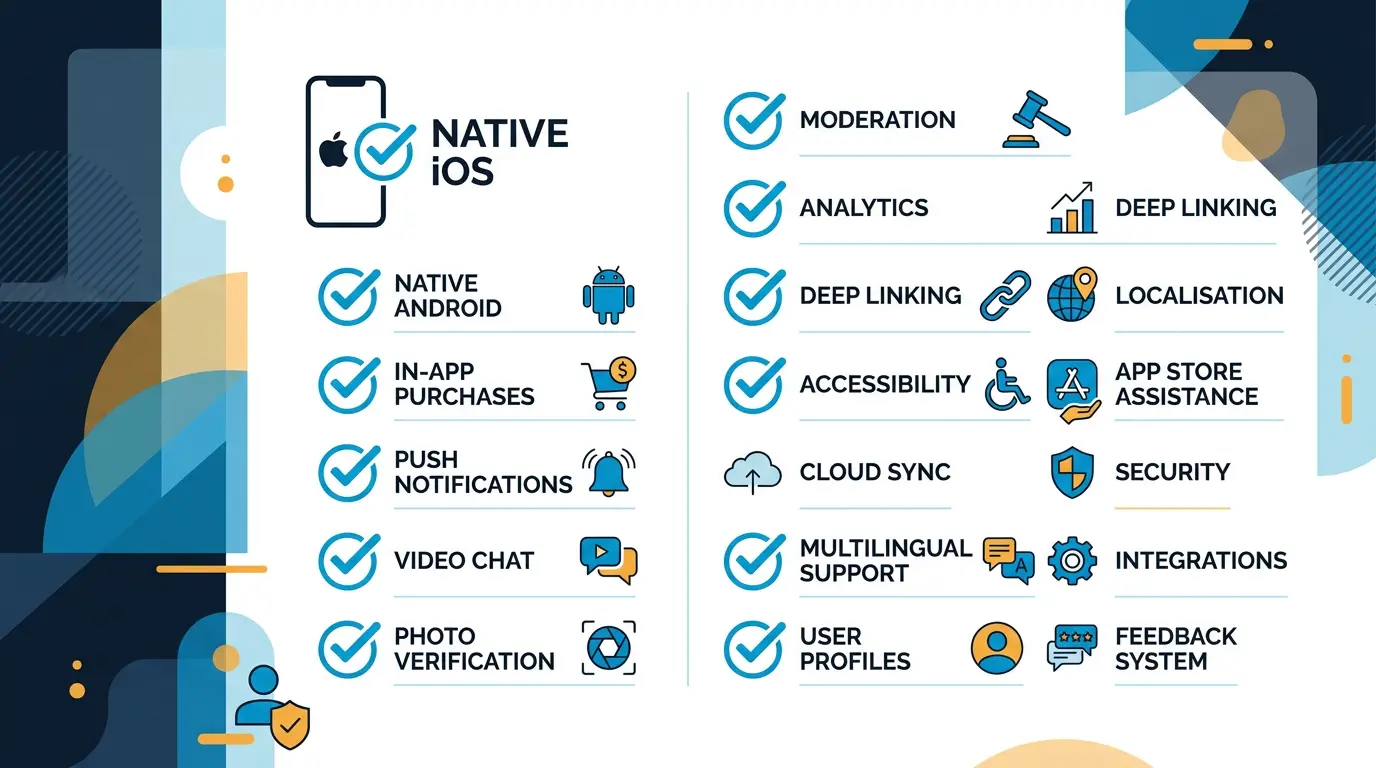
- Video/voice call integration (increasingly standard)
Most white label providers offer solid messaging. The question is whether they support the monetisation strategy you want. Can you restrict free users to limited messages. Can you gate video calls behind a premium feature.
Profile Creation and Customisation
How much flexibility do users have in creating profiles, and how much can you customize the profile experience for your brand.
Look for:
- Profile photo upload (usually 6-12 photos)
- Profile questions and text fields
- Ability to create custom profile questions
- Video profiles or profile video uploads
- Verification features (ID check, photo verification)
- Privacy controls (who can see what)
This matters because your dating app's entire value depends on profile quality. If profiles are weak, matching fails, and users leave. Good white label solutions give you control over what information users provide.
Safety and Moderation Features
Dating platforms face serious legal requirements around safety. This is non-negotiable.
Essential features:
- Age verification system
- Identity verification (photo ID check)
- Report and block functions
- Admin moderation tools (ability to review profiles, messages, reported content)
- Scam detection and prevention
- Support for taking down inappropriate content quickly
- Compliance with local regulations (varies by country)
Weak safety and moderation is how dating platforms get sued or shut down. Your white label provider's investment in this area reflects their maturity. New providers often skip this. Established ones have battle-tested systems.
Payment Processing and Monetisation
Different white label solutions support different revenue models. Before you choose, confirm they support your intended monetisation strategy.
Check what payment methods they support: Credit cards, Apple Pay, Google Pay, local payment methods (important if you're international). Ask about payment processor fees (usually 2-3%). Confirm they support recurring subscriptions if you're doing a subscription model.
Ask whether they support in-app purchases (for tokens/credits) and whether they take a cut of that revenue. Most do.
Push Notifications and Engagement
Dating apps depend on push notifications to drive engagement. Users download the app, go dormant, then notifications bring them back.
Verify the white label solution has:
- Reliable push notification system
- Customisable notification triggers (new match, new message, etc.)
- Ability to set notification frequency and timing
- Analytics on notification performance
Poor push notifications sink engagement metrics. This is often overlooked during evaluation but it's critical.
Admin Dashboard and Analytics
You need visibility into what's happening in your app. An admin dashboard should give you:
- User counts and growth metrics
- Revenue/payment data
- Engagement metrics (daily active users, session length, etc.)
- Retention cohorts
- Custom report generation
- User management (ability to ban, verify, or restore users)
- Moderation queue visibility
Weak analytics mean you're flying blind. You won't know if something's working until it's too late.
Scalability and Performance
Your white label provider needs to handle growth. Ask directly:
- How many concurrent users can the platform support
- What's the infrastructure (cloud-based, their own servers)
- How do they handle traffic spikes
- What's their uptime guarantee
- How fast is the app on slower networks
- Do they auto-scale or do you need to manually increase capacity
Most modern white label solutions use cloud infrastructure (AWS, Google Cloud) which handles scaling automatically. Older solutions might have limitations. This matters less at launch but becomes critical once you get traction.
Major White Label Dating App Providers
Here's an overview of the main players in white label dating apps. This landscape changes, so treat this as a starting point for your research.
HubPeople
HubPeople focuses on the European and Asian markets. They offer white label solutions for niche dating platforms. They provide both web and app solutions.
Strengths: Good for community-based dating. Strong support for customisation. Competitive pricing.
Weaknesses: Less exposure in the US market. Smaller user base means fewer resources to tap into through network partnerships.
Mobile offering: Hybrid app available for both iOS and Android.
Dating Factory
Dating Factory is one of the oldest players in white label dating. They've been around since the early 2000s and acquired by Sparks Networks (now owned by Match Group's parent company Avast).
Strengths: Massive experience. Proven track record. Huge database of users across their white label network. Strong monetisation infrastructure built in.
Weaknesses: Legacy codebase can feel outdated. Less flexibility for truly custom experiences. More prescriptive about how you run your business.
Mobile offering: Native iOS and Android apps. Heavy investment in mobile over the last few years.
DatingPartners (via https://www.datingpartners.com)
DatingPartners is owned by the same parent company as WhiteLabelDating and offers white label solutions specifically for operators. They focus on providing white label platforms with strong backend infrastructure.
Strengths: Purpose-built for dating operators. Good documentation. Flexible customisation. Strong payment processing support. Can link into network of other white label sites for cross-promotion.
Weaknesses: Smaller team than some competitors. Less marketing support.
Mobile offering: Hybrid apps using React Native. Clean, modern codebase.
SkaDate
SkaDate offers both white label solutions and consulting for dating platforms. They're known for customisation flexibility.
Strengths: Highly customisable. Good for operators who want control. Strong for building niche dating communities. Reasonable pricing.
Weaknesses: Requires more technical knowledge to get the most out of. Customer support is more DIY-oriented. Less established than some alternatives.
Mobile offering: Both native and hybrid options available.
PG Dating Pro
PG Dating Pro (PHP Grabber) is an older white label solution that requires hosting on your own server or their managed hosting.
Strengths: Affordable. Fully open-source option available. Good for extreme customisation. Transparent pricing.
Weaknesses: More technical to manage. Smaller support community. Feels older compared to modern solutions.
Mobile offering: Mobile apps available but less polished than newer competitors.
Costs and Pricing Models
White label dating app costs fall into several categories.
Initial Setup Costs
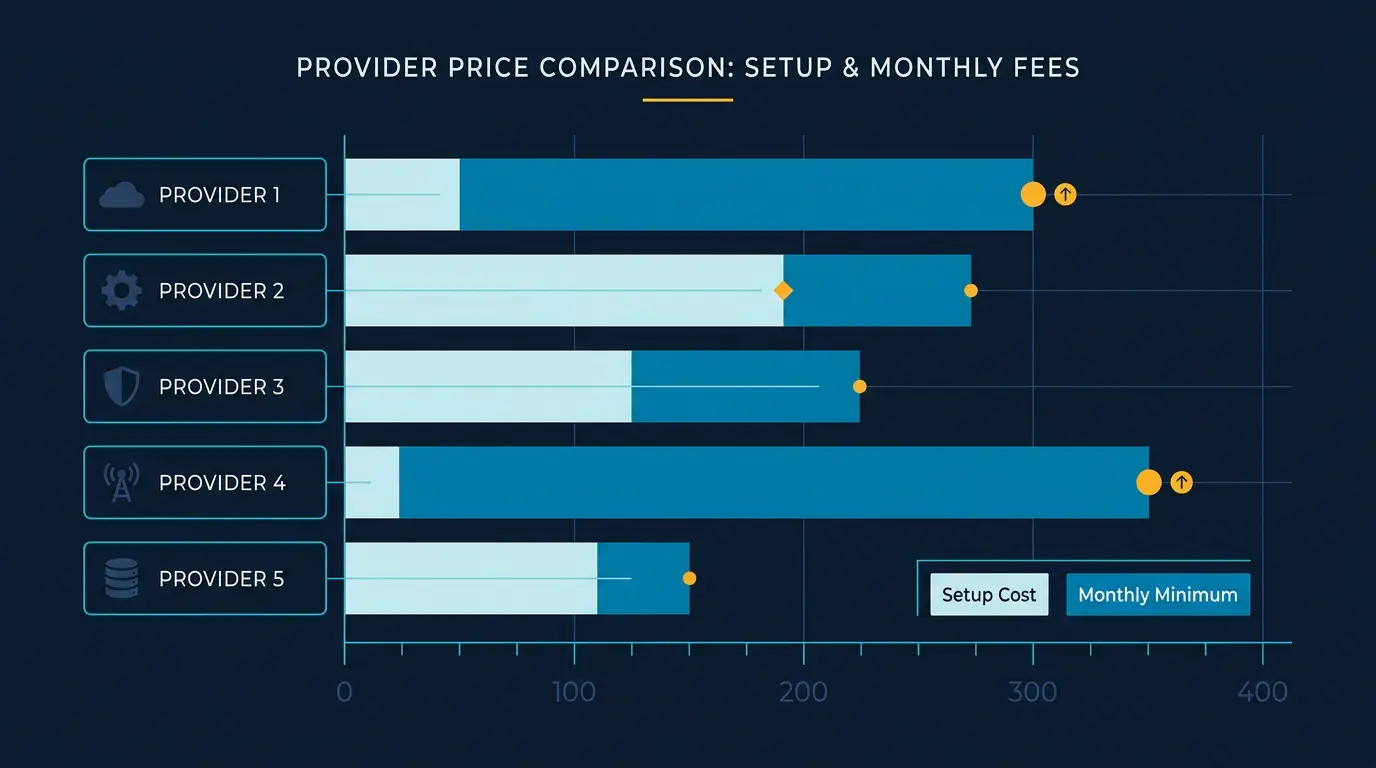
Setup fees vary widely: $0 to $10,000 depending on the provider and configuration.
Some providers charge nothing upfront (you pay everything monthly). Others charge a one-time setup fee that covers configuration, custom branding, initial app store submission, etc. A setup fee isn't inherently bad. Sometimes it reflects the provider doing more work to get you launched properly.
Monthly Recurring Costs
This is where most of your expense goes: $300 to $5,000 per month depending on:
- Platform complexity (basic to fully custom)
- Number of users on your platform
- Level of support included
- Whether they include backend hosting or you host separately
- Payment processing fees (usually separate, 2-3% per transaction)
Most providers use a tiered pricing model. You start at a basic tier and move up as you add users. Alternatively, they might charge per user (e.g., $0.50-$2.00 per monthly active user).
Revenue Share Models
Some providers take a cut of your revenue instead of charging monthly fees. Typical revenue share ranges from 15-30%. This can work well if you're early stage with minimal revenue. The provider is incentivised to help you grow. But as you scale, revenue share becomes expensive compared to flat fees.
Calculate the breakeven point. If a provider wants 25% of revenue and you're making $10,000/month, that's $2,500 in costs. If another provider charges $1,500/month flat, the flat fee is better. But if you're only making $3,000/month, revenue share ($750) beats flat fees.
Payment Processing Fees
Separate from white label costs, you'll pay payment processor fees: typically 2.9% plus $0.30 per transaction for credit cards. If your users pay $9.99/month and you have 1,000 paid users, that's $2,970 in monthly processing fees. This is unavoidable and non-negotiable.
Cost Comparison Table
| Provider | Initial Setup | Monthly Base | Per-User Cost | Revenue Share | Best For |
|---|---|---|---|---|---|
| HubPeople | $2,000-5,000 | $500-2,000 | Variable | None | Community dating, niche |
| Dating Factory | $0-3,000 | $800-3,000 | Up to $1/user | None | High-volume affiliate networks |
| DatingPartners | $1,000-4,000 | $400-1,500 | $0.25-0.75 | Optional | Bootstrap operators, niches |
| SkaDate | $500-2,000 | $300-1,200 | Variable | None | Custom, tech-savvy operators |
| PG Dating Pro | $0-1,000 | $100-800 | None | None | Bootstrapped, highly custom |
Reality check: Budget $1,500-$3,000/month for a solid white label solution once you factor in all costs. Your actual cost per user depends entirely on your business model and growth rate. Early on, when you have 100 users, a $1,000/month platform costs you $10 per user. At 10,000 users, it's $0.10 per user. This is why white label makes sense for new operators.
Customisation and Branding Capabilities
The whole point of white label is that it's yours. But how much can you actually customize.
Branding Elements
Every white label provider lets you change:
- App name and logo
- Color scheme
- Custom app icons
- Splash screens
This is table stakes. If a provider doesn't offer this, pass.
Better providers also let you:
- Custom fonts and typography
- Custom loading screens and animations
- Custom app store descriptions and screenshots
- Branded email notifications
- Custom help and support pages
Feature Customisation
This is where providers differ. Some give you complete control over which features are visible and available. Others lock you into a fixed feature set.
Look for providers who let you:
- Turn features on/off (if you don't want video messaging, disable it)
- Customize profile questions
- Create custom matching criteria
- Adjust matching algorithm weights
- Customize registration flow (what data users provide)
Less flexible providers make you take their full feature set whether you want it or not.
Code Access and Customisation
The most flexible white label solutions let you modify source code. This matters if you want to make custom features not available in the standard platform.
Typical options:
- Closed box: You cannot modify code. You work entirely within the admin dashboard. (Easiest but least flexible)
- Managed customisation: Provider makes custom changes for you (usually expensive, $5,000-50,000+)
- Source code access: You get the code, can modify it yourself or hire developers. (Most flexible, requires technical knowledge)
For most new dating businesses, closed-box is fine. As you scale or discover competitive advantages you want to build, managed customisation or source code access becomes appealing.
API Access
Some white label providers expose APIs so you can build integrations. This matters if you want to connect to:
- Payment processors (beyond what they support)
- Analytics platforms
- CRM systems
- Email marketing platforms
- Custom features you're building
Good API documentation is underrated. Poor API docs mean you'll waste time trying to integrate.
App Store Submission and Compliance
This is where a lot of dating entrepreneurs get stuck. App store submission isn't just uploading your app. There's a compliance journey.
!Comparison chart showing native vs hybrid vs PWA performance, cost, development time, and customization capabilities *Native vs hybrid vs PWA: comparing performance, cost, speed to market, and customization for dating apps*
Apple App Store Requirements
Apple reviews dating apps carefully. You need:
- Privacy policy (Apple requires this. They check that your app actually follows it.)
- Terms of service defining liability and user conduct rules
- Age verification system (dating apps must be 17+)
- Proof that you verify user identity or have a moderation system
- Developer account ($99/year)
- App signing certificate
- Build ready for iOS 15+
Apple's review takes 1-3 days usually. Dating apps sometimes take longer because Apple scrutinises them.
Google Play Store Requirements
Google is less strict than Apple but still requires:
- Privacy policy
- Terms of service
- Age verification (dating apps are 17+)
- Developer account ($25 one-time fee)
- Build ready for Android 8.0+
Google's review is often faster, usually 2-24 hours.
Common Rejection Reasons for Dating Apps
Your app will be rejected if:
- No age verification system
- Misleading listings (pictures of models who aren't users, fake engagement)
- Links to external payment (you can't direct users to pay outside the app to avoid app store fees)
- Inappropriate content (users can upload explicit photos and app doesn't moderate)
- Scam potential (too easy for users to receive payments for "dating")
Important: Your white label provider should help you navigate this. They've submitted dozens of dating apps. They know what works and what doesn't. This is a factor in evaluating providers. Do they have documented processes for app store submission. Do they help you prepare submission materials. Do they have existing relationships with app store reviewers.
Ongoing Compliance Updates
App stores update their policies. iOS 17 required new privacy features. Google periodically updates its dating app policy (they've been cracking down on scam apps). Your white label provider needs to keep the platform compliant as things change. This is a hidden cost. Providers who don't invest in staying current create compliance risk for you.
Ongoing Maintenance and Support
Here's what people underestimate: The work doesn't stop at launch.
Provider Support Quality
You need responsive support when something breaks. Look for:
- Support hours (24/7 is ideal, but 9-5 during your timezone is minimum)
- Response time SLA (what's their promise to respond to urgent issues)
- Support channels (email, chat, phone)
- Documentation quality (well-written docs reduce support questions)
- Community forum (useful if provider has one)
Poor support destroys your operation. You've got a bug affecting payments. Your provider takes 48 hours to respond. Money is lost. Users are upset. This matters more than you think.
Updates and Maintenance Windows
White label providers periodically update their platform (security patches, new features, bug fixes). During updates, your app may be temporarily unavailable.
Ask:
- How often do they update the platform
- How long are typical maintenance windows
- Do they notify you in advance
- Can you choose when updates happen or is it forced
- What's their rollback procedure if an update breaks something
Most modern providers use zero-downtime deployment (they update without taking the app offline). Older platforms might require 15-30 minute downtime. This matters.
Security Updates and Patching
Dating platforms handle sensitive user data. They need security updates as vulnerabilities are discovered. Good providers patch security issues within days. Poor ones wait months.
Ask about their security practices:
- Do they perform regular security audits
- What's their policy for disclosing vulnerabilities
- How quickly do they patch discovered issues
- Do they have bug bounty programs that incentivise finding issues
Version Upgrades and Deprecation
Eventually, white label providers deprecate old versions. An update forces you to move from version 2 to version 3. If you've customized heavily or built integrations, major version updates can be painful.
Ask:
- What's their support window for a given version
- What breaks in major version upgrades
- How much work is required for you to upgrade
- Can you negotiate extended support for older versions
Scaling Support
As you grow, you'll need help managing scale. Does your provider offer:
- Database optimisation
- Performance tuning
- Advice on scaling to 100k+ users
- Infrastructure recommendations
Some providers are good at helping you scale. Others assume you'll figure it out. This becomes relevant once you have real traction, but it's worth knowing.
Key Takeaways
- White label dating apps let you launch a branded mobile platform without building from scratch. Choose between native (best performance, highest cost), hybrid (good balance), or PWA (cheapest, trade-off in user expectations).
- Evaluate white label providers on matching engine, messaging, profiles, safety features, payment processing, notifications, admin tools, and scalability. These are non-negotiable.
- Major white label providers include HubPeople, Dating Factory, DatingPartners, SkaDate, and PG Dating Pro. Each has different strengths. Dating Factory and DatingPartners are most established. SkaDate is best for customisation.
- Budget $1,500-$3,000/month for a solid white label solution once you factor in hosting, payment processing, and support. Setup costs range $1,000-$5,000. Add $99-$125/year for app store developer accounts.
- Prioritise app store submission support when evaluating providers. They've done this before and can help you navigate Apple and Google's dating app requirements.
- Ongoing support quality is often overlooked but critical. Poor support means bugs take weeks to fix. Good support means problems are solved in hours.
- You can switch white label providers later but it's painful. Choose thoughtfully the first time. Ask about data portability and source code escrow before committing.
DatingPartners offers native iOS and Android white label apps with full App Store compliance support and a transparent setup fee. Book a demo to see the app in your brand.
Visit DatingPartners.com →