
Most explanations of dating stop at "you put your brand on someone else's platform." That is true but it does not tell you how the thing actually functions. This guide takes the model apart and shows you each moving piece, so you understand what you are buying, what you are responsible for, and where the money goes. I have run dating platforms for 21 years from both sides of this arrangement, as an operator and as the provider behind DatingPartners.com.
The two-layer model
The simplest way to understand white label dating is to picture two layers stacked on top of each other.
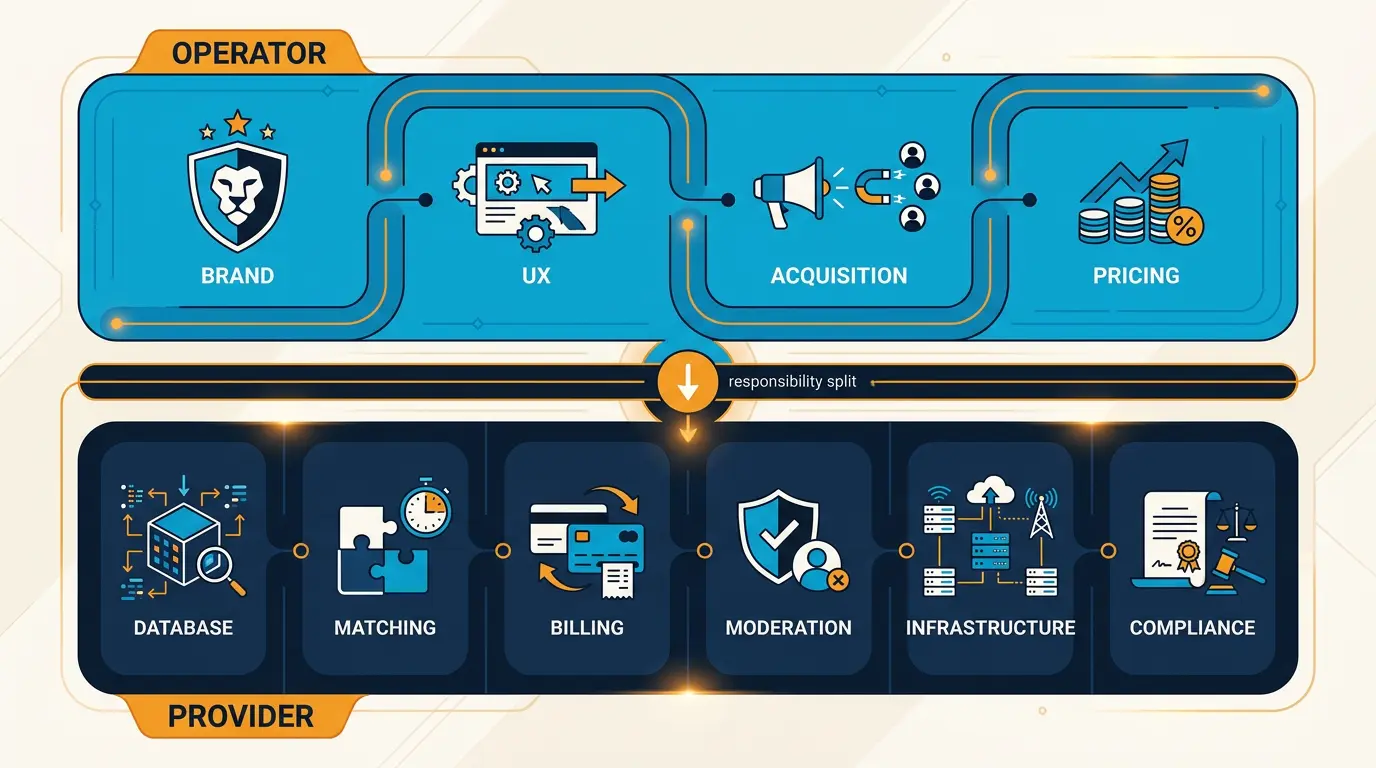
The bottom layer is the platform. It is the code, the servers, the database, the payment system, the moderation tools and the compliance framework. One provider builds and maintains this layer once, then lets many operators use it at the same time.
The top layer is the brand. It is the domain name, the logo, the colours, the site name, the niche positioning and the marketing. Each operator owns their own top layer and never sees anyone else's.
A member visiting your site sees only the top layer. They see your brand, your niche, your tone of voice. Underneath, they are using shared infrastructure that thousands of other members on other branded sites are also using. The two layers are deliberately invisible to each other from the member's point of view, and that separation is the whole product.
What sits in the provider layer
The provider carries everything that is expensive, technical, or risky to run. There are five parts to it.
The platform itself is the profile system, the search and matching engine, the messaging system, the admin panel and any mobile apps. The member database holds every profile across the network. Payment processing covers merchant accounts, subscription billing, tax collection across jurisdictions, and handling. Moderation is the round the clock work of screening photos, messages and profiles, removing scammers and fake accounts, and handling reports. Compliance is the documented framework that keeps the platform legal under the UK Online Safety Act, the EU Digital Services Act, GDPR and the patchwork of other regulations.
The reason these five sit with the provider is simple. Each one is costly to build, costly to run, and dangerous to get wrong. Spreading that cost across many operators is what makes the economics work for everyone.
What sits in the operator layer
The operator carries the things the provider cannot do for you. There are three.
The first is brand. You choose the domain, design the identity, name the site and set the tone. A strong brand is what makes a site feel built for its audience rather than a generic skin.
The second is niche. You decide who the site is for. This is the single most important commercial decision in the model, because a focused niche is far easier to market and far easier to make members feel at home in than a general "dating for everyone" site.
The third is acquisition. You bring the traffic. That means search, paid advertising, content, social, affiliates or partnerships. The platform can show members to your visitors, but it cannot create visitors. That job is yours, and it is the job that decides whether the site earns.
The shared member database, step by step
The shared member database is the part that confuses people, so here it is step by step.
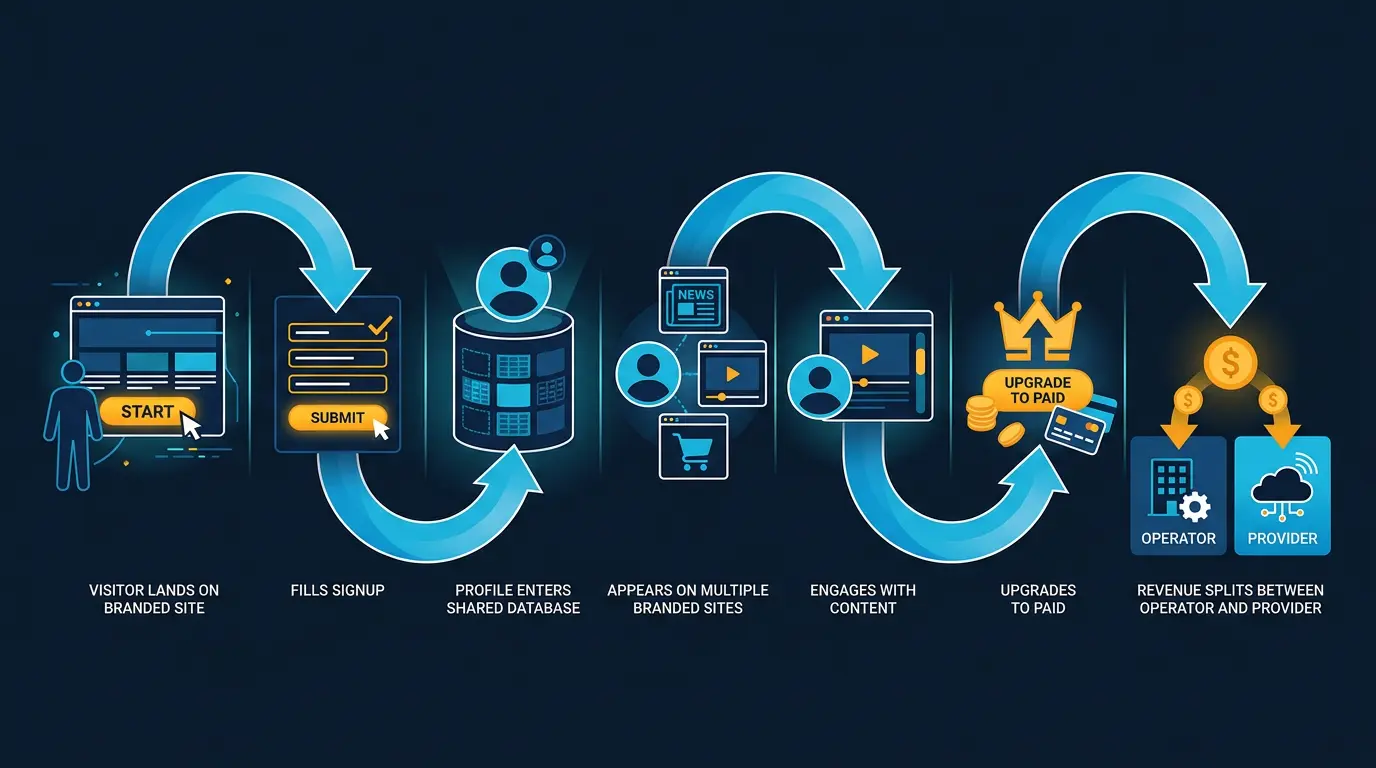
Imagine one central store of member profiles that every site in the network can read from and write to. When someone signs up on your site, their profile is added to that central store. When a member browses or searches on your site, the platform reads from the central store and shows them a filtered slice of it, based on age, location, gender and the niche your site targets.
That filtering is what makes each branded site feel distinct. A member on a site called "Mature Country Dating" sees profiles that match that site's declared audience. Those same profiles may also appear, suitably filtered, on a sister site with a different name. Reputable providers disclose this in the privacy policy and terms, and give members the ability to control where they appear.
For the operator, this is the mechanism that solves the hardest problem in dating. A brand new site has no members of its own, but because it reads from the shared store, it can show active members to its very first visitor. Without the shared database, every new site would launch empty and almost no one would stay.
How money flows
Money flows in one direction and then splits. A member pays a subscription, commonly in the range of twenty to twenty five pounds a month. That payment is processed by the provider, because the provider holds the merchant account.
The provider then splits the revenue. The standard arrangement gives the operator 60 to 70 percent and the provider 30 to 40 percent. There is usually no upfront fee. The provider earns only when the operator earns, which aligns both sides.
The operator's costs sit outside this split. They are the domain, the marketing budget and the operator's own time. Because the provider carries the servers, the staff and the compliance, the operator's fixed costs are close to zero. That is the reason a solo operator can run a profitable dating site, and the reason the model attracts small teams rather than large companies.
How a member experience is assembled
It helps to see the whole thing assembled from the member's side.
A visitor arrives on your branded site through your marketing. They see your brand and your niche promise. They register, and their profile is written to the shared database. They browse, and the platform serves them a filtered view of the wider that matches your site's audience. They try to send a message and hit the paywall. They subscribe, and the provider processes the payment. They start a conversation, and the messaging system, moderation and safety tools all run underneath without the member ever seeing them.
Every technical part of that journey is the provider's. Every brand and audience part is yours. The member experiences it as one coherent product, which is exactly the point.
Where white label platforms differ
Not all white label platforms work identically, and the differences matter when you choose a provider.
| Variable | What to check |
|---|---|
| Database model | Fully shared pool, or partly isolated tenants at a premium |
| Revenue share | Operator share, and whether it changes with volume |
| Data export | Whether you can export your members at any time |
| Apps | Responsive web only, progressive web app, or native iOS and Android |
| Moderation | Who runs it, and the response time for reported abuse |
| Exit terms | Notice period, and whether a non compete is attached |
The platform mechanics described above are common to the category. The commercial terms around them are where providers genuinely differ, and where you should focus your questions before signing anything.
A worked example: one member, one site
Follow a single member through the model and every layer becomes concrete.
A woman in her fifties searches for a dating site for people her age. She finds a site called Mature Connections, which is an operator's brand on a white label platform. She does not know that, and she does not need to. She registers, uploads photos and writes a profile. At that moment her data is written into the shared database, tagged with the niche and demographic filters that Mature Connections targets.
She starts browsing. The platform reads the shared pool and serves her a filtered view: members in her age range, in her region, who match the site's positioning. Some of those members joined through Mature Connections. Others joined through sister sites with different names but a similar audience. To her, they are simply members of the site she joined.
She finds someone interesting and tries to message him. She hits the paywall and subscribes for £24.99. The provider processes that payment, takes its 30 to 40 percent, and credits the operator with the rest. She and her match begin talking, and every message passes through the platform's moderation and safety systems without her ever seeing them.
Nothing in that journey required the operator to write code, run a server, employ a moderator or hold a merchant account. The operator's only contributions were the brand she trusted, the niche that made the site feel right for her, and the marketing that put the site in front of her in the first place. That is the model working exactly as designed.
Common misconceptions
A few misunderstandings come up so often that they are worth correcting directly.
The first is that white label means reselling software. It does not. You are not selling a product to end users. You are operating a live dating service that happens to run on shared infrastructure. The members are yours to acquire and serve, not licences to resell.
The second is that the operator has no real business because the provider does everything. The opposite is true. The provider does everything that is commoditised, which frees the operator to focus entirely on the parts that actually create value and are genuinely hard: choosing a niche, building a brand people trust, and acquiring an audience. Those are not lesser work. They are the work.
The third is that white label sites are low quality by nature. Quality is set by the operator's effort and the provider's standards, not by the model. A carefully run white label site, on a good provider, with proper branding and honest positioning, is indistinguishable in member experience from an independent site, and often better, because the platform underneath has been refined across thousands of members.
The fourth is that the shared database is a trick played on members. It is a normal way to run a dating network, and it is disclosed in the terms and privacy policy of any reputable operator. The pool is also what makes a niche site useful enough to be worth joining. Handled honestly, it serves members as much as operators.
Clearing away these misconceptions leaves the accurate picture: white label dating is a genuine operating model in which two specialists, a platform provider and a brand operator, each do the half of the job they are best placed to do.
How it differs from building your own
To understand how white label works, it helps to see clearly what it replaces. If you built a dating platform yourself instead, you would be taking on every part of the provider layer described above, and the scale of that is easy to underestimate.
You would need to build and host the platform: the profile system, the search and matching engine, the messaging system, the admin tools and, if you wanted them, mobile apps. You would need to obtain a merchant account, which is harder in the dating category than in most, and build subscription billing, tax handling and chargeback defence around it. You would need to recruit and run a moderation team covering every hour of every day, because abuse does not keep office hours. You would need to build and maintain a compliance framework that holds up under the UK Online Safety Act, the EU Digital Services Act and GDPR, and keep it current as the law changes. And you would need an empty member database that you must fill from zero before the site is useful to anyone.
White label replaces all of that with a licence and a revenue share. The trade is real and worth stating plainly: you give up ownership of the platform and a share of revenue, and in return you skip a project that costs hundreds of thousands of pounds, takes twelve to eighteen months, and carries the risk of getting any one of those hard parts wrong. For an operator whose strength is audience rather than engineering, that trade is not close. The model exists precisely so that the audience specialist does not have to become a platform company first.
The operator's role, week to week
Because the provider carries the technology, new operators sometimes wonder what is actually left for them to do. The honest answer is that there is plenty, and it is the part of the business that decides success.
A typical operating week is spent on three things. The first is acquisition: producing content, managing campaigns, reviewing which channels are bringing qualified visitors and at what cost, and adjusting accordingly. This is the largest and most important use of an operator's time, because traffic is the input the whole model depends on. The second is retention and member experience: reviewing how members move through onboarding, sending or refining email and messaging, watching the conversion from free to paying, and looking for the friction points that make members leave. The third is oversight: checking the dashboard, reading member feedback, keeping an eye on the metrics that matter, and handling anything the provider escalates.
What the operator is not doing is firefighting servers, reviewing every reported photo, or chasing payment failures. That work is real, but it belongs to the provider. The operator's week is spent on marketing and on the member experience, which is exactly where operator effort translates into revenue. Two operators on the identical platform will produce very different results, and the difference is entirely in how well those weekly hours are spent. The platform is the same for everyone. The operating is not, and the operating is the business.
What to read next
For the plain definition, start with what white label dating is. For a deeper look at the member pool, read shared dating databases explained. To weigh the model up, see the pros and cons of white label dating. And to see the operator economics in numbers, read is white label dating profitable. When you are ready to look at a live platform, DatingPartners.com will walk you through the stack.
Want to understand exactly how a modern white label dating platform is built? DatingPartners offers full technical transparency including API access, moderation controls, and exportable member data.
Visit DatingPartners.com →