
Most articles on this subject are written by providers, so they read like a sales pitch. This one is written by someone who operates sites and also runs a provider, which means I have no reason to hide the weak points. White label dating is the right choice for most people who ask me about it, but "most" is not "everyone," and you should go in knowing exactly what you give up.
How to weigh the model up
The mistake people make is comparing white label dating to a perfect imaginary alternative. The real comparison is against the two things you would actually do instead: build a platform from scratch, or not launch at all.
Against a custom build, white label trades control for speed and cost. Against not launching, white label trades a slice of revenue for the ability to have a business at all. Hold those two comparisons in mind as you read the lists below, because a disadvantage only matters if the alternative genuinely does it better.
The advantages
Speed to launch. A white label site can be live in two to four weeks. A custom build takes twelve to eighteen months. For most operators, that gap is the difference between testing an idea this quarter and testing it next year.
Near-zero fixed cost. There is usually no setup fee. You do not pay for servers, developers, moderators or compliance staff. Your costs are a domain, your marketing budget and your time. That low fixed cost is what lets a solo operator survive the slow early months while traffic builds.
A member pool from day one. This is the big one. A dating site with no members is useless, and building a member base from zero is the hardest problem in the industry. White label solves it by giving you access to a shared database, so your very first visitor sees active members.
Inherited compliance and moderation. The UK Online Safety Act, the EU Digital Services Act and GDPR all impose real obligations on a dating platform. A good provider has built and maintains that compliance, and runs 24-hour moderation. You inherit their posture rather than building your own, which removes the single most dangerous part of running a dating site alone.
Proven, maintained technology. The platform already works, on web and usually on mobile apps. It gets updated, patched and improved without any effort or cost from you.
The disadvantages
Limited differentiation. You control the brand and the niche, but not the core product. Your matching, your messaging and your feature set are broadly the same as every other operator on the platform. You compete on audience and brand, not on a unique experience.
Provider dependence. Your business runs on infrastructure you do not own. If the provider raises the revenue share, changes the platform, or has an outage, you are affected and you have limited recourse. You are a tenant, not a landlord.
A revenue share ceiling. Keeping 60 to 70 percent of member revenue is fine at a small scale where the alternative is keeping zero percent of nothing. But it does cap your margin permanently. A large custom operator keeps 100 percent of revenue, minus their own costs.
Restricted data portability. The member database is the provider's. Depending on your contract you may be able to export the members who signed up through your site, but you usually cannot take the wider pool. This limits your options if you ever want to leave.
The shared pool question. The shared database is the model's greatest strength and also its most criticised feature. Critics argue it can mislead members about where their profile appears. Reputable providers address this with disclosure and opt-outs, but you should be comfortable operating a site built on a shared pool before you commit.
An honest side-by-side
| Factor | White label | Custom build |
|---|---|---|
| Time to launch | 2 to 4 weeks | 12 to 18 months |
| Upfront cost | £0 to £5,000 | £300,000 plus |
| Fixed running cost | Near zero | Team and infrastructure |
| at launch | Shared pool, active | Empty |
| Product control | Brand and niche only | Total |
| Margin | 60 to 70 percent share | 100 percent minus costs |
| Compliance burden | Inherited | Entirely yours |
| Exit and data | Constrained by contract | You own everything |
Read down the table and the pattern is clear. White label wins decisively on speed, cost and risk. Custom wins decisively on control, margin and ownership. Neither is "better" in the abstract. The right choice depends entirely on which column matches your situation.
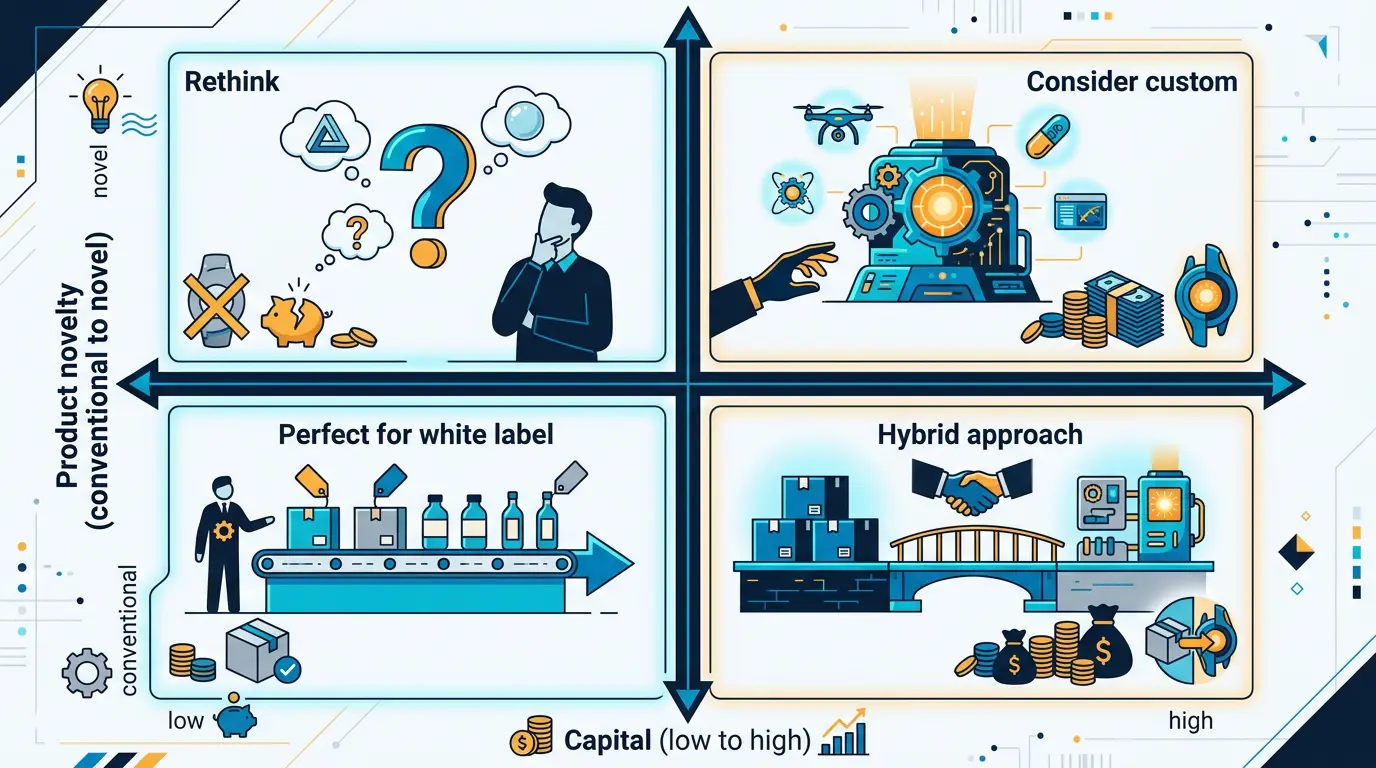
Who white label dating suits
White label suits the operator whose advantage is audience and marketing rather than technology. If you understand a specific community, or you already have traffic in a relevant vertical, or you simply want to test a niche quickly and cheaply, the model fits you well. It also suits anyone launching a network of related niche sites, because the near-zero fixed cost means each new site costs almost nothing to add.
In short, if your plan is "find an audience and serve it well," white label removes everything standing between you and that plan.
Who should avoid it
White label is the wrong choice if your business depends on owning something the platform cannot give you. If your entire pitch is a unique matching algorithm, a novel product mechanic, or a technology you intend to patent or raise venture capital against, you need to control the product, and that means building it. Match Group and Hinge did not license someone else's platform, and if you are genuinely building the next category-defining app, neither should you.
It is also the wrong choice if you are not prepared to do the marketing. White label removes the technology problem but it does not remove the acquisition problem. An operator who will not or cannot bring traffic will fail on any platform, white label included.
How the trade-offs change as you scale
The balance of pros and cons is not fixed. It shifts depending on where you are in the journey, and operators who do not see that make the wrong call.
At the very start, when you are testing whether a niche works at all, the advantages dominate completely. Speed and near-zero cost mean you can find out cheaply. The disadvantages barely matter, because you have nothing yet to differentiate and no margin to protect. At this stage white label is almost always right, and a custom build would be reckless.
In the middle, once a site is established and earning a few thousand pounds a month, the picture is balanced. The advantages are still real, but the revenue share is now a visible cost and the lack of product control can start to chafe. This is the stage where operators begin to wonder about alternatives. The honest answer for most is still to stay, because the cost and risk of moving outweigh the irritations.
At genuine scale, when an operator is running a large network or a single site doing serious six-figure monthly revenue, the calculation can change. The revenue share now represents real money, and the operator may have the resources to build or to negotiate a more owned arrangement. This is the point at which a move can make sense, and even then only if the operator has a clear plan for the member liquidity they would lose.
The lesson is to judge the trade-offs against your current stage, not against an imagined endpoint. White label being "limited" matters far less in month three than it might in year five, and most operators never reach the scale where the limits genuinely bind.
Five questions that decide it for you
Rather than weighing every pro and con, you can usually settle the decision with five honest questions.
First, do you have a unique technology bet at the centre of your plan? If yes, white label is wrong and you should build. If no, white label is in play.
Second, can you fund and wait out an eighteen-month custom build? If no, white label is effectively your only route to launching at all.
Third, is your advantage audience and marketing rather than product? If yes, white label lets you put all your effort exactly where your advantage is.
Fourth, are you comfortable operating on a , disclosed honestly to members? If you are not, the model is not for you, and that is a legitimate position.
Fifth, are you genuinely prepared to do the marketing? White label removes the technology problem but not the acquisition problem. If you will not market the site, no model will save it.
For most people who ask me about white label dating, the answers are no, no, yes, yes and yes. That combination is exactly the profile the model was built for. If your answers come out differently, the lists of pros and cons above will tell you which direction to take instead.
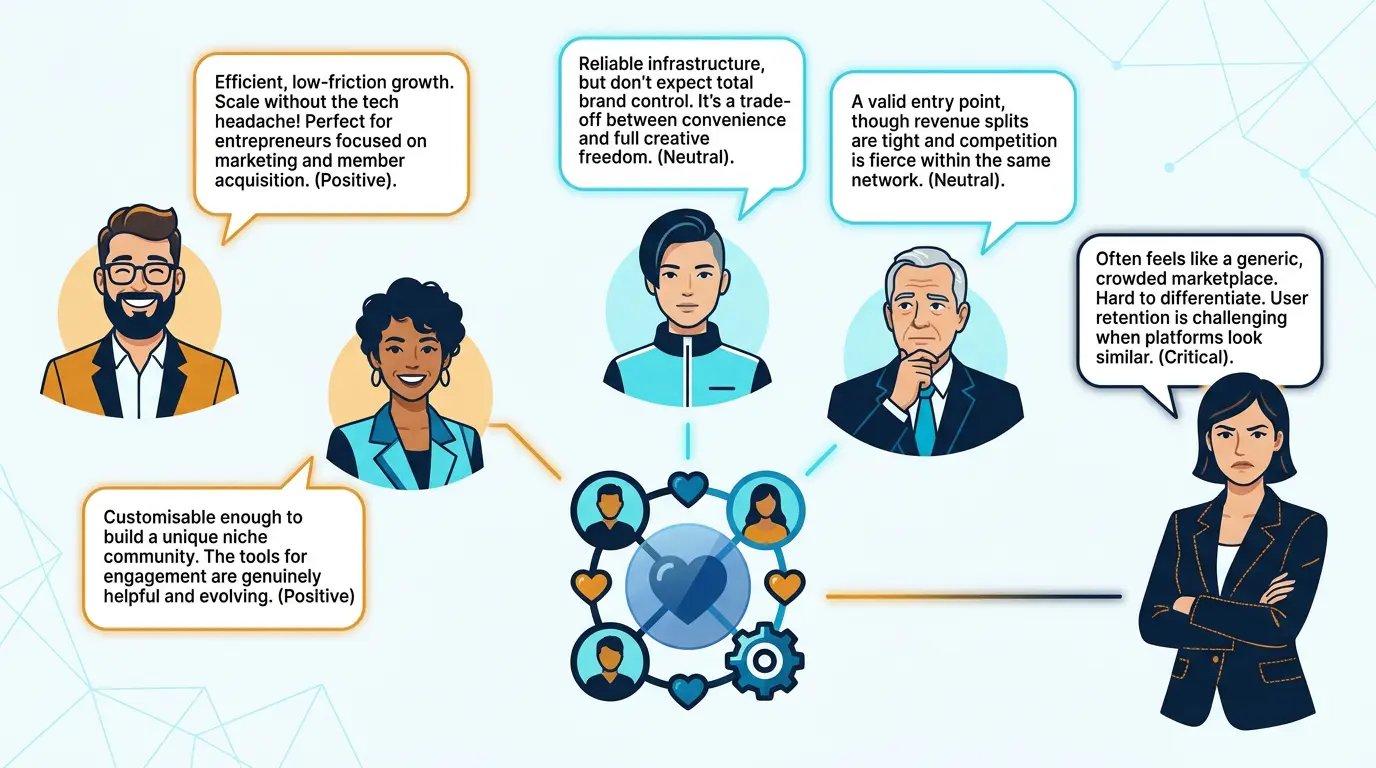
Turning the disadvantages into managed risks
A disadvantage is only a reason to avoid something if you cannot manage it. Most of the drawbacks of white label dating can be managed down to an acceptable level by an operator who is paying attention, and it is worth seeing how.
Take provider dependence, the biggest genuine concern. You cannot remove it, but you can manage it. You manage it by choosing a financially sound, transparent provider rather than the cheapest one, and by securing a contract with a clean data export right and a fair exit clause. A managed version of provider dependence is "I rely on a stable provider and I can leave with my members if I ever need to." That is a normal business risk, not a trap.
Take limited differentiation. You cannot change the core product, but you can differentiate hard on the things you do control: brand, niche, tone, content and community. Two sites on the same platform can feel completely different to members because the operator layer carries the personality. The disadvantage is real, but a strong operator narrows it considerably.
Take the revenue share. You cannot remove it, but you can make it matter less by being good at the inputs. A skilled marketer keeping 65 percent of strong revenue earns far more than a weak one keeping 100 percent of nothing. The share is a fixed percentage; the size of the number it applies to is up to you.
Take restricted data portability. You manage it by negotiating the export right before you sign, when you have leverage, rather than discovering the problem when you want to leave.
The only disadvantage you genuinely cannot manage away is the shared pool itself. If you are not comfortable operating on a shared, disclosed member database, that is a fixed feature of the model and the model is not for you. Every other drawback is a risk to be managed, and a competent operator manages them.
What I tell people who ask me directly
When someone asks me, plainly, whether they should use white label dating, I do not recite the lists above. I say something shorter.
I tell them that if they have an audience or a niche they understand, and they are willing to do the marketing, white label is almost certainly their best route, and the things they will give up, total product control and a slice of revenue, are things they were never going to use well anyway in their first business. I tell them the model has made it possible for ordinary operators, with no technical background and modest budgets, to build real dating businesses, and that this is genuinely rare and genuinely valuable.
I also tell them the two things that will actually decide whether they succeed, and neither is on the pros and cons list. The first is niche selection: pick a niche that is real, specific and reachable, and do not launch until you have validated it. The second is persistence through the slow start: the model compounds, the early months feel quiet, and most of the people who fail simply quit before the curve turned upward.
And I tell them the one circumstance in which I would steer them away: if their whole plan rests on owning unique technology. In that case the pros and cons are beside the point, because they need control white label cannot give, and they should build.
That is the honest version, stripped of the lists. White label is the right tool for most operators, it is the wrong tool for a few, and for everyone it rewards niche discipline and persistence far more than it rewards any clever reading of the trade-offs.
What to read next
For the mechanics behind these trade-offs, read how white label dating works. To compare the model against building your own, see white label vs custom dating software. For the numbers, read is white label dating profitable. And when you want to assess a provider's terms, DatingPartners.com publishes its revenue share and exit terms openly.
Honest advice from someone who sees the full picture. DatingPartners offers transparent revenue share terms and clear exit clauses — the kind of provider you want to work with.
Visit DatingPartners.com →