
SEO Fundamentals for Dating
Most people think SEO is about keyword stuffing and links. That's 2010 thinking. Modern SEO is:
- Relevance - Does your content match what users search for?
- Authority - Do other sites link to you?
- User Experience - Do visitors stay, engage, convert?
- E-E-A-T - Expertise, Experience, Authoritativeness, Trustworthiness
For dating affiliate sites:
- Relevance: Your comparison pages directly answer "which dating app?"
- Authority: Get links from dating blogs, review sites, news outlets
- User Experience: Pages load fast, compare apps clearly, users find what they want
- E-E-A-T: You've used the apps, written reviews, have credentials/experience
The good news: Dating affiliate sites can win on relevance and UX even with lower authority than competitors. Clarity beats complexity in dating content.
Keyword Research Strategy
Understanding Dating Keywords
Dating keywords fall into categories:
Informational (Learning intent):
- "How to write a dating profile"
- "First date ideas"
- "Signs someone likes you"
- Lower conversion, high volume, easy to rank
Comparative (Decision intent):
- "Best dating apps"
- "Dating apps vs dating sites"
- "Hinge vs Bumble vs Match"
- High conversion, medium volume, medium competition
Branded (Specific intent):
- "Match reviews"
- "Bumble sign up"
- "Hinge dating app"
- High conversion if ranking, owned by brand
Niche/Long-tail (Specific intent + specific audience):
- "Best dating apps for over 50"
- "Free dating apps for serious relationships"
- "Dating app for professionals"
- Very high conversion, low competition, underserved
Your Target Mix
| Keyword Type | Target Count | Monthly Searches | Difficulty | Conversion |
|---|---|---|---|---|
| Comparison | 5-8 | 500-2000 | Medium | High (8-12%) |
| Niche/Demographic | 10-15 | 100-500 | Low | Very High (12-20%) |
| Long-tail Guide | 5-10 | 50-300 | Low | Medium (5-8%) |
| Informational Support | 20-30 | 100-500 | Low | Low (2-5%) |
How to Find Keywords
Tools (free options available):
- Google Search Console (shows what you already rank for)
- Keyword Planner (Google Ads free tool)
- Ubersuggest, Ahrefs free version, Moz
- Answer the Public (shows what people ask about a topic)
Manual research:
- Google "best dating apps" and look at People Also Ask
- Search "dating for [niche]" and see suggestions
- Look at competitor sites and note their topics
- Ask friends what they'd search for in dating
High-value niche keywords to target:
| Niche | Keyword | Monthly Vol | Difficulty |
|---|---|---|---|
| Age | "dating apps for over 50" | 150 | Low |
| Location | "dating apps in [city]" | 50-200 | Low |
| Goal | "dating app for serious relationships" | 100 | Low |
| Identity | "best gay dating apps" | 300 | Low |
| Profession | "dating app for professionals" | 80 | Low |
| Lifestyle | "dating app for introverts" | 150 | Low |
| Religion | "christian dating apps" | 200 | Low |
These niche keywords are gold. Low competition, high conversion. Build your niche empire.
Content Strategy and Topics
Foundation Content (Build First)
Create these pages/posts in your first 3 months:
Comparison Pages (5-8):
- "Best Dating Apps Overall" - Compare 5-8 mainstream apps
- "Best Free Dating Apps" - Budget-conscious users
- "Best Dating Apps for Serious Relationships" - Long-term seekers
- "Best Dating Apps for Casual Dating" - Hookup-oriented
- "Best Dating Apps for Over 50" - Demographic-specific
- "Best Gay Dating Apps" - LGBTQ+ audience
- "Best Dating Apps by [City]" - Location-specific
- "Dating Sites vs Apps" - Format comparison
Each comparison page should:
- Compare 3-5 apps side by side
- Show pros/cons for each
- Have a comparison table
- Include affiliate links to each app
- 1200-1500 words minimum
Guide Posts (10-15):
- "How to Write a Dating Profile That Gets Matches"
- "Best First Date Ideas"
- "How to Take a Good Dating Profile Photo"
- "Red Flags in Online Dating"
- "How to Start a Conversation on Dating Apps"
- "Tips for Video Chatting on Dating Apps"
- "Safety Tips for Online Dating"
- "How to Know When Someone is Into You"
- "Dating App Etiquette"
- "How Long Should You Message Before Meeting?"
Each guide should:
- Solve one specific problem
- Be 800-1200 words
- Include natural affiliate recommendations
- Have clear, subheaded structure
Supporting Content (20-30):
- FAQ pages ("Is Bumble better than Tinder?")
- Resource pages ("40 Dating Conversation Starters")
- Lifestyle articles ("Dating as an Introvert")
Content Creation Workflow
Month 1:
- Create 3 comparison pages
- Create 5 guide posts
- Optimize all 8 pages
Month 2:
- Create 2 more comparison pages
- Create 5 more guide posts
- Build 5-10 internal links between pages
- Start link building
Month 3:
- Create 5 more guide posts
- Create 2-3 niche comparison pages (over 50, LGBTQ+, etc.)
- Create 5 supporting pieces
- Continue link building
Content Quality Standards
Each piece should:
- Answer the question completely - If someone searches "best dating apps over 50," they should find a complete answer on your page
- Be original - Don't copy competitors. Use your own experience.
- Have clear structure - H1 title, H2 sections, H3 subsections
- Be scannable - Use lists, tables, bold text. 50% of readers scan, not read.
- Include multimedia - Screenshots of apps, comparison tables, videos
- Have a call-to-action - "Try this app free today"
- Be updated regularly - Refresh every 6 months to stay current
Technical SEO Checklist
Technical SEO makes sure Google can crawl, index, and understand your site.
Site Speed
Dating users are impatient. Page speed matters.
- Target: Load in under 2 seconds on mobile
- Test with PageSpeed Insights (free Google tool)
- Optimize images (use WebP format, compress)
- Use caching plugin (Cloudflare, WP Super Cache)
- Consider CDN for global speed
Impact: 1-second delay in load time loses 7% conversion
Mobile Optimization
70%+ of dating searches are mobile.
- Use mobile-first design
- Test on actual phones, not just browsers
- Touch targets should be 48px minimum
- Don't use pop-ups that cover content
- Use viewport meta tag
```html <meta name="viewport" content="width=device-width, initial-scale=1.0"> ```
Crawlability
Google needs to crawl your site.
- Create XML sitemap (WordPress plugins do this automatically)
- Check robots.txt doesn't block important pages
- Ensure internal links work
- Use descriptive file names (dating-over-50.html not page123.html)
- Fix broken links (404 errors)
Structure Data (Schema)
Add schema markup to help Google understand your content.
```json { "@context": "https://schema.org", "@type": "Article", "headline": "Best Dating Apps for Over 50", "datePublished": "2026-01-15", "dateModified": "2026-04-03" } ```
Also add Product schema for comparison pages:
```json { "@type": "Product", "name": "Match", "image": "match.jpg", "description": "Best overall dating app" } ```
Impact: Rich snippets can increase CTR by 20-30%
Security (HTTPS)
Use HTTPS (SSL certificate).
- Encrypt user data
- Signal trust to Google
- Cost: Often free with hosting (Let's Encrypt)
- Impact: Ranking boost + user trust

On-Page Optimization
Title Tags
The title tag appears in search results and browser tabs.
Formula: [Primary Keyword] [Modifier] [Brand]
Examples:
- "Best Dating Apps for Over 50 - [Your Site]"
- "Free Dating Apps That Work - Complete Guide 2026"
Rules:
- 50-60 characters (shows fully in search)
- Include primary keyword first
- Make it click-worthy (users click based on title)
- One title tag per page
Meta Descriptions
The description under the title in search results.
Formula: One-sentence answer + benefit + CTA
Example: "Compare the best dating apps for serious relationships. Pros, cons, and features of 5 top platforms. Find your match today."
Rules:
- 150-160 characters
- Include keyword once
- Include a benefit or pain relief
- Create desire to click
H1 Tags
Your main page heading (not to be confused with title tag).
Rules:
- One H1 per page
- Include primary keyword
- Make it clear what page is about
- Example: "The 7 Best Dating Apps for Over 50"
H2 and H3 Tags
Subheadings that structure your content.
Best practice: ``` H1: Best Dating Apps for Over 50 H2: 1. Match H3: Pros H3: Cons H3: Who It's Best For H2: 2. eHarmony H3: Pros H3: Cons H3: Who It's Best For ```
Keyword Placement
Include your primary keyword in:
- Title tag (required)
- Meta description (once)
- H1 tag (once)
- First paragraph (naturally)
- Once in H2 or H3 (naturally)
- Naturally 2-3 more times in body
Do NOT stuff keywords. Google penalizes keyword stuffing. Write naturally.
Internal Linking
Link from your guides to your comparison pages and vice versa.
Example: In your "How to Write a Dating Profile" post, link to "Best Dating Apps for Serious Relationships."
Benefits:
- Helps Google understand site structure
- Distributes link juice
- Keeps users on site longer
- Improves rankings for linked pages
Target: 3-5 internal links per 1000-word post
Link Building for Dating Sites
Links from other sites are Google's "votes of confidence" in your site.
Types of Links
High-Value Links (pursue these):
- Dating blogs and publications
- Lifestyle and relationship blogs
- News outlets (mention your site)
- Review aggregators
- Niche authority sites (over 50 dating guides, LGBTQ+ resources, etc.)
Medium-Value Links (acceptable):
- General lifestyle directories
- Podcast guest appearances with link
- Social media shares with link
- Forum mentions with link
Low-Value Links (avoid):
- Paid link networks
- Comment spam
- Article directories
- PBN (Private Blog Networks)
- Reciprocal link schemes
Link Building Strategies
1. Create Linkable Assets
- Comprehensive guides that bloggers reference
- Original data/research
- Interactive tools (dating profile checkers, etc.)
- Infographics about dating trends
2. Blogger Outreach
- Find relevant dating or lifestyle blogs (20-30)
- Read their content, find a post related to yours
- Write genuine email:
- Compliment specific article
- Explain why your content is better/different
- Ask if they'd link to it
- Follow up once after 1 week if no response
3. Guest Posting
- Write posts for larger dating blogs
- Include link to your site in author bio
- Establish authority
- Typical approach: 1500-word guest post for 1 link
4. Mention Mining
- Find sites mentioning "best dating apps" or related terms but not linking to you
- Contact and ask them to add your link
- Usually 20% conversion rate
5. Niche Site Partnerships
- Dating sites for [demographic] (over 50 communities, LGBTQ+ organizations)
- They often have resource pages with links
- Reach out with your guide for [demographic]
6. Link Building Tools
- BrokenLinkCheck finds broken links on other sites
- Offer your content as replacement
- High conversion (50%+)
Link Building Targets
Month 1-2 Target: 5-10 backlinks Month 3-4 Target: 10-20 backlinks Month 6+ Target: 20-30 backlinks
Quality > Quantity: One link from DatingOver50.com worth more than 10 links from random directories.
User Experience Signals
Google measures how users interact with your site.
!SEO keyword research strategy for dating *Keyword research categories and difficulty levels for dating affiliate site optimization*
Click-Through Rate (CTR)
Percentage of searchers who click your result.
How to improve:
- Write compelling titles
- Write benefit-driven descriptions
- Use power words ("Complete Guide," "Updated 2026")
- Show you're latest version ("2026 Edition")
Target: 5-8% CTR for your keywords
Bounce Rate
Percentage of visitors who leave without engaging.
How to improve:
- Make it obvious what page is about (headline clarity)
- Load fast
- Use compelling opening paragraph
- Have clear navigation
- Match content to search intent
Target: Under 40% bounce rate
Dwell Time
How long visitors stay on your page.
How to improve:
- Write comprehensive, valuable content
- Use visuals and formatting
- Include interactive elements
- Make content engaging (stories, examples)
Target: Average time on page above 3 minutes
Pages Per Session
How many pages visitors view.
How to improve:
- Internal links to related posts
- Suggest "You Might Also Like" posts
- Build topic clusters (guide -> comparison -> FAQ)
Target: Average 2+ pages per session
Monitoring and Adjustments
Tools to Monitor
Google Search Console (Free):
- See which keywords you rank for
- Track clicks and impressions
- Find indexing issues
- Monitor backlinks
Google Analytics (Free):
- Track traffic sources
- Monitor user behavior
- Identify high/low performing pages
- Track conversions
Google Rank Tracker (Free):
- Track ranking position for target keywords
- Monitor progress over time
Monthly Review Process
Week 1: Analyze Search Console data
- Which keywords drove most clicks?
- Which pages need improvement?
- Are you ranking for target keywords?
Week 2: Analyze user behavior (Analytics)
- Which pages have highest conversion?
- Which pages have high bounce?
- Where are users coming from?
Week 3: Create action plan
- Optimize underperforming pages
- Build more content for high-converting topics
- Identify link building opportunities
Week 4: Execute
- Update pages based on analysis
- Create new content based on keyword gaps
- Build 2-3 new links
Adjustment Triggers
Adjust if:
- Not ranking after 6 months for any target keywords
- Solution: Improve on-page SEO, build more links, improve content quality
- High traffic but low conversion
- Solution: Improve landing page experience, change affiliate offers, improve call-to-action
- High bounce rate on page
- Solution: Improve clarity, match search intent, improve load speed
- Competitor pages ranking above you
- Solution: Create better content, build more links, improve user experience
Key Takeaways
- Niche keywords outperform competitive keywords - "Dating over 50" converts 2x better than "best dating apps" with 1/10 the competition.
- Content structure matters more than length - A well-organized 1000-word post beats a rambling 3000-word post.
- Internal linking structures your site - Don't write 50 isolated posts. Link them together into topic clusters.
- Links compound over time - 5-10 quality links in Month 1 become 30+ by Month 6-12 as your content ages and attracts more links.
- User experience signals are becoming more important - Fast loading, low bounce rate, high dwell time matter more than they did 5 years ago.
- Regular updates improve rankings - Updating a page annually keeps it competitive. Updating monthly makes it dominant.
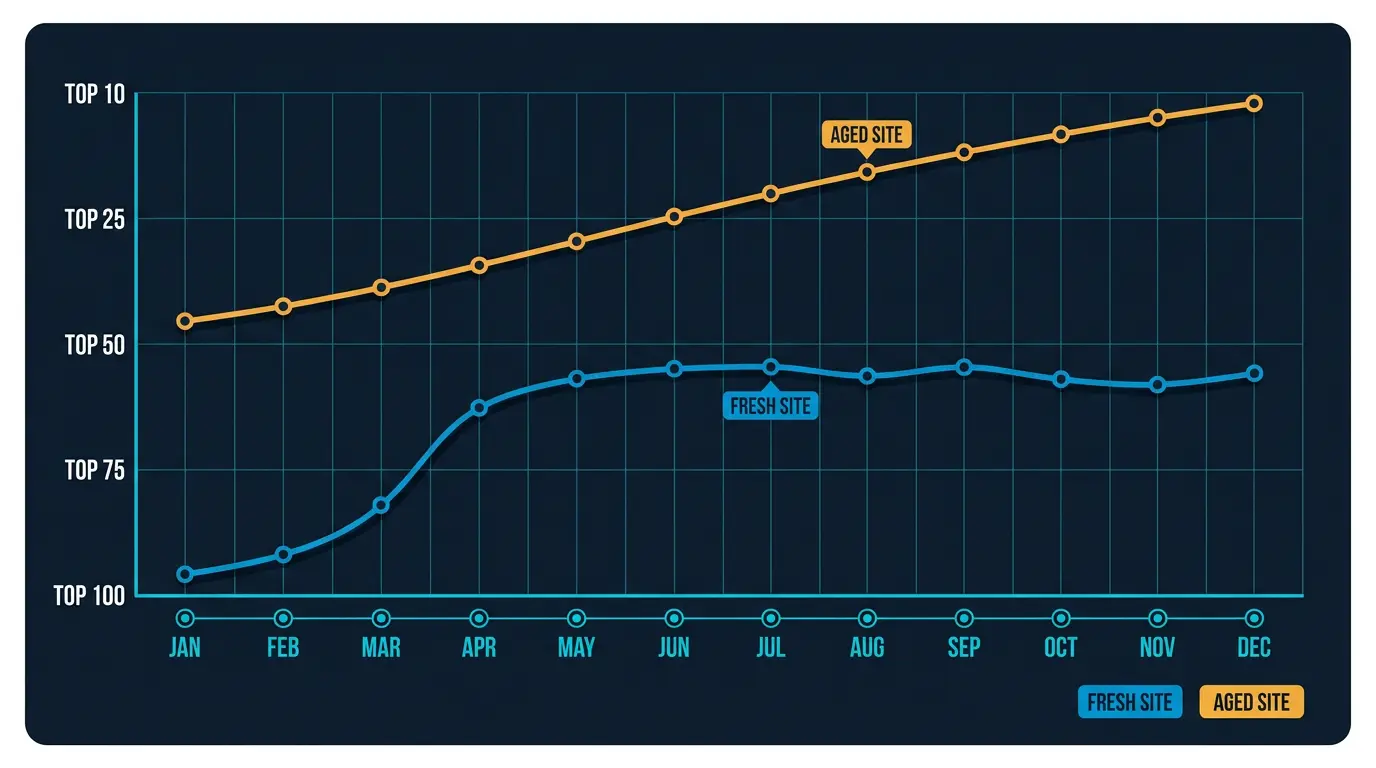
- First year is about building, not ranking - Your Month 6 site looks nothing like your Month 12 site. Expect slow growth early, compound growth later.
Next Steps
- Identify 8-10 target keywords using keyword research
- Create 8-10 initial comparison and guide posts
- Implement technical SEO checklist
- Start building 1-2 links per week
- Monitor Search Console monthly
- Create monthly content additions and optimization updates
- By Month 6, you should be ranking for at least 3-5 target keywords
For a detailed guide on building a dating comparison site from scratch, read our complete guide to Building a Dating Comparison Site That Earns.
To supplement your organic strategy, learn about additional traffic sources that work alongside SEO to accelerate your revenue while SEO builds. You should also understand which dating compliance rules govern your content so you don't get penalized after investing months in SEO effort.
Rank for dating terms with WhiteLabelDating Community (when live). Build authority with peers.
Visit DatingPartners.com →