
Revenue share is one of the most important and most misunderstood concepts in dating affiliate marketing. This guide explains how works, how it compares with the other commission models, and how to think about which to choose.
What revenue share means in dating affiliate marketing
Revenue share, almost always shortened to RevShare, is a way an affiliate is paid for the dating members they refer.
A dating affiliate is someone who promotes dating offers, a dating site, a dating app, to an audience, and earns a commission when people they send convert into members. The commission can be structured in several ways, and RevShare is one of them.
Under RevShare, the affiliate earns an ongoing percentage of the revenue that the members they referred generate. When a member the affiliate sent subscribes to the dating site and pays, the affiliate receives a share of that payment. And, crucially, this continues: as long as that member keeps paying, month after month, the affiliate keeps receiving their share. The affiliate is not paid once for the referral; they are paid continuously, in proportion to the revenue the referred member produces over their whole lifetime on the site.
It is worth noting, to avoid confusion, that the term "revenue share" appears in two related but distinct places in dating. There is the revenue share, the arrangement between a dating operator and their platform provider, where the provider takes a share of the operator's revenue. And there is this, the affiliate revenue share, the commission an affiliate earns. This guide, in the affiliate marketing pillar, is about the affiliate RevShare.
For an affiliate, the starting point is to understand RevShare as an ongoing-percentage commission: not a one-off payment for sending a member, but a continuing share of what that member pays, for as long as they pay. That ongoing nature is what makes RevShare distinctive, and it is what the rest of this guide explores.
The main commission models
To understand RevShare properly, an affiliate should see it alongside the other dating affiliate commission models, because the choice between models is one of the most important decisions an affiliate makes.
There are three main models, and a fourth that blends them.
, cost per lead, pays the affiliate for each lead they generate, a person who takes some defined initial action, such as signing up, registering, or completing a form, regardless of whether that person ever becomes a paying member. The affiliate is paid per lead delivered.
CPA, cost per acquisition, also called cost per action, pays the affiliate a one-off amount for each member they refer who completes a defined, more meaningful conversion, typically becoming a paying member or making a first payment. The affiliate is paid once, per converting member.
RevShare, revenue share, as described above, pays the affiliate an ongoing percentage of the revenue the referred member generates, for as long as that member keeps paying.
The hybrid model blends these, most commonly combining a smaller CPA-style payment up front with an ongoing RevShare, so the affiliate gets some immediate payment and some ongoing income.
These models are genuinely different deals. CPL pays for volume of leads; CPA pays a fixed amount per real conversion; RevShare pays a variable amount that depends on how much the referred members go on to spend over time. An affiliate promoting dating offers will encounter all of them, and which one an affiliate chooses, for a given offer and a given piece of traffic, materially affects what they earn.
For an affiliate, the starting point is to know all four models exist, to understand that they pay in fundamentally different ways, and to recognise that choosing between them, especially between CPA and RevShare, is a real strategic decision, which the rest of this guide helps with.
How RevShare works
It is worth walking through how RevShare actually works in practice, so an affiliate can see the mechanism clearly.
An affiliate joins a dating affiliate programme on a RevShare deal. The deal specifies the percentage: the share of referred members' revenue the affiliate will earn. The affiliate then promotes the dating offer and sends traffic to it.
When a person the affiliate referred becomes a paying member, that member starts generating revenue for the dating site. Under RevShare, the affiliate begins earning their agreed percentage of that revenue. If the member pays a monthly subscription, the affiliate earns their share of each monthly payment.
The defining feature is what happens over time. The referred member, as the retention guidance describes, may stay and keep paying for months, or in some cases years. For every one of those payments, the affiliate continues to earn their share. A single referred member who stays a long time can pay the affiliate many times over. The affiliate's earnings from that member are not fixed at the moment of referral; they accumulate for as long as the member remains a paying subscriber.
This also means the affiliate's RevShare income is connected to the quality of the members they refer and to how well the dating site retains them. A referred member who pays once and leaves earns the affiliate a little; a referred member who stays and pays for a long time earns the affiliate a great deal. The economics section returns to this.
Attribution makes the mechanism work: the dating affiliate programme tracks which members each affiliate referred, so it can credit the affiliate's share of those members' ongoing revenue. This tracking is part of what an affiliate relies on the programme to do properly, which the affiliate-network and KPI guidance address.
For an affiliate, the practical picture of RevShare is: agree a percentage, refer members, and then earn a continuing share of those members' payments for as long as they keep paying, with the total depending entirely on how much, and how long, the referred members spend.
RevShare versus CPA: the core tradeoff
The central decision in dating affiliate commission models is the choice between RevShare and CPA, and an affiliate should understand the tradeoff clearly, because it is genuine and it cuts both ways.
CPA pays a fixed amount, once, the moment a referred member converts. Its advantages are certainty and speed. The affiliate knows exactly what each conversion is worth, and they get paid promptly, not spread over time. This makes CPA easier to plan around: an affiliate can calculate, fairly precisely, what their traffic is worth and whether a campaign is profitable, because the payout per conversion is fixed and immediate.
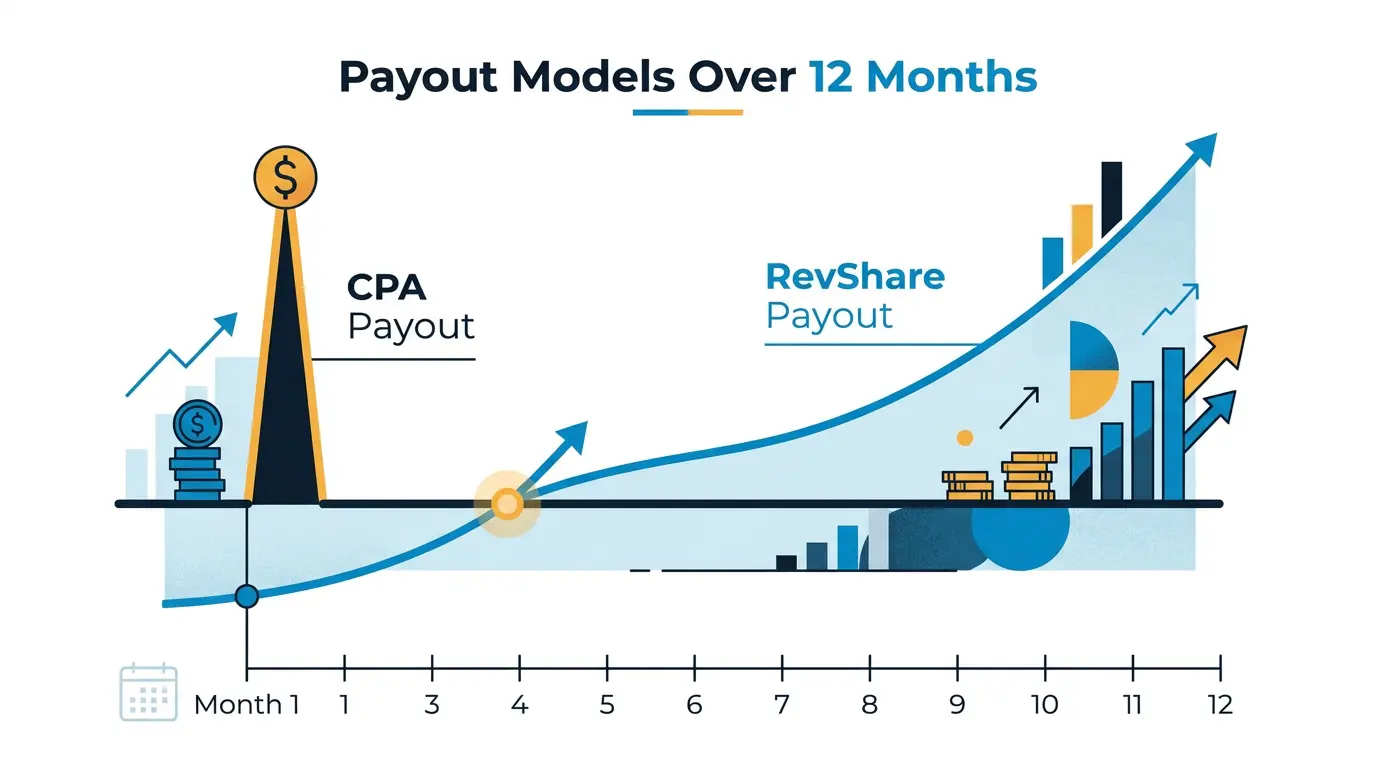
RevShare pays a variable amount, spread over time, depending on how much the referred members go on to spend. Its disadvantage is exactly the mirror of CPA's advantage: it pays less, sometimes much less, up front, and it is uncertain, because the affiliate does not know in advance how much a referred member will end up spending. But its advantage is the upside: a referred member who stays and pays for a long time can, over their lifetime, earn the affiliate far more than any single CPA payment would have. RevShare gives the affiliate the full long-term value of a good member, rather than a fixed slice of it.
So the tradeoff is, at its heart, certain-and-immediate against uncertain-but-potentially-larger. CPA is the bird in the hand: smaller, certain, now. RevShare is the bet on the future: larger if the members are good and stay, but uncertain and slow.
The honest framing is that neither is simply better. CPA suits an affiliate who needs predictable, immediate income, who wants to plan campaigns on known numbers, or who is not confident the referred members will stay long. RevShare suits an affiliate who can wait for income to build, who believes the members they refer are genuinely good and will stay, and who wants the long-term upside. The hybrid model, as noted, tries to give some of both.
For an affiliate, the core decision is this CPA-versus-RevShare tradeoff, and the right answer depends on the affiliate's own situation, which the choosing section addresses, after the next sections explain why dating in particular makes RevShare worth serious consideration.
Why dating suits RevShare
Dating is one of the categories where RevShare is most worth considering, and an affiliate should understand why, because the reasons are specific to how dating works.
The first reason is the recurring subscription model. As the pricing and monetisation guidance establish, dating is largely a subscription business. Members do not pay once; they pay recurring subscriptions, month after month. RevShare earns a share of revenue over time, and a subscription business is precisely a business that generates revenue over time. The two fit each other naturally. In a category where members paid only once, RevShare would have little to share beyond that single payment; in dating, where members pay repeatedly, RevShare has a long stream of payments to share.
The second reason is dating's retention. A dating member who finds the site valuable can stay for a long time, and the retention guidance shows that the dating model compounds through members who stay. Every month a referred member stays is another month of RevShare for the affiliate. Dating's capacity to retain paying members for extended periods is exactly what gives RevShare its long-term upside.
The third reason is member lifetime value. The combination of recurring subscriptions and genuine retention means a dating member can have a substantial lifetime value, the total they pay over their time on the site. RevShare gives the affiliate a share of that whole lifetime value, not just of the first payment. In a category with meaningful lifetime value, that share can be considerable.
The fourth reason is that dating traffic, when it is genuine and well-targeted, can produce members who genuinely stay, which is exactly the kind of member RevShare rewards. An affiliate sending genuine, well-matched traffic to a good dating offer is sending the members most likely to make RevShare pay.
For an affiliate, the lesson is that dating's structure, recurring subscriptions, real retention, meaningful lifetime value, is unusually well-suited to RevShare. It is one of the categories where the RevShare bet on the future has the most genuine upside, which is why so much dating affiliate activity uses it.
The economics of RevShare over time
To choose well, an affiliate needs to understand the economics of RevShare over time, because RevShare's whole character is that its value unfolds rather than arriving all at once.
The defining feature of RevShare economics is the slow start and the building tail. In the early period after an affiliate starts sending traffic on a RevShare deal, earnings are modest. Each referred member has only paid once or a few times, so the affiliate's share is small. Compared with CPA, which would have paid the full fixed amount immediately, RevShare in its early period looks underwhelming.
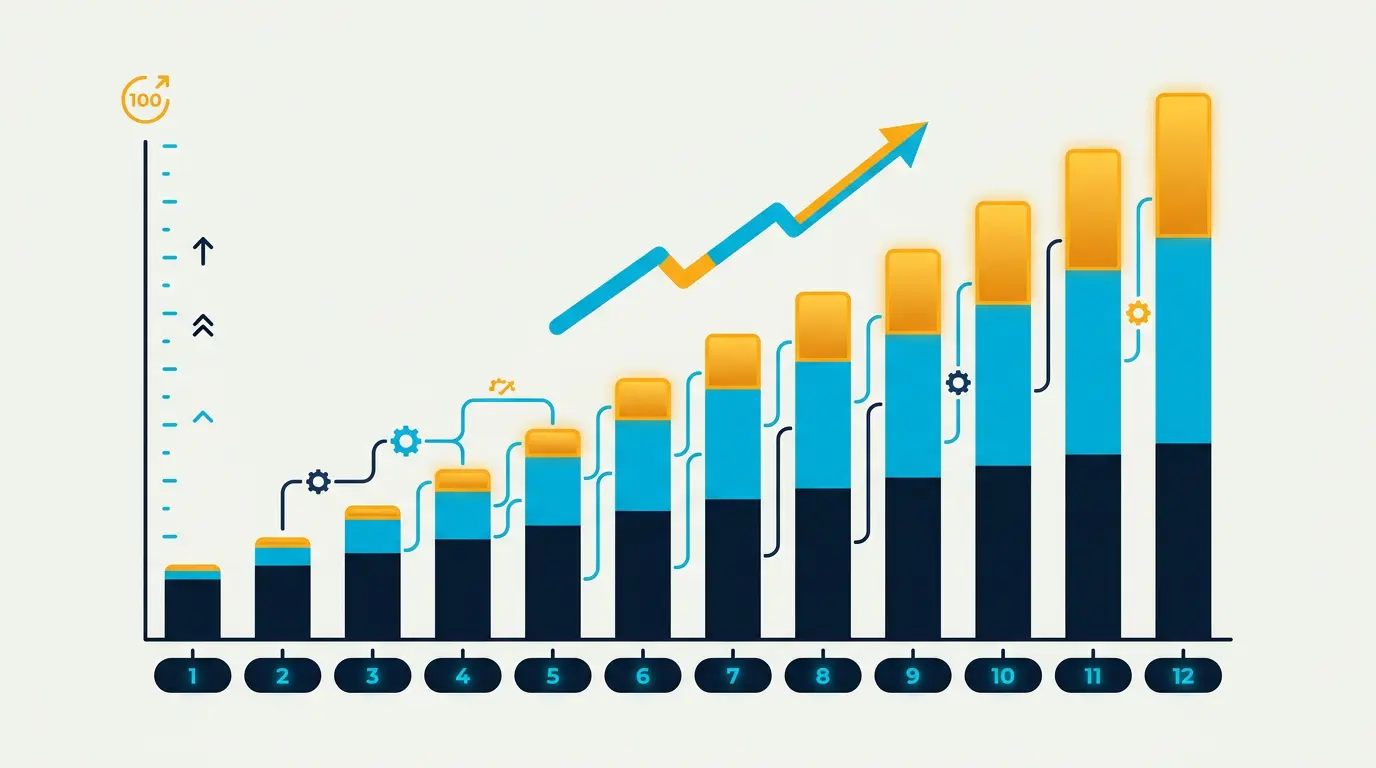
But the picture changes as time passes. The members referred in the early period, if they are good and they stay, keep paying, and the affiliate keeps earning from them. Meanwhile the affiliate continues to refer new members, who also begin to pay. So the affiliate accumulates a growing base of referred members all generating ongoing RevShare. Earnings from the existing referred base build on top of earnings from new referrals. Over time, a RevShare income that started small can grow into something substantial, because it is the sum of a continually growing stack of members all paying their share.
This is the compounding character of RevShare, and it mirrors the compounding of the dating subscription model itself that the retention guidance describes. Just as a dating site's revenue compounds through retained members, an affiliate's RevShare income compounds through a growing base of retained referred members.
The implication is about time horizon. RevShare rewards patience and punishes impatience. An affiliate who judges RevShare on its first weeks or months will see only the slow start and may conclude, wrongly, that it is inferior to CPA. An affiliate who can sustain their effort through the slow start and let the base build is the affiliate for whom RevShare's compounding economics genuinely pay off.
For an affiliate, the economic picture to internalise is: RevShare starts slow and builds, it compounds through a growing base of retained referred members, and it rewards a long time horizon. Judging it on the short term misreads it entirely.
What affects RevShare earnings
An affiliate considering or running RevShare should understand what actually drives the earnings, because RevShare income is not fixed but depends on several genuine factors.
The first factor is the RevShare percentage. The share the affiliate negotiated or was offered directly scales the earnings. A higher percentage means a larger slice of every referred member's revenue. The percentage is a key term of the deal, and the contracts and network guidance address negotiating it.
The second factor is the quality of the traffic and the members it produces. RevShare earns from members who pay and stay. Traffic that produces genuine, well-matched members who genuinely value the dating site and stay paying is traffic that makes RevShare pay. Traffic that produces members who do not convert, or who pay once and leave, earns the affiliate little under RevShare. This is the single biggest reason RevShare rewards quality over raw volume: the model pays for members who stay, so the affiliate's incentive is to send the kind of traffic that produces stayers.
The third factor is the dating offer itself and how well it retains members. RevShare ties the affiliate's earnings to the dating site's retention. A genuinely good dating site that retains members well will, all else equal, produce more RevShare for its affiliates than a weak site that loses members quickly. This means an affiliate on RevShare has a real interest in promoting genuinely good dating offers, because the offer's quality directly affects the affiliate's long-term earnings.
The fourth factor is volume and consistency over time. Because RevShare compounds through a growing base, the affiliate who consistently sends good traffic, building the referred base steadily, earns more over time than one who sends a burst and stops.
For an affiliate, the lesson is that RevShare earnings are driven by the percentage, the quality of traffic, the quality and retention of the offer, and consistent volume over time, and that, above all, RevShare rewards genuine quality, because it pays for members who genuinely stay.
Choosing a model for your situation
With the models, the tradeoff and the economics understood, an affiliate can make the real decision: which commission model to choose for their situation. The honest answer is that it depends on the affiliate, and there are clear factors.
The first factor is cash flow and time horizon. An affiliate who needs predictable income now, who cannot wait through RevShare's slow start, or who needs to recover their traffic costs quickly, is better suited to CPA, which pays promptly and predictably. An affiliate who can sustain themselves through the slow start, who can wait for the compounding to work, is positioned to take RevShare's long-term upside.
The second factor is confidence in the traffic and the offer. RevShare's upside depends on referred members staying and paying. An affiliate who is confident that their traffic is genuine and well-matched, and that the dating offer is good and retains members well, has good reason to back that confidence with RevShare and take the long-term value. An affiliate who is unsure whether their traffic will produce stayers, or unsure of the offer's quality, may prefer CPA's certainty.
The third factor is the affiliate's stage and stability. An affiliate building a business that will run for years, who can let a RevShare base accumulate, is well-placed for RevShare. An affiliate running shorter-horizon campaigns, or just starting and needing to learn what works on known numbers, may do better starting with CPA.
The fourth factor is that the choice need not be all-or-nothing. The hybrid model exists precisely to give some immediate payment and some ongoing income, and an affiliate can also run different models for different offers or different traffic. Many experienced affiliates use a mix.
For an affiliate, the guidance is to choose by reasoning honestly from their own situation: cash-flow needs, confidence in traffic and offer, time horizon and stage. CPA for certainty and immediacy; RevShare for long-term, compounding upside on genuine quality; hybrid for a balance. The dating category, as established, makes RevShare genuinely worth considering for the affiliate whose situation can support it.
Common mistakes
The defining mistake is judging RevShare on the short term, looking at its slow early period, comparing it unfavourably with CPA's immediate payout, and abandoning it before the compounding economics have had time to work.
The second is choosing RevShare without the cash flow or time horizon to sustain the slow start, and being forced to abandon it for income reasons before it pays off.
The third is treating RevShare as a volume game, sending large amounts of poorly-matched traffic, when RevShare pays for members who genuinely stay and so rewards quality over raw volume.
The fourth is ignoring the offer's quality, promoting a weak dating site on RevShare, when RevShare ties the affiliate's long-term earnings directly to how well the offer retains members. The fifth is treating the model choice as fixed and universal, rather than reasoning from the affiliate's own cash flow, confidence and horizon, and considering the hybrid model or a mix. Understand the tradeoff, match the model to your situation, and give RevShare the time horizon it needs.
What to read next
For choosing where to run these deals, read how to choose a dating affiliate network. For protecting the model, see dating affiliate fraud. For measuring performance, read dating affiliate KPIs and reporting. And to understand the dating offers behind the commissions, DatingPartners.com can walk through the platform.
DatingPartners pays lifetime 50% RevShare on mainstream dating brands. Maths favours patience.
Visit DatingPartners.com →