
A dating affiliate who does not measure properly is guessing. This guide explains the KPIs that genuinely matter, the ones to ignore, and how to use the numbers to actually improve.
What affiliate KPIs are
KPIs, key performance indicators, are the metrics an affiliate uses to measure how their dating affiliate marketing is performing.
A dating affiliate sends traffic to dating offers and earns commission when that traffic converts into members, as the revenue-share guidance describes. KPIs are the numbers that tell the affiliate how well that whole activity is working: how much traffic they are sending, how it is converting, what they are earning, and, crucially, how good the members they refer genuinely are.
Reporting is how an affiliate sees those KPIs. As the affiliate-network guidance noted, the network or advertiser provides reporting, the data and dashboards through which the affiliate sees their performance, and an affiliate may also use their own measurement on their own side, their own traffic and campaign data. Together, the affiliate's own data and the network's reporting give the affiliate the picture of how they are doing.
The point of KPIs and reporting is not measurement for its own sake. It is to let the affiliate understand their performance well enough to improve it: to see what is working and what is not, where the genuine earnings are coming from, and what to change. An affiliate who measures well can run their affiliate marketing as a genuine, improvable business. An affiliate who does not measure, or who measures the wrong things, is, as the opening capsule says, guessing.
This guide, like the dating-app-analytics guidance for operators, takes the view that the goal is not a long list of every possible metric, but a clear sense of the few KPIs that genuinely matter, why each matters, and how to act on them.
For an affiliate, the starting point is to understand KPIs as the metrics that reveal how their affiliate marketing is genuinely performing, reporting as how they see those metrics, and the purpose of both as improving the affiliate's genuine earnings.
Why measure as an affiliate
It is worth being clear about why measuring matters for an affiliate, because some affiliates run on intuition and instinct alone, and that is a mistake.
Affiliate marketing involves real choices and real costs. An affiliate chooses which offers to promote, which traffic sources to use, which audiences to target, which approaches to take, and many of these involve spending money or, at least, spending the affiliate's finite time and effort. Those choices should be informed by evidence, and the evidence is the KPIs.
Without measurement, an affiliate cannot tell what is genuinely working. They cannot tell which offers genuinely earn and which do not. They cannot tell which traffic sources produce genuine, converting members and which produce worthless traffic. They cannot tell whether a campaign is profitable, whether their costs are justified by their earnings, or which of their efforts is genuinely paying. They are, in effect, running blind, and an affiliate running blind tends to keep pouring effort and money into things that are not working while missing the things that are.
With measurement, all of that becomes visible. The affiliate can see which offers, traffic sources and approaches genuinely earn, and concentrate their effort and budget there. They can see which are not working, and stop. They can tell a profitable campaign from a loss-making one. They can improve, deliberately, on evidence.
There is also the specific affiliate-marketing reality that the affiliate's earnings depend on conversion and, on , on member quality and retention, things the affiliate cannot see without measurement. An affiliate might send a great deal of traffic and feel busy and productive, while that traffic converts poorly or produces members who do not stay, so the genuine earnings are thin. Only measurement reveals the gap between activity and genuine earning.
For an affiliate, the lesson is the same as the dating-app-analytics guidance gives operators: running on intuition alone is guessing, measurement turns guessing into informed decisions, and the affiliate who measures the right things and acts on them runs a genuine, improvable business.
The affiliate funnel
The most useful frame for affiliate KPIs, as for operator analytics, is the funnel, because it organises the metrics into a logical sequence and locates problems.
The affiliate funnel is the sequence the affiliate's activity moves through. The affiliate generates traffic, people reached by the affiliate's promotion. Some of that traffic clicks through to the dating offer. Some of those who click convert, becoming members in whatever sense the commission model pays for. And, crucially for dating and especially for RevShare, some of those converted members go on to be genuinely valuable, paying and retained members. Each stage is a step, and at each step there is fall-off.
The power of the funnel frame, as the dating-app-analytics guidance explains for operators, is that it locates problems. An affiliate whose earnings are disappointing has a vague problem. The funnel turns it into a specific one. If the affiliate is generating traffic but few click through, the problem is in the promotion or the offer's appeal at the click stage. If people click but few convert, the problem is at the conversion stage, the offer, the landing experience, the fit of the traffic. If people convert but, on RevShare, the members do not stay and earn, the problem is the quality of the traffic, it is producing members who do not last. Each diagnosis points to a different fix.
So an affiliate should read their KPIs as a funnel, not as isolated numbers. A single number, traffic, or conversions, or earnings, in isolation, means little. The same number's place in the funnel, and how it compares with the stages around it, means a great deal.
The funnel frame also makes clear why traffic volume alone is a vanity metric, as a later section explains: traffic is only the top of the funnel, and what matters is how it flows through to genuine earnings.
For an affiliate, the guidance is to think of their KPIs as an affiliate funnel, traffic, clicks, conversions, and genuine member value, and to read every metric in that context, because the funnel is what turns a vague sense of performance into a specific, fixable diagnosis.
Traffic and click metrics
The first stage of the funnel is traffic and clicks, and an affiliate should measure these, while understanding that they are the start of the story, not the end.
Traffic is the volume of people the affiliate's promotion reaches and brings toward the dating offer. The affiliate should measure their traffic, broken down by source, because knowing where traffic comes from is essential to knowing which sources are worth the affiliate's effort. Traffic volume on its own, though, is a vanity metric, as the vanity section explains: a large traffic number that does not flow through to genuine earnings is not success.
Clicks are the people who actually click through to the dating offer. The affiliate should measure clicks, and the click-through rate, the share of the traffic that clicks through. The click-through rate is a genuine performance metric: it tells the affiliate how effectively their promotion is turning reached people into people who actually go to the offer. A low click-through rate suggests the promotion or the offer's appeal is not compelling the audience to act; a healthy one suggests the affiliate is reaching the right people with the right message.
The affiliate should measure these by source and by campaign, so they can compare. Different traffic sources and different campaigns will produce different volumes and different click-through rates, and the affiliate needs to see which sources and campaigns genuinely perform.
The honest framing is that traffic and click metrics are the necessary first stage of the picture, but they are only the first stage. They tell the affiliate about the top of the funnel, how much traffic, how well it clicks through, but they say nothing yet about whether that traffic genuinely converts and genuinely earns. An affiliate who looks only at traffic and clicks is looking at the start of the story and stopping there.
For an affiliate, the guidance is to measure traffic and clicks, by source and campaign, to use the click-through rate as a genuine measure of how well promotion turns reach into action, but never to mistake traffic and click volume for genuine performance, because the real story is in the stages that follow.
Conversion metrics
The next stage is conversion, and conversion metrics are where the affiliate begins to see whether their traffic genuinely earns.
Conversion, for an affiliate, is traffic turning into the thing the commission model pays for, a lead, a converting member, depending on the model. The conversion rate is the share of clicks, or of traffic, that converts. It is one of the most important affiliate KPIs, because it is the bridge between sending traffic and earning.
The affiliate should measure the conversion rate, and measure it by source and by campaign and by offer. This is where the affiliate learns the crucial thing that traffic and click metrics cannot tell them: which of their traffic genuinely converts. Two traffic sources can deliver similar volumes and similar click-through rates, and yet one converts well and the other barely at all, because one source delivers genuine, well-matched people interested in dating and the other delivers poorly-matched traffic. The conversion rate, broken down, exposes that difference.
The affiliate should also understand conversion in the context of the funnel. A poor conversion rate, read as part of the funnel, points to a specific problem: the traffic is poorly matched to the offer, the offer itself converts badly, the landing experience is weak, or the affiliate's promotion attracted people whose interest does not survive contact with the actual offer.
The affiliate should be conscious of what counts as a conversion under their commission model and contract, as the revenue-share and contracts guidance describe, because the conversion metric should reflect the genuine, qualifying conversions the affiliate is actually paid for, not a looser count.
The conversion rate is also a key input to the earnings metrics that follow, because earnings depend on both how much traffic converts and how much each conversion is worth.
For an affiliate, the guidance is to treat the conversion rate as one of the most important KPIs, to measure it by source, campaign and offer so the affiliate can see which traffic genuinely converts, and to read a poor conversion rate, in funnel context, as a pointer to a specific problem.
Earnings metrics
The earnings metrics are where the affiliate sees what their activity actually pays, and they are, in the end, the metrics that matter most.
The most important single earnings metric for an affiliate is earnings per click, usually shortened to EPC. EPC is, broadly, the average earnings the affiliate generates per click sent to an offer. Its power is that it combines the whole funnel into one number: it reflects both how well the affiliate's clicks convert and how much each conversion is worth. A high EPC means the affiliate's clicks are genuinely valuable, converting well into worthwhile earnings; a low EPC means they are not, whether because they convert poorly or because the conversions are worth little.
EPC is especially useful for comparison. An affiliate can compare the EPC of different offers, different traffic sources and different campaigns, and EPC, because it captures genuine earnings per click, is a much better basis for that comparison than traffic volume or even conversion rate alone. The offer or source with the higher EPC is genuinely earning the affiliate more per click of effort.
Beyond EPC, the affiliate should measure their total earnings, by offer, source and campaign, so they can see, in absolute terms, where their genuine income is coming from.
The affiliate should measure earnings against their costs. Where the affiliate spends money to generate traffic, advertising in particular, the genuine measure of success is earnings set against that cost: is the campaign genuinely profitable. An affiliate who measures earnings without measuring them against cost can be busy and earning and still losing money.
And on RevShare, the affiliate should understand that earnings are not fully captured at a single moment, because, as the revenue-share guidance explains, RevShare earnings build over time. The quality and retention metrics that follow are essential to seeing the genuine, full earning picture on RevShare.
For an affiliate, the guidance is to make the earnings metrics, above all EPC, set against cost, central, because they are what genuinely measure performance, and to use EPC in particular as the best basis for comparing offers, sources and campaigns.
Quality and retention metrics
For a dating affiliate, and especially one on RevShare, there is a further set of metrics that is genuinely the most diagnostic of all: the quality and retention of the members the affiliate refers.
The conversion and earnings metrics so far largely capture what happens up to and at the point of conversion. But for dating, and decisively for RevShare, what happens after the conversion is what determines the affiliate's genuine, full earnings. As the revenue-share guidance explains, RevShare earns from members who genuinely pay and genuinely stay. A referred member who converts and then immediately leaves earns the affiliate little; a referred member who converts and stays paying for a long time earns the affiliate a great deal.
So the affiliate should, as far as their reporting allows, watch the quality and retention of the members they refer. Are the members the affiliate refers genuinely engaging and paying? Are they staying, on RevShare, and continuing to generate revenue? How do the members from one traffic source or campaign compare, in retention and ongoing value, with those from another?
This matters because it can completely change the picture that the conversion metrics alone suggest. Two campaigns might convert at similar rates, but if one produces members who stay and pay for a long time and the other produces members who pay once and leave, those two campaigns are, on RevShare, worth vastly different amounts. An affiliate looking only at conversion rate would think them equal; an affiliate watching quality and retention sees the truth.
This is also why, as the revenue-share and fraud guidance both stress, RevShare rewards quality over volume, and why the genuine-quality focus is the honest affiliate's strength. The quality and retention metrics are how the affiliate sees that genuine quality.
The affiliate's ability to see these metrics depends partly on the network's or advertiser's reporting, which is one reason the affiliate-network guidance lists reporting quality as a criterion. An affiliate should use whatever quality and retention visibility their reporting gives, and value a network or advertiser whose reporting shows it.
For an affiliate, the guidance is that the quality and retention of referred members are the most diagnostic metrics of all for dating, especially on RevShare, that they can completely change the picture conversion metrics suggest, and that an affiliate should watch them and let them, not raw conversion counts, guide where the affiliate concentrates effort.
Vanity metrics to ignore
As the dating-app-analytics guidance warns operators, some numbers look impressive and tell an affiliate little, and an affiliate should consciously discount these vanity metrics.
The classic affiliate vanity metric is raw traffic volume. A large traffic number feels like success, it looks like a lot of activity and reach, but on its own it tells the affiliate almost nothing about genuine performance. As the funnel frame makes clear, traffic is only the top of the funnel. Traffic that does not click through, convert and genuinely earn is not success, however large the number. An affiliate who judges themselves by traffic volume can feel productive while earning little.
Raw click volume is a similar, slightly lesser vanity metric: better than traffic volume because it is one stage further down the funnel, but still, on its own, not a measure of genuine earning.
Even raw conversion count can mislead, especially on RevShare, if it is read without the quality and retention metrics. A large number of conversions that produce members who do not stay is, on RevShare, worth far less than a smaller number of conversions that produce genuine, retained members. The conversion count alone, without quality, can flatter.
The test for whether an affiliate metric is vanity or real is the same as the dating-app-analytics test: does it genuinely connect to earnings and to a decision. Traffic volume connects to neither on its own. EPC, earnings against cost, and the quality and retention of referred members connect to both: they genuinely reflect performance and they genuinely inform what the affiliate should do.
For an affiliate, the guidance is to consciously discount the vanity metrics, raw traffic volume above all, and to spend their attention on the metrics that genuinely tell them whether their affiliate marketing is earning, EPC, earnings against cost, conversion rate read in funnel context, and the quality and retention of referred members.

Reading the numbers and acting
Measuring is only half the discipline; the other half, as the dating-app-analytics guidance stresses for operators, is reading the numbers honestly and acting on them.
Reading the numbers well means reading them as a funnel, as established, so that a disappointing earnings number becomes a specific diagnosis: the problem is at the traffic, click, conversion, or member-quality stage. It means breaking the numbers down, by offer, source and campaign, so the affiliate can see which specific offers, sources and campaigns genuinely perform, rather than looking only at totals that average the good and the bad together.
Reading the numbers well also means being honest about them. An affiliate, like an operator, can be tempted to look at the flattering vanity metrics and feel successful. The disciplined affiliate looks at the genuine metrics, EPC, earnings against cost, member quality, and reads them honestly, including when they show that a favoured campaign or source is not genuinely working.
Acting on the numbers means doing something in response. The affiliate should concentrate effort and budget on the offers, sources and campaigns the genuine metrics show are working, and reduce or stop the ones that are not. The affiliate should diagnose the weak stage of the funnel and address it: weak click-through means improving the promotion, weak conversion means reconsidering the offer or the traffic fit, weak member quality and retention means the traffic source is producing poor members and should be changed. And the affiliate should test changes, as the dating-app-analytics guidance advises, ideally one at a time, so they can see what genuinely improved the result.
Acting on the numbers also means patience with the timescale, especially on RevShare. As the revenue-share guidance explains, RevShare earnings build over time, and the quality and retention of referred members only become visible as those members age. An affiliate must give RevShare performance the time horizon it needs to be read genuinely, rather than judging it on its slow early weeks.
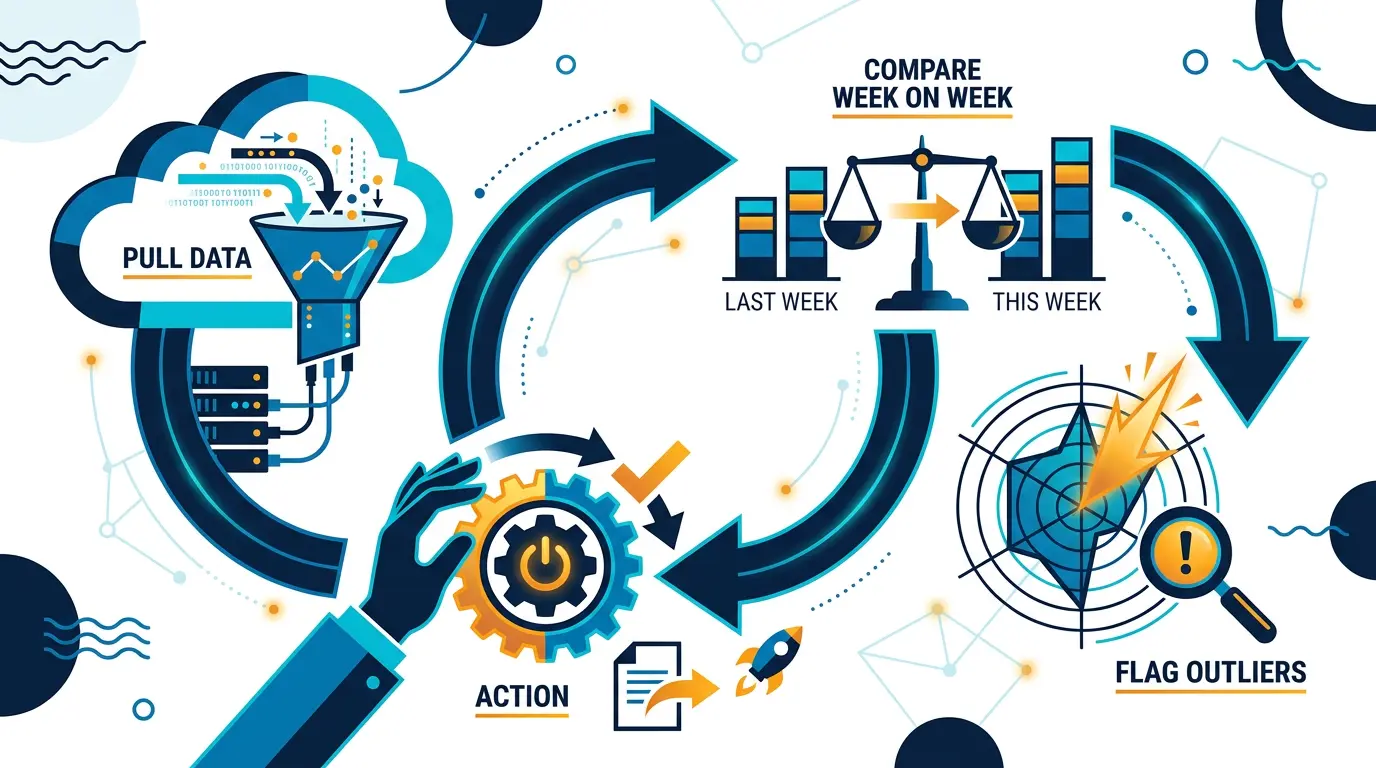
For an affiliate, the guidance is the same loop the dating-app-analytics guidance gives operators: read the numbers as a funnel, broken down and honestly, then act, concentrate on what works, fix the weak funnel stage, test changes, and be patient with the RevShare timescale. Measurement without action is just reporting.
Common mistakes
The defining mistake is judging performance by traffic volume, the classic affiliate vanity metric, feeling productive because the traffic number is large while the genuine earnings are thin.
The second is not measuring at all, running affiliate marketing on intuition, unable to tell which offers, sources and campaigns genuinely earn.
The third is reading metrics in isolation rather than as a funnel, so a disappointing result stays a vague problem instead of being located at a specific stage.
The fourth, and most dating-specific, is ignoring the quality and retention of referred members, judging by raw conversion counts when, on RevShare, a smaller number of genuine, retained members is worth far more than a large number of members who do not stay. The fifth is measuring without acting, treating KPIs as reporting rather than as the basis for concentrating effort, fixing the weak stage, and testing changes. Watch the few metrics that genuinely earn, read them as a funnel, and act.
What to read next
For the commission models the earnings metrics measure, read dating revenue share explained. For the reporting a network provides, see how to choose a dating affiliate network. For scaling once the numbers work, read scaling a dating affiliate business past 1M USD. And to understand member quality from the advertiser's side, DatingPartners.com can walk through it.
DatingPartners gives live KPI dashboards per offer. No spreadsheet nights.
Visit DatingPartners.com →