
Content Moderation Fundamentals
Content moderation is the process of reviewing and removing content that violates your platform's policies. For dating sites, this includes:
- Inappropriate or sexually explicit photos
- Harassment and threats in messages
- Spam and commercial solicitation
- Misleading profile information
- Illegal content (CSAM, trafficking)
- Scams and fraud
Moderation is not censorship. You're enforcing rules you set, not suppressing speech. Users voluntarily agree to your terms by joining.
Effective moderation requires:
- Clear policies - Users understand what's allowed
- Consistent enforcement - Rules applied fairly (see building a moderation team)
- Speed - Action within hours, not weeks
- Transparency - Users understand why content was removed (see user reporting systems)
- Appeals - Users can challenge wrong decisions
Strong moderation directly improves user trust and retention, making it essential for growth.
Dating sites face particular challenges:
- Dating content is inherently sexual (balancing safety vs. naturalness)
- Culture varies across regions (what's inappropriate in London might be normal elsewhere)
- New techniques emerge constantly (AI-generated fake photos, deepfakes)
What to Moderate (Policy Framework)
Define Your Policy
Your policies should specify what's not allowed. Be specific - vague policies lead to inconsistent enforcement.
Photos
Clearly prohibited:
- Genitalia or sexually explicit images
- Breasts/nipples (on any gender)
- Fully nude bodies
- Sexual acts or simulations
- Child sexual abuse material (CSAM) - mandatory to remove immediately
- Non-consensual intimate images
- Heavily filtered images that deceive about appearance
- Photos that aren't the member (catfishing)
Often allowed but worth considering:
- Shirtless photos (common in dating, though some platforms restrict)
- Partially clothed or suggestive but not explicit
- Swimwear photos
- Close-up face with visible tattoos or makeup
Policy decision: What's your brand? Premium luxury dating site might ban shirtless photos. Casual hookup site might allow them.
Messages
Clearly prohibited:
- Threats or violence ("I'll hurt you")
- Hate speech (slurs, ethnic/religious attacks)
- Harassment (repeated unwanted contact after rejection)
- Exploitation or trafficking ("sell your photos")
- Solicitation (commercial sex work)
- Spam (repeated identical messages to many users)
- Scam content (requests for money)
Often addressed but not removed:
- Rude or insulting messages (depends on severity)
- Sexual propositions (natural on dating site, but some users find uncomfortable)
- Pickup lines (annoying but harmless)
Policy decision: How sexually permissive is your site? Hookup apps allow explicit propositions. Relationship-focused apps might have stricter rules.
Profile Information
Clearly problematic:
- Fake information (false age, false location)
- Misleading photos (photoshopped, very old pictures)
- Catfishing (using someone else's photos)
- Illegal services (sex work solicitation)
- Unlicensed professional services ("dating coaching")
Acceptable:
- Exaggeration ("athletic" when slightly overweight)
- Optimistic photos (professional photos, good lighting)
- Old photos (as long as recent photos are also included)
Photo Moderation Systems
Automated Photo Screening
Modern AI can detect:
- Nudity and explicit content
- Weapons, hate symbols
- Faces (to verify it's a real person)
- Quality issues (blurry, heavily filtered)
- Copycat detection (same photo across multiple accounts)
Tools available:
- Amazon Rekognition (AWS)
- Microsoft Content Moderator
- Clarifai
- Custom ML models trained on dating content
Accuracy: 95%+ for explicit nudity, lower for edge cases (suggestive but not explicit)
Photo Moderation Workflow
Step 1: Automated scan Photos are scanned on upload. Explicit content is automatically rejected or flagged.
Step 2: Edge cases to human review Photos that are borderline (suggestive but not explicit) go to human reviewers.
Step 3: Human decision Reviewers make final call within 4-24 hours.
Step 4: Appeal User can appeal decision, goes back to review.
Implementation Strategy
Most platforms use this flow:
``` Upload photo ↓ Automated AI scan ↓ Explicit? → Reject (auto-remove) [95% catch rate] ↓ Borderline? → Send to human review [5% of uploads] ↓ Human decision (approve/reject) ↓ User notification + appeal option ```
Handling Appeals
Users appeal when their photo is rejected. Common scenarios:
- Artistic nudity (statue, painting background)
- Medical context (post-surgery scar)
- Swimwear rejection (considered too revealing)
- Misidentification (photo of a group)
Appeals should go to different reviewer if possible. Give users benefit of doubt on appeals - bad reviews damage trust.
Copycat Photo Detection
Use reverse image search (Google Images API, TinEye) to detect:
- Photos stolen from Instagram or other dating sites
- Catfishing (same photo across multiple accounts)
- AI-generated faces posing as real people
Flag accounts with stolen photos for manual review or removal.
Text Moderation Strategies
Message Screening
Different challenges than photos:
- Context matters (ambiguous content)
- Language varies by region
- Requires understanding intent
Automated message screening flags:
- Explicit threats ("I'll kill you")
- Hate speech (slurs detected via keyword list)
- Spam (repeated identical messages)
- Scam language (money requests, investment offers)
- Sexual solicitation keywords
- Platform circumvention (sharing contact info to move off-platform)
Accuracy: 85-90% for clear violations, lower for context-dependent content
Keyword and Pattern Matching
Build keyword lists for different violation types:
Threats:
- "I'll kill", "I'll hurt", "I'm going to [violence]"
- More context-sensitive
Hate speech:
- Racial slurs (maintain list updated)
- Religious attacks
- Homophobic/transphobic slurs
- More straightforward keyword matching
Spam:
- Repeated exact same message (easy detection)
- Links to external sites (especially commercial)
- CTA (call-to-action) repeated patterns
Scam language:
- "You won", "Claim your prize"
- "Investment opportunity", "Click here"
- Request for card details, wire transfers, gift cards
Context Analysis
Some platforms use NLP (Natural Language Processing) to understand context:
- Sarcasm (threat said sarcastically is less concerning)
- Romantic language (explicit content in flirtation context)
- Intent analysis (difference between "want to have sex" vs. "sex work solicitation")
But context analysis is developing and imperfect. Use with caution.
Automated Tools and Services
Popular Platforms
Crisp Thinking Specializes in online safety, particularly harassment and threats. Good for identifying toxic patterns.
!Photo moderation workflow from upload through AI screening to human review and appeals *Photo moderation workflow from upload through AI screening to human review and appeals*
Two Hat Security Focuses on preventing exploitation and grooming patterns, particularly child safety.
Microsoft Content Moderator General content moderation service covering images, text, and video.
Amazon Rekognition Photo and video analysis service with explicit content detection.
Google Cloud Vision Similar to Rekognition, good for photo analysis and explicit content.
Custom ML Models Build your own using historical moderation data. Best long-term, requires significant data and expertise.
Choosing a Tool
Decision matrix:
| Factor | Priority | Consideration |
|---|---|---|
| Accuracy on dating content | High | Generic tools may not understand dating context |
| Speed | High | Real-time decisions for user experience |
| Cost | Medium | Ranges from 0.01-0.10 GBP per item |
| Scalability | High | Can handle peak traffic? |
| Language support | Medium | Supporting multiple languages? |
| Integration | Medium | Easy to integrate with your backend? |
Most dating platforms use combination: automated tool (AWS, Microsoft) plus specialized tool (Two Hat for safety patterns) plus in-house review.
Human Review Workflows
Automation isn't perfect. Humans handle edge cases and appeals.
When to Use Human Review
Automated tools should handle:
- Clearly explicit content (nudity, violence)
- Spam and commercial solicitation
- Simple threats
Humans should handle:
- Borderline photos (artistic nudity, swimwear)
- Context-dependent messages (sarcasm, culture-specific)
- Appeals from users
- Sophisticated scams (harder for AI to detect)
Moderator Roles
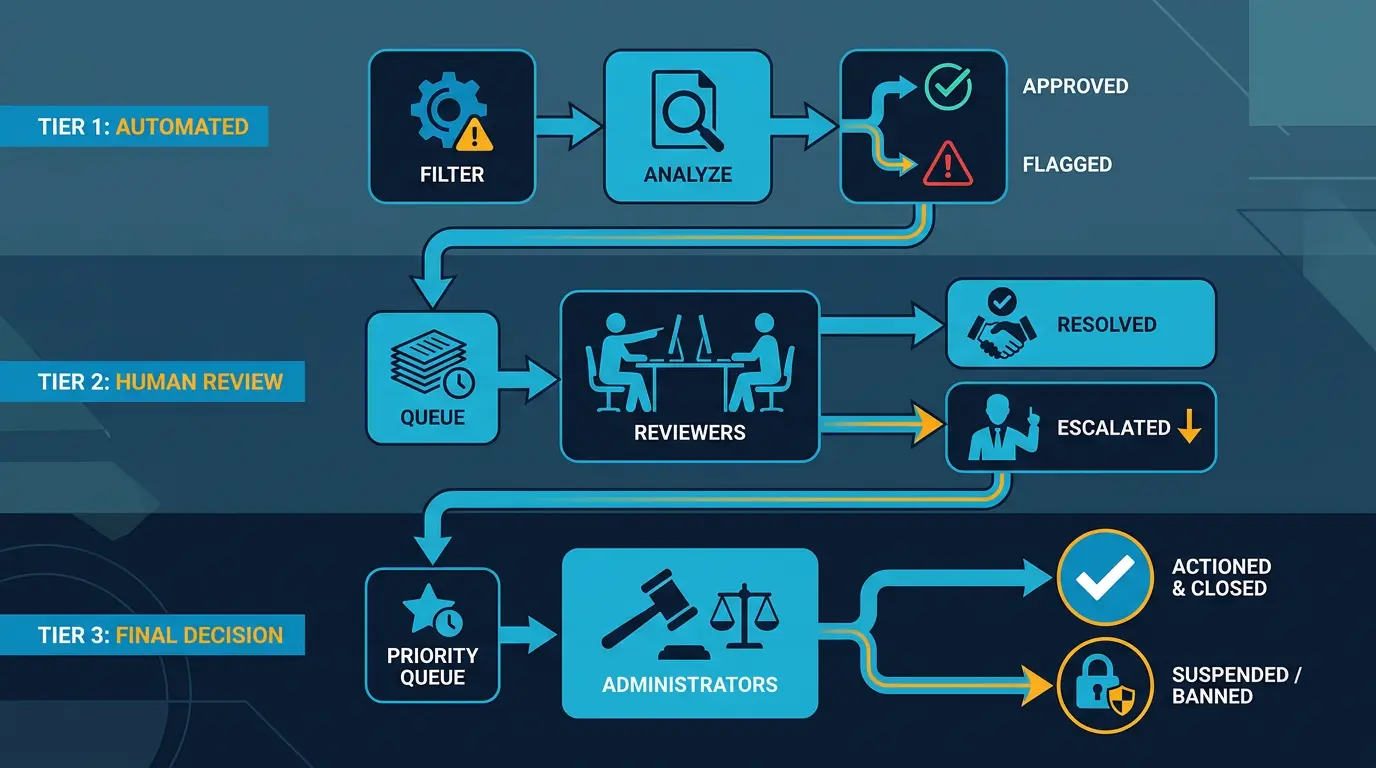
Tier 1: Reviewers (Entry-level)
- Review flagged content
- Apply policy decisions
- Respond with decisions
- Volume: 500-1000 items per day
Tier 2: Senior Reviewers (Specialists)
- Handle appeals and edge cases
- Train new reviewers
- Suggest policy improvements
- Volume: 100-200 items per day
Tier 3: Leads (Managers)
- Oversee teams
- Handle escalations
- Policy decisions
- Strategic improvements
Moderation Queues
Organize work by priority:
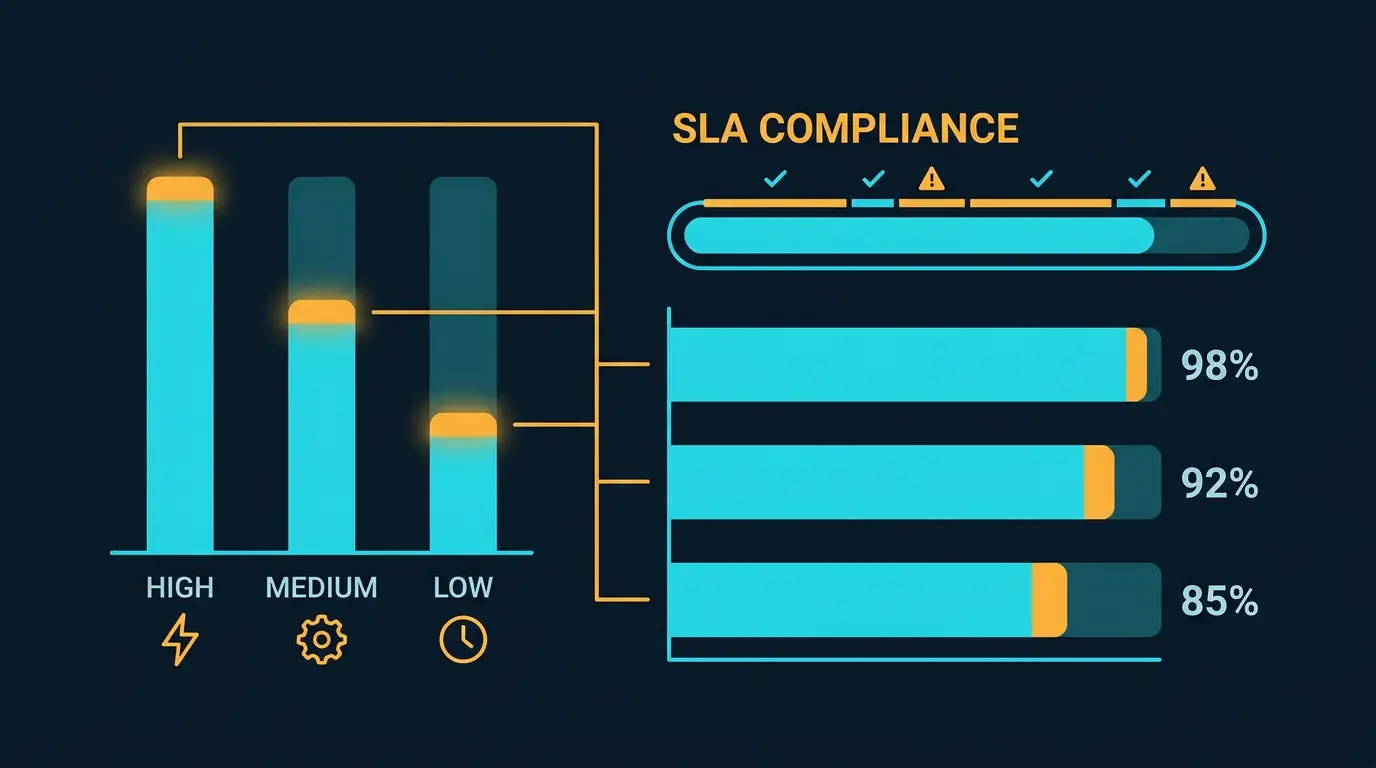
- Urgent (1-hour SLA) - Illegal content, threats, violence
- High (4-hour SLA) - Explicit content, serious harassment
- Medium (24-hour SLA) - Borderline photos, spam
- Low (72-hour SLA) - Appeals, policy clarifications
Escalation and Appeals
Users should be able to appeal removals.
Appeal Process
- User initiates appeal - Click "Appeal decision" in notification
- Upload explanation - User explains context (e.g., "That's a statue in background of my photo")
- Send to different reviewer - Goes to tier 2 reviewer, preferably different person
- Decision within 48 hours - Uphold original decision or reverse it
- Communicate result - "Your appeal was approved. Photo restored."
Appeal Outcomes
Uphold decision: User's content violated policy. Keep it removed.
- Explain why briefly
- Offer guidance on acceptable content
- Don't allow re-appeal for same content
Reverse decision: Moderator made error. Restore content.
- Apologize for error
- Restore immediately
- Note for training (what should we have caught)
Escalation Path
If user is repeatedly appealing:
- First appeal: reviewed thoroughly
- Second appeal of same content: escalate to lead
- Third appeal: final decision, usually upheld
- Multiple appeals across content: consider if user is testing boundaries or genuinely confused
Moderator Training and Wellbeing
Training Program
Onboarding (Week 1-2):
- Policy training (what's allowed/not)
- Tool training (use of moderation platform)
- Decision scenarios (practice with examples)
- Shadowing (watch experienced moderators)
Ongoing:
- Monthly policy updates
- Weekly scenarios training
- Quarterly calibration sessions (all moderators review same content, discuss decisions)
- Annual mental health check-ins
Common Training Topics
Dating context understanding:
- What's normal for dating site vs. what crosses line
- Cultural differences in flirtation
- Distinguishing confidence from arrogance
- Understanding consent language
Policy interpretation:
- When is nudity allowed (artistic) vs. prohibited
- Threat assessment (serious vs. joking)
- Harassment patterns (single vs. repeated)
- Scam detection language
Difficult decisions:
- Age verification challenges (profile appears to be minor, need to investigate)
- Marginalized users (balancing protection with avoiding over-censorship of LGBTQ+ content)
- Abusive relationships (identifying patterns of control)
Moderator Wellbeing
Content moderation is emotionally taxing. Many moderators see:
- Explicit and violent content
- Harassment and threats
- Scams targeting vulnerable people
- Sexual exploitation
Protect your team:
- Limit daily exposure to worst content (rotate roles)
- Provide mental health support
- Offer counseling/therapy
- Regular breaks and rotation
- Clear escalation for trauma-inducing content
- Debriefs after particularly difficult cases
Metrics and Improvement
Key Metrics
| Metric | Target | Notes |
|---|---|---|
| Appeal rate | <5% | If >5%, consider if moderation is too strict |
| Overturn rate on appeal | <10% | If >10%, moderators need training |
| Average moderation time | <12 hours | Faster is better for user experience |
| False positive rate | <2% | Accuracy matters - users lose trust if wrongly moderated |
| User satisfaction with moderation | >85% | Survey users on fairness |
Measuring Accuracy
Regularly audit moderator decisions:
- Pull random sample of 100 moderation decisions per reviewer
- Have lead reviewer check decisions
- Identify patterns (too harsh, too lenient, inconsistent)
- Provide feedback
Improvement Cycle
- Audit: Pull random sample of decisions, check accuracy
- Identify issues: What types of content are being moderated incorrectly?
- Root cause: Is it policy clarity, training, or tool limitation?
- Action: Update policy, retrain team, or adjust tools
- Monitor: Track improvement in next audit cycle
Key Takeaways
- Content moderation requires layered approach: automated scanning, human review, and clear policies.
!Moderation team structure showing tier 1 reviewers, specialists, and escalation to team leads *Moderation team structure showing tier 1 reviewers, specialists, and escalation to team leads*
- Define clear policies on photos (nudity, filters, fakeness), messages (threats, harassment, spam), and profiles (false info).
- Automated tools catch 95%+ of explicit content and obvious violations. Use for volume. Humans handle edge cases and appeals.
- Popular tools: AWS Rekognition, Microsoft Content Moderator, Two Hat Security. Most platforms combine multiple tools.
- Human reviewers should handle appeals, context-dependent decisions, and sophistication violations like advanced scams.
- Moderation SLA: 1 hour for illegal/threats, 4 hours for serious violations, 24 hours for routine decisions.
- Appeals process is critical - users should be able to challenge decisions. Use different reviewer for appeals.
- Moderator wellbeing matters - content moderation is emotionally difficult. Provide support and rotation.
- Track metrics: appeal rate, overturn rate, moderation time, false positive rate, user satisfaction.
- Continuous improvement through regular audits and retraining based on findings.
Cross-Links
- Fake Profiles and Bots: How to Detect and Remove Them
- How to Prevent Romance Scams on Your Dating Platform
- Online Safety Act: What Dating Site Owners Need to Know
DatingPartners delivers moderation workflow, logs, appeals and reporting. End to end.
Visit DatingPartners.com →