
Types of Video Features
Not all video features are created equal. Some are worth the cost. Others waste engineering time.
One-on-One Video Calling - Live 1:1 video between matched users. Think Facetime for dating. This is what most platforms mean by "video dating."
Cost: High (infrastructure, moderation). ROI: Medium to high if monetized.
Video Profiles - Users record a short video (30-60 seconds) as part of their profile. Others watch them asynchronously.
Cost: High (storage, encoding, streaming). ROI: Low to medium (rarely watched, doesn't move engagement).
Speed Dating Events - Live group video events with 20-50 users. Timed rotation through 1:1 video chats. Like speed dating in person.
Cost: High (infrastructure, moderation, programming). ROI: High for engagement and monetization.
Live Group Chat - Users broadcast to multiple viewers simultaneously. Like Instagram Live but for dating.
Cost: Medium (streaming infrastructure). ROI: Low (messy moderation, hard to convert to matches).
Video Booth or Dating Show - Recorded video of users doing challenges or answering prompts. Built for entertainment.
Cost: Medium to high. ROI: Very low (entertainment, not dating).
Most platforms should focus on one-on-one video calling if they do video at all. It's the most monetizable and least complicated.
Video Calling Infrastructure
Building video calling at scale is non-trivial. You can't DIY with Zoom.
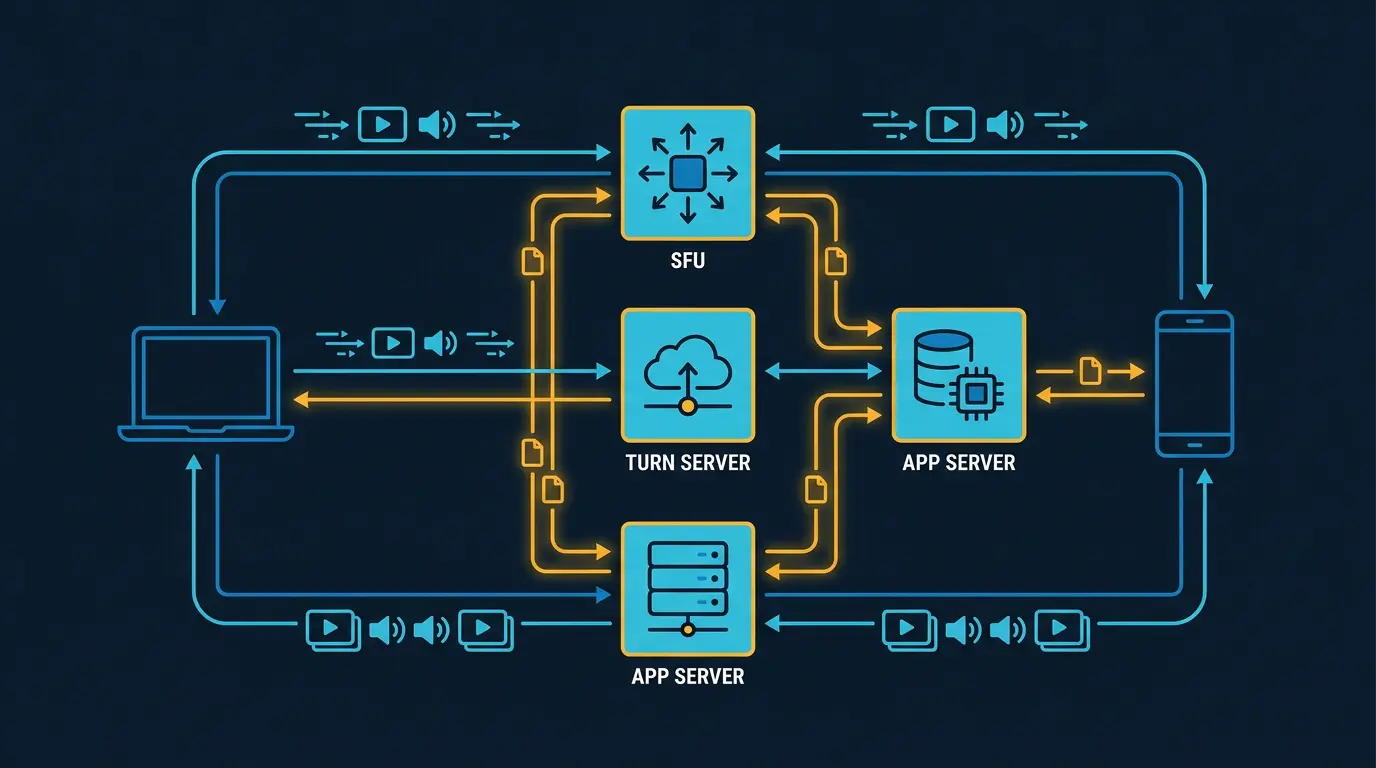
How Video Calling Works - Two users are matched. They tap "Start Video Call." Your backend:
- Verifies they're both online
- Connects them to a video server
- Encrypts the stream
- Records the call (for moderation if needed)
- Charges them (if applicable)
- Logs the call for analytics
Video servers handle the heavy lifting. Your options:
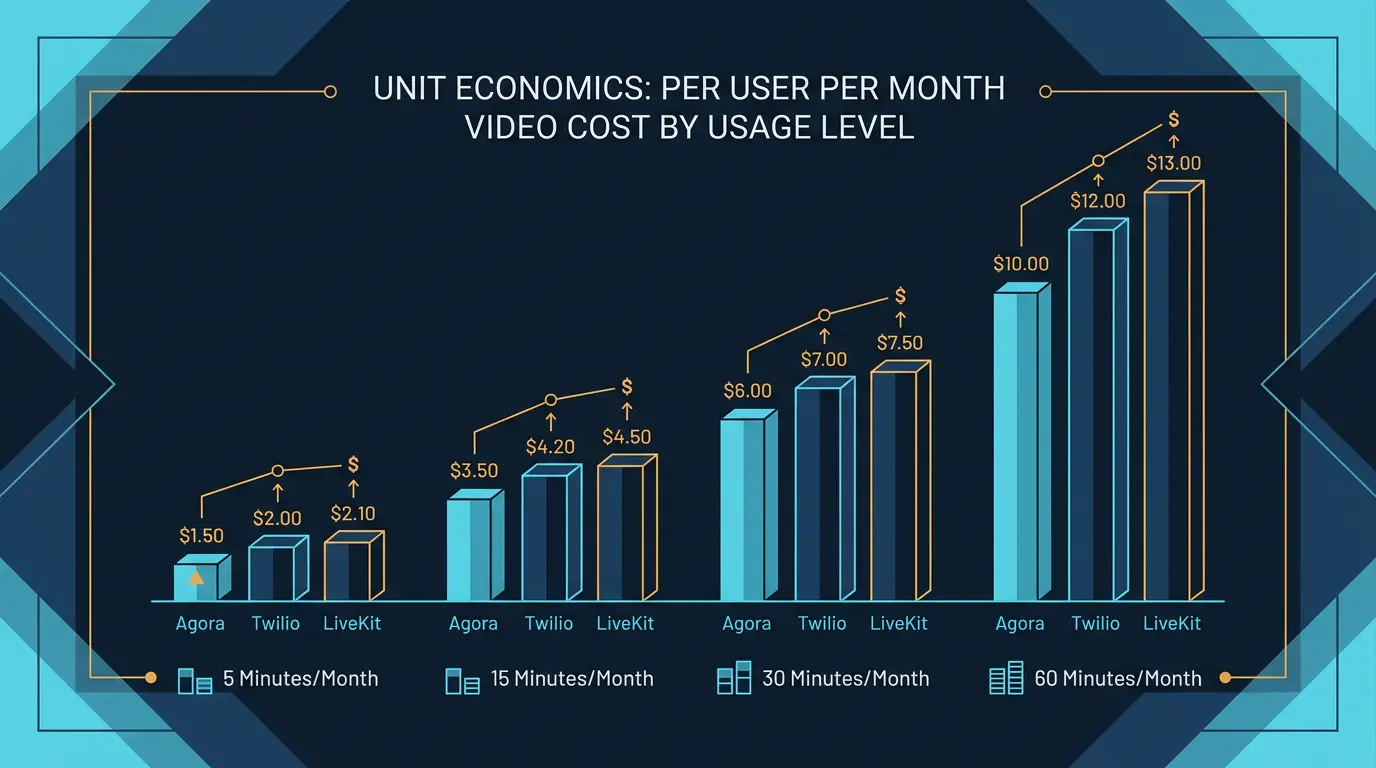
Twilio Video - Managed service. You don't manage infrastructure.
- Cost: $0.01 per participant-minute (so a 5-minute 1:1 call costs $0.10)
- Reliability: 99.9% uptime
- Latency: 100-200ms (noticeable but acceptable)
- Setup: 2-4 weeks
- Scales to millions of calls
Pros: zero infrastructure overhead, automatic scaling. Cons: expensive at scale, limited customization.
Jitsi Meet - Open source video server.
- Cost: free software, but you host it
- Infrastructure: need dedicated servers ($500-5k monthly for 10k concurrent calls)
- Latency: 50-100ms (better than Twilio)
- Setup: 4-8 weeks (requires DevOps)
- Scales to thousands of concurrent calls (limited)
Pros: full control, cheaper at huge scale. Cons: requires infrastructure expertise, updates and patching are your responsibility.
Agora - Video platform for apps.
- Cost: $0.0099 per 1000 participant-minutes (cheaper than Twilio)
- Reliability: 99.9%
- Latency: 100-150ms
- Setup: 2-3 weeks
- Scales to millions
Similar to Twilio but slightly cheaper. Newer, less battle-tested.
WebRTC (DIY) - Build video using open standards (WebRTC).
- Cost: infrastructure ($5-20k monthly)
- Complexity: very high (4-6 months build time)
- Latency: 50-100ms (best possible)
- Scale: limited by your infrastructure
Only do this if you have extreme scale (10M+ users) or very specific needs.
Comparison
| Provider | Cost per Call | Uptime | Latency | Setup Time | Best For |
|---|---|---|---|---|---|
| Twilio Video | $0.10 (5min 1:1) | 99.9% | 100-200ms | 2-4 weeks | Most platforms |
| Agora | $0.05 (5min 1:1) | 99.9% | 100-150ms | 2-3 weeks | Cost-sensitive |
| Jitsi | $0.001 (self-hosted) | 99% | 50-100ms | 4-8 weeks | High-volume, technical |
| WebRTC DIY | $0.01+ (varies) | 95-99% | 50-100ms | 4-6 months | Massive scale only |
For most platforms, Twilio Video is the pragmatic choice. Proven, reliable, minimal setup.
Video Profiles
Some platforms let users record a 30-60 second video as part of their profile. Like TikTok but for dating.
Why Platforms Add It - Marketing reason: "See their personality in motion." Real reason: differentiation from competitors.
Reality - Most video profiles are watched by 2-5% of users who view a profile. Click-through rates are 10-15% lower compared to text-based profiles.
Why? Users find videos awkward. A video shows mannerisms, voice, and self-consciousness that text hides. It's more revealing, which makes users uncomfortable.
Cost - Hosting video is expensive:
- Encoding (converting uploaded videos to multiple resolutions): $0.01-0.05 per video
- Storage: $0.023 per GB per month (at scale)
- Streaming: $0.02-0.10 per GB delivered
For 100k users with 10% uploading a video (10k videos at 50MB each = 500GB stored):
- Encoding: $100-500
- Monthly storage: $11.50
- Monthly streaming (10k users watching, 50 videos each, 50MB = 25TB): $500-1000
Annual: $7-15k. For a feature 95% of users ignore.
When It Works - Niches where video adds real value:
- Musicians/performers (shows talent)
- Fitness coaches (shows physique in motion)
- Language learners (shows accent, fluency)
For general dating, skip it. The ROI is poor.
Speed Dating and Group Video Events
This is trending. Speed dating events (rotated 1:1 video calls with 50 users) create urgency and drive engagement.
How It Works - Platform hosts "event" at 8pm Thursday. 50 users register. They enter a video room. System randomly pairs them for 3 minutes of video chat. Bell rings. System pairs them with a different person. Repeat 10-15 times.
After the event, users see a list of people they chatted with and can send messages.
Engagement Results - Events drive 3-5x higher engagement compared to normal browsing. Users feel social pressure (others are watching), urgency (only 3 minutes), and discovery (meeting new people rapidly).
Retention impact: small (most users return once, not consistently).
Monetization: you can charge $10-20 entry fee per event.
Cost - Hosting one 50-person event for 15 minutes uses:
- Video infrastructure: 50 participants * 15 minutes * $0.01 per participant-minute = $7.50
- Moderation: 1-2 people monitoring, $50-100 labor
- Engineering (scheduling, matching logic): amortized cost
Cost per event: $100-200 if you're efficient.
At 50 users paying $15 entry: $750 revenue. ROI: 3-7x.
Scaling to weekly events with 100 participants each = $800-1600 cost, $1500 revenue. Breakeven to modest profit.
Moderation Complexity - Live group video requires active moderation. Users can be inappropriate, harass each other, or show nudity. You need 1-2 people monitoring in real time.
No moderation and someone flashes the group: liability and user trust destroyed.
Implementation - Twilio Video + custom matching logic. 4-6 weeks to launch. $20-30k engineering cost.
Most providers don't include this. You'd build it custom or partner with event platforms (Eventbrite integration, Zoom integration).
Cost-Benefit Analysis
When should you add video to your dating platform?
Scenario 1: Bootstrapped or Early Stage (under 10k users) - Skip video. It's expensive and won't drive adoption. Focus on core features (browsing, messaging, monetization).
Timeline: Add after product-market fit and 50k+ users.
Scenario 2: Growth Stage (10-100k users) - Consider video calling if:
- You have $500k+ annual revenue (can afford $50-100k feature cost)
- You see messaging engagement declining (video might re-engage users)
- You have niche positioning where video matters (rural dating, professional matching)
Start with 1:1 video calling. Skip video profiles and events initially.
Timeline: 4-6 week launch. Cost: $20-40k engineering, $10-20k infrastructure annually.
Scenario 3: Scale Stage (100k+ users) - Video is fully justified:
- Video calling monetization alone ($0.50-2 per call) generates $10-50k monthly
- Events drive engagement spikes
- Video becomes a retention feature
Timeline: Add multiple video features. Cost: $100-200k annually.
Financial Model Example: 100k Users
Scenario: Add video calling with 10% adoption (10k users calling monthly), average 3 calls per user per month = 30k calls.
- 5-minute average calls: 150k participant-minutes
- Twilio cost: 150k * $0.01 = $1,500 monthly = $18k annually
- Engineering (support, feature development): $20-30k annually
- Moderation (occasional reports): $5-10k annually
Total cost: $43-58k annually.
Revenue (if charged):
- 20% of callers pay ($0.99 per call): 6k calls * $0.99 = $6k monthly = $72k annually
- Premium subscription (+$5/month for unlimited calls): 1k users * $5 = $5k monthly = $60k annually
Total revenue: $132k annually.
Net: $74-89k profit.
At higher adoption (30% of users, more calls), profit doubles.
Moderation and Safety Challenges
Live video is harder to moderate than text messaging.
!Video dating features cost ROI and usage analysis *Video dating features cost ROI and usage analysis*
Content Issues - Users can show nudity, weapons, or engage in illegal activity. You need to:
- Record calls (with user consent) for moderation
- Flag inappropriate calls automatically (AI video analysis)
- Ban users who violate policies
- Respond to reports within hours
Recording requires informed consent (legal requirement). Users can opt out of recording, but then you can't moderate.
AI Video Analysis - Detects nudity, weapons in video streams. Services like AWS Rekognition can do this in real time.
Cost: $0.10-0.30 per minute of video recorded. At 30k calls (150k minutes monthly), that's $15-45k monthly. Expensive.
Most platforms do reactive moderation (wait for reports) rather than proactive (scan all videos).
Harassment - Users can be harassed during video calls. You need:
- Quick blocking mechanisms (tap to block mid-call)
- Easy reporting (report button during call)
- Swift action (banned user within hours)
Text-based harassment is easy to log. Video harassment requires manual review (watching the call).
Safety Best Practices -
- Always record with consent
- Auto-moderate obvious violations (nudity)
- Manual review of reports
- Swift banning of violators
- Educate users on safety (don't share personal info, know who you're calling)
User Adoption and Engagement
Video features aren't automatically adopted. You need to position them correctly.
Adoption Rates - For platforms that add video calling:
- 5-15% of users try it once
- 2-5% use it regularly (weekly)
- 10-20% never use it
For speed dating events:
- 10-25% register once
- 5-10% attend (event day flaking is common)
- 2-5% become regular attendees
These are lower than messaging (40%+ regular adoption) or browsing (80%+ adoption).
Friction Points - Why don't users adopt video?
- Lighting and appearance anxiety (users worry how they look)
- Latency and technical issues (poor WiFi, audio glitches)
- Stranger discomfort (seeing a stranger's face is more personal)
- No clear value (text messaging works fine)
Adoption Strategy - Start with optional video. Make it easy to decline without awkwardness. Incentivize use:
- Verified badge for users with video calls (builds trust)
- Matching boost if you've had video calls
- Event rewards (extra matches post-event)
Gradual onboarding beats forced adoption.
Technical Implementation
If you're building video, here's the rough architecture:
Call Initiation - User A taps "Start Video Call" on User B's profile.
- Backend checks both are online
- Backend requests token from video provider (Twilio)
- Frontend A and B connect to video room
- Video streams exchange
Latency: 1-3 seconds before video appears.
Billing - If you charge:
- Record call duration in backend
- Queue billing event
- Process charge via Stripe monthly
Need idempotency to avoid double-charging if billing retries.
Recording and Moderation - If you record:
- Video server captures both streams
- Uploads to S3 or equivalent
- AI scans for violations
- Stores for 30 days (legal hold period)
- Deletes after 30 days or user request
Cost is significant (storage, bandwidth, AI scanning).
Real-Time Monitoring - For events, you need:
- WebSocket connection from moderators to event
- Live feed of video streams (sampled, not full recording)
- One-click blocking/banning
This is custom work. Most video providers don't include it.
*Caption: Cost-benefit analysis of video features including infrastructure costs, per-call expenses, usage rates, and revenue impact comparison.*
Key Takeaways
- Video is a retention feature, not an acquisition feature - it improves engagement for existing users but doesn't drive signup.
- Infrastructure costs are 3-5x higher than messaging - Twilio Video costs $0.01 per participant-minute. At scale, this matters.
- One-on-one video calling is the simplest and most monetizable feature - start here if you add video.
- Speed dating events drive 3-5x engagement spikes - but require ongoing moderation and programming.
- Video profiles have poor ROI - <5% watch rates, expensive storage. Skip unless your niche is visual (fitness, music).
- Don't add video until 50k+ users - infrastructure costs don't justify early-stage use.
- Moderation is non-negotiable - record with consent, scan for violations, ban quickly.
- Twilio is the pragmatic choice - proven, scalable, 2-4 week setup time.
- User adoption is lower than text - expect 5-15% to try, 2-5% regular use. Not everyone wants synchronous video.
- Charging for video creates alignment - if users pay, they're more likely to use quality infrastructure.
Next: Learn whether open source dating scripts are a cost-saving solution or a hidden money pit.
Deciding on Video Features
Ensure your chosen platform supports video if it matters to you. Review essential features that are more important initially. And explore AI features that might enhance video interactions.
Video dating is ready on DatingPartners with Agora embedded and moderation live. Demo it today.
Visit DatingPartners.com →