
WordPress powers a large share of the web, so it is natural to ask whether it can power a dating site too. It can, and this guide explains exactly how. It is also honest about where the approach works and where it quietly fails, because the cheap headline cost of WordPress dating hides real burdens.
What WordPress dating plugins are
WordPress on its own is a content management system. It does not, out of the box, do dating. WordPress dating plugins are the add-ons that bolt the missing pieces, member profiles, search, matching, messaging, paid memberships, onto a WordPress site to make it function as a dating platform.
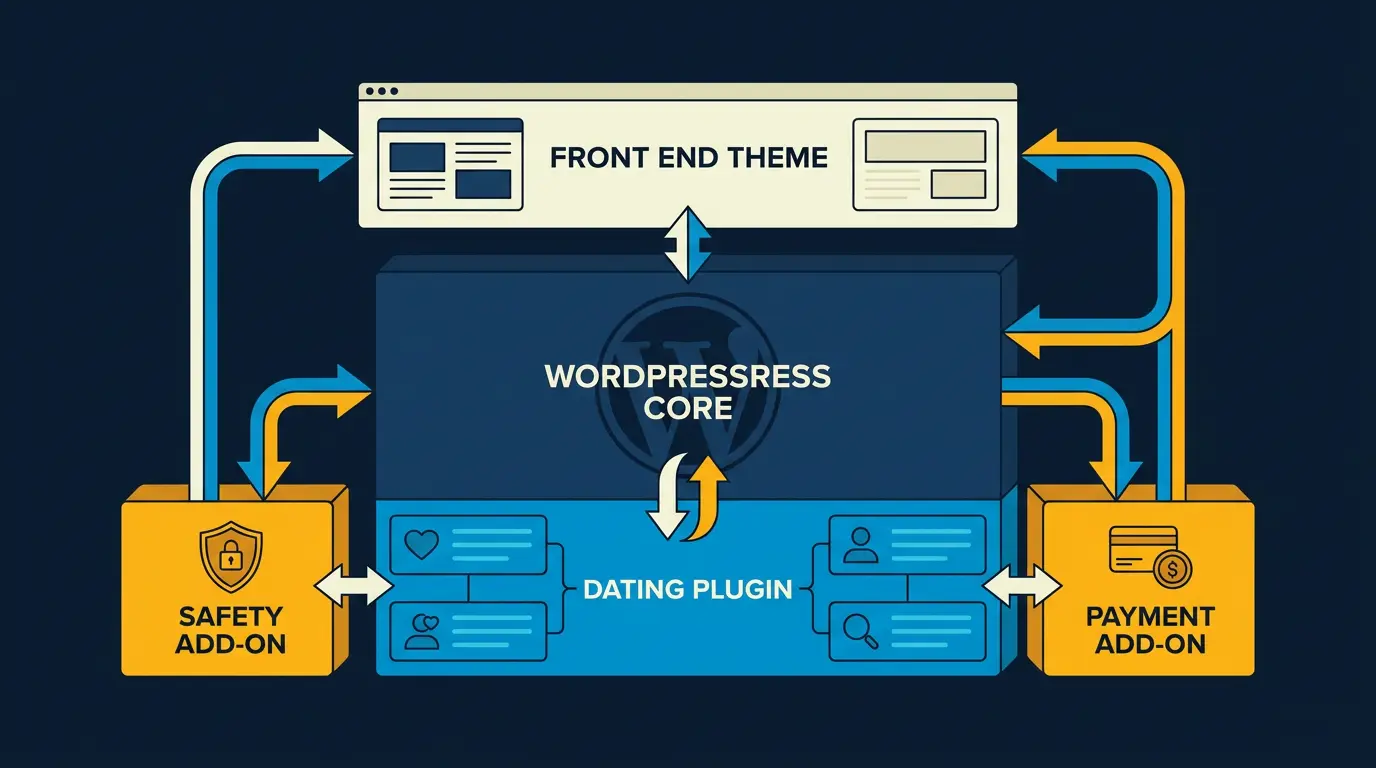
In practice this usually means combining several plugins, or using a dedicated dating plugin or theme that bundles them. A typical stack includes a membership and profile system, a matching or search component, a messaging system, and a payment and subscription plugin, all running on top of WordPress and a theme.
The result is a dating site that you host, own and control entirely, assembled from WordPress and a set of plugins rather than licensed as a finished platform. That ownership is the appeal. The assembly, and everything that comes after it, is the catch.
The main approaches and plugins
There are a few recognised routes to a WordPress dating site.
The first is building on BuddyPress, the established WordPress plugin for social networking and member communities. BuddyPress provides member profiles, activity and connections, and dating-specific plugins extend it with matching and dating features. This is a flexible, well-known route.
The second is a dedicated dating plugin or dating theme: products built specifically to turn WordPress into a dating site, bundling the profile, matching, messaging and payment features into one package. These are quicker to stand up than assembling BuddyPress plus extensions, but you are tied to that product's quality and roadmap.
The third is assembling general-purpose plugins, a membership plugin, a directory or profile plugin, a messaging plugin, a payment plugin, into a dating-shaped whole yourself. This gives the most flexibility and the most assembly work.
Whichever route, you are choosing components and then becoming responsible for making them work together and keep working. Plugin quality in this space varies considerably, so the choice of components genuinely matters.
The advantages of WordPress dating
WordPress dating has real advantages, and an honest guide should state them clearly.
It is cheap to start. WordPress itself is free, hosting can be inexpensive, and plugins range from free to modest one-off or annual fees. The headline cost of getting a basic WordPress dating site standing is low.
It is familiar. A great many people already know WordPress, and that familiarity lowers the barrier to assembling and managing the site.
It gives full control and ownership. You own the site, the data, the code and the configuration. You can change anything the plugins allow, and you are not sharing infrastructure or paying a revenue share.
It is flexible. WordPress's vast plugin and theme ecosystem means you can shape the site, add content, and extend it in many directions.
For a technical person who wants a cheap, owned, controllable small dating site, these advantages are genuine. The question is whether they survive contact with what running a dating site actually requires.
The disadvantages
The disadvantages of WordPress dating are mostly invisible at the start and become heavy later.
You are responsible for everything. Hosting, performance, security, backups, updates, plugin compatibility, and the moderation and compliance covered below are all yours. WordPress and the plugins give you the building blocks; running a live dating service on them is your job, permanently.
Plugin quality and longevity vary. A dating site assembled from plugins depends on each plugin being well built, well maintained, and still supported in a year. Plugins are abandoned, break on WordPress updates, or conflict with each other, and resolving that is your problem.
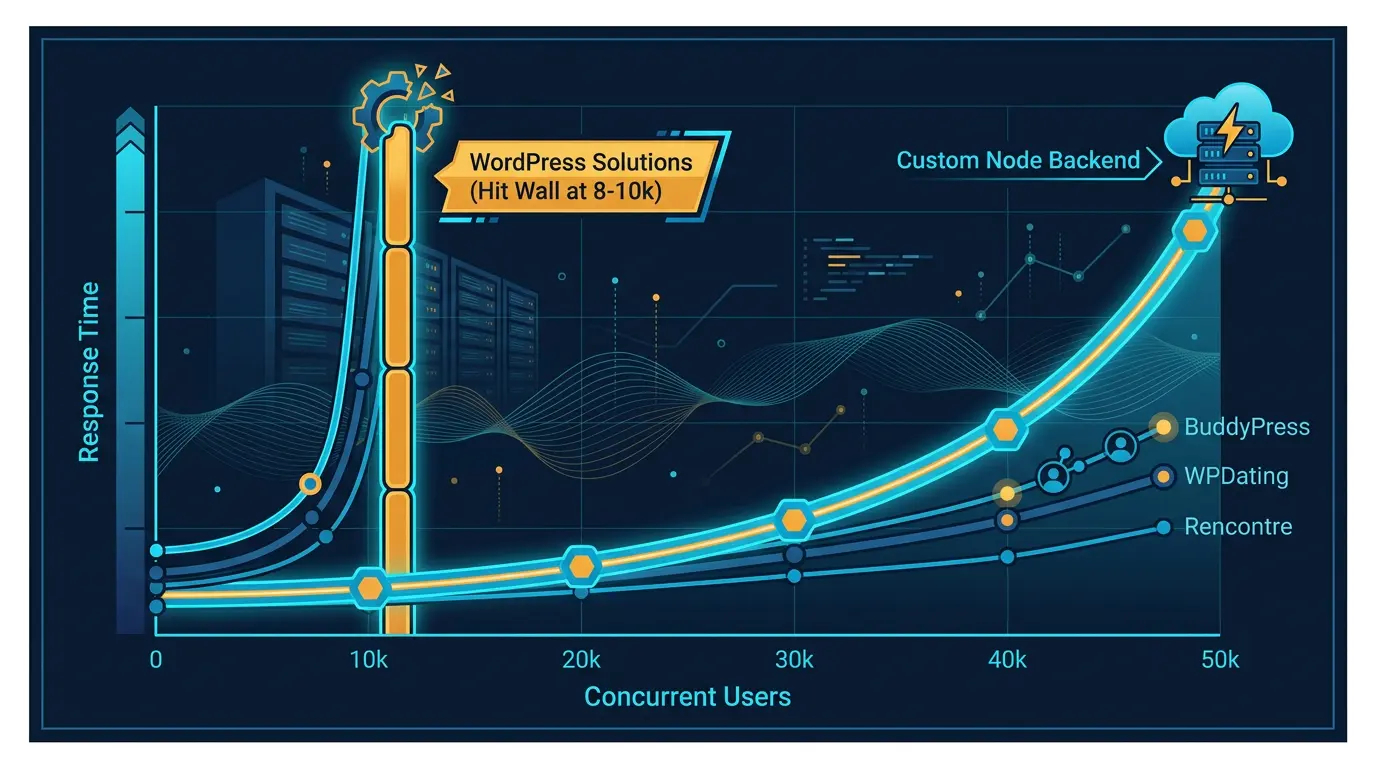
Scaling is hard. WordPress can run a small dating site, but a dating site that grows, with heavy real-time messaging and search load, pushes WordPress beyond what it does comfortably, and scaling it takes real technical work.
And, as the next sections explain, WordPress gives you no and no built-in answer to the heavy moderation and compliance demands of a modern dating platform. These are not minor gaps. They are the gaps that decide whether a dating site can succeed.
The cold-start problem on WordPress
This is the disadvantage that quietly kills most WordPress dating sites, and it deserves its own section.
A WordPress dating site launches completely empty. You have built a functional dating site, and on its first day it has no members, because there is no shared pool feeding it. A dating site with no members is useless, and the cold-start problem, the impossibility of attracting members to an empty site, is the single hardest thing in the dating industry.
WordPress gives you no help with this whatsoever. You must fill the entire member base yourself, from zero, through marketing, before the site becomes useful to anyone. The overwhelming majority of independent dating sites, WordPress or otherwise, fail at exactly this point.
This is the clearest single contrast with , where the means a new site shows active members from day one. WordPress dating's cheap start is real, but it buys you a site that nobody can use yet, and bridging that gap is far harder and more expensive than the plugin licences ever were.
The compliance and moderation burden
A modern dating platform carries serious obligations, and WordPress gives you none of them out of the box.
Moderation is a round-the-clock operation. Dating sites attract scammers, fake profiles, abusive users and harmful content, and a credible dating site must screen photos, messages and profiles and respond to reports continuously. WordPress and a few plugins do not provide a moderation team or robust moderation tooling. That work, and its cost, is entirely yours.
Compliance is heavy and growing. The UK Online Safety Act, the EU Digital Services Act and GDPR all impose real, documented obligations on a dating platform, around age assurance, illegal-content duties, data protection and more. A WordPress dating site does not inherit a compliance framework. You must build, document and maintain one yourself, and keep it current as the law changes.
This is the burden operators most underestimate. It is also the strongest argument for white label, where moderation and compliance come built in and maintained. On WordPress, they are a significant, permanent operational load that the low plugin cost completely conceals.
The real cost of "free"
WordPress dating is marketed, in effect, as the cheap option, and the plugin costs genuinely are low. But the real cost of a WordPress dating site is not the plugins.
The real cost is everything around them: capable hosting that can handle a dating site's load, security and maintenance, the marketing budget needed to overcome the cold start and fill an empty site, and the moderation and compliance operation. Add the value of your own time spent assembling, maintaining and running all of it, and the "free" or "cheap" WordPress dating site is not cheap at all. It has simply moved the cost from a visible licence fee to a set of invisible operational burdens.
A fair comparison with white label is not "free WordPress versus a revenue share." It is "a low plugin cost plus heavy hidden operational burden and an empty site, versus no setup fee, a revenue share, and a populated, maintained, compliant platform." Seen that way, WordPress's cost advantage largely disappears.
When WordPress dating makes sense
WordPress dating is not always the wrong choice. It genuinely fits a specific situation.
It makes sense for a technical operator, comfortable with WordPress, hosting and ongoing maintenance, who wants a small dating site or a hobby project, who is realistic about the cold-start and moderation burden, and who values full ownership and control over speed and convenience. For someone running a small local or special-interest community where the scale is modest and the operator can personally handle moderation, WordPress can be a reasonable, low-cash-cost way to run it.
It can also make sense as a learning exercise, or as a content site with a light social or directory element rather than a full dating product.
The common thread is small scale, a technical and hands-on operator, and realistic expectations. Within that, WordPress dating is a legitimate choice.
When it does not
WordPress dating is the wrong choice for an operator trying to build a serious, growing dating business.
If your goal is a real commercial dating site, if you are not deeply technical, if you do not want to personally run moderation and compliance, if you need the site to be useful from day one rather than empty, or if you intend to scale, WordPress will work against you on every one of those points. The cold start will be brutal, the moderation and compliance burden will be heavy, the maintenance will be constant, and scaling will be a fight.
For that operator, the cheap headline cost is a false economy. The effort that goes into overcoming WordPress's gaps, the empty pool, the missing moderation and compliance, the maintenance, would be far better spent on the actual business: the niche, the brand and the marketing. That is precisely what white label frees an operator to do.
Security on a WordPress dating site
Security deserves singling out, because a dating site is a high-value target and WordPress, assembled from many plugins, has a wide surface to defend.
A dating site holds exactly the data attackers want: personal details, photos, private messages, and payment information. That makes any dating site a target, and it makes a breach genuinely serious, both for the members harmed and for the operator who is responsible for protecting them. Security on a dating site is not optional housekeeping; it is a duty the operator owes the people who trusted the site with their data.
WordPress can be run securely, but it does not make it easy. A WordPress dating site is built from WordPress core, a theme, and a stack of plugins, and every one of those is a piece of software that can carry a vulnerability. WordPress is the most attacked platform on the web, precisely because it is the most used, and a site assembled from a dozen components is only as secure as its weakest plugin. A single outdated or poorly built plugin can be the way in.
Keeping a WordPress dating site secure is therefore continuous work. It means updating WordPress, the theme and every plugin promptly whenever security fixes are released, removing anything unused, choosing plugins that are well built and actively maintained, hardening the hosting, enforcing strong access controls, and keeping reliable backups. It also means watching for the day a plugin is abandoned and quietly stops receiving security fixes, at which point it becomes a liability that has to be replaced.
This is real, specialist, never-finished work, and on WordPress it is entirely the operator's responsibility. It is also the kind of work that is easy to neglect until something goes wrong, and on a dating site something going wrong means real people being harmed. On a white label platform, security is the provider's job, handled across the whole platform by people who do it full time. For an operator weighing the cheap headline cost of WordPress, the ongoing burden, and the genuine risk, of securing a dating site alone belongs firmly in the comparison.
WordPress dating versus white label
Set side by side, the two routes serve different operators.
WordPress gives ownership, control and a low cash cost, in exchange for an empty member pool, full responsibility for moderation, compliance, hosting and maintenance, and a hard scaling path. White label gives a populated member pool from day one, built-in moderation and compliance, a maintained platform and a fast launch, in exchange for a revenue share and control of brand and niche only.
The decision is the same one that runs through all dating software decisions. If your advantage is technical control and you want a small, owned project, WordPress can fit. If your advantage is audience and marketing and you want a serious business launched fast, white label removes exactly the burdens WordPress leaves on your shoulders. For most operators building a dating business rather than a technical hobby, that points clearly to white label.
Common mistakes
The defining mistake is choosing WordPress for the low headline cost without accounting for the heavy hidden operational burden, hosting, security, maintenance, moderation, compliance, and marketing to overcome the cold start.
The second is forgetting the empty member pool and discovering, after building the site, that nobody can use it and there is no shared pool to help.
The third is underestimating the moderation and compliance load, which WordPress does nothing to lighten.
The fourth is assembling a dating site from poor-quality or poorly-maintained plugins that break, conflict or are abandoned. The fifth is choosing WordPress when you are not genuinely technical and hands-on, which turns every one of its burdens into a crisis. Be honest about scale, technical capacity and expectations before choosing this route.
What to read next
For the broader build decision, read dating app development: build, buy or white label and white label vs custom dating software. For the cost picture, see how much it costs to start a dating site. And to compare the WordPress route against a maintained platform, DatingPartners.com can show what white label includes.
Outgrown WordPress? DatingPartners migrates your WP database and relaunches you on a platform built for scale. Talk to us.
Visit DatingPartners.com →